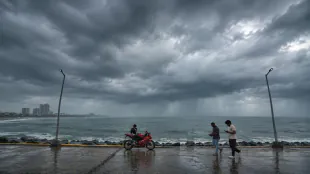
Typhoon Champi knocks out power to thousands in Taiwan / Photo: © AFP

 Malta Stuns Sweden with Late Penalty Comeback in Rugby Europe Trophy

 BingX: Major Announcement of Far-Reaching Significance

 Élan Opens as Late-Night Wine Bar in Honolulu

 Shiv Sena (UBT) Criticizes NCP Merger Talks as 'Ridiculous Laughing Stock'

 Dell Announces AI-Integrated PC Lineup for 2026 with Wi-Fi 7 Support

 Rocky Fans Break Guinness World Record at Philadelphia Museum Steps

 FAA Grounds All US Flights Amid Nationwide Air Traffic Control Communication Failure

 Argentina vs Uruguay Kick-off Time, TV Channels & Free Streaming Guide

Emergency crews scrambled on Saturday to restore power to tens of thousands of households in Taiwan after Typhoon Champi's fierce winds battered the island as the storm moves towards China and Japan.
More than 5,000 people were evacuated from their homes ahead of the storm, which toppled trees, brought down power lines, and triggered brief flooding.
One person was killed and over 500 injured since Thursday when the government began issuing warnings about the approaching typhoon.
Around 56,000 households are still without power as Champi continues to buffet the island, with nearly 24 centimetres (9.4 inches) of rain recorded in the western county of Miaoli on Saturday.
Most shops across northern and central Taiwan were closed for a second day as the typhoon gradually moves away from the island's northeast and heads north towards China and Japan.
"Although the period of the typhoon's most severe impact has passed, we would like to remind everyone that winds and waves in the waters around Taiwan remain strong as the typhoon moves northwards," the Central Weather Administration's Wuu Woan-hwa said at a briefing.
Champi is the latest in a busy Pacific storm season turbocharged by the El Nino weather phenomenon that has caused unprecedented warming in the equatorial Pacific.
The storm was briefly a super typhoon as it crossed the ocean in recent days, with reported maximum sustained wind speeds of nearly 300 kilometres (186 miles) per hour.
It was packing wind speeds of 176 kph on Saturday, according to the latest update from the Joint Typhoon Warning Center.
The storm's intensity weakened overnight as it made a loop off Taiwan's northeastern county of Yilan, where it dumped 65 cm of rain since Thursday, the forecaster said.
Martha Wang said she was afraid of being "blown away" by the wind as she rode her scooter across a bridge in New Taipei City on Saturday morning.
"I was really scared because I was on the bridge. My scooter was shaking," the 55-year-old secretary told AFP.
William Yu, however, was unfazed by the storm, saying it "wasn't any stronger than other typhoons."
"I went to the convenience store to eat yesterday (evening) and everything was fine," the 55-year-old librarian said.
- 'Strong winds and heavy rain' -
Authorities in China warned of "strong winds and heavy rain" as Champi approaches the country's east coast, the state-controlled broadcaster said.
Some train services have been suspended and tens of thousands evacuated from their homes in Shanghai.
"Some areas of Jiangsu, Shanghai, Zhejiang, and other regions are expected to experience heavy to torrential rainfall," it said.
Dozens of flights have been cancelled in the region, including in Japan's southernmost prefecture of Okinawa where the government said two people were injured in the typhoon.
The United Nations said Wednesday that the El Nino system gripping the planet is heading off the charts and that countries should take urgent action to prepare for the worst.
El Nino is expected to peak in December, but the human impact is set to last into 2027 and beyond.
The warming phase of a natural climate cycle, El Nino temporarily raises sea temperatures in the tropical Pacific, triggering changes in weather that can increase the risk of drought and flooding and exacerbate human-caused global warming.
burs-joy/amj/ceg
N.Fournier--BTB