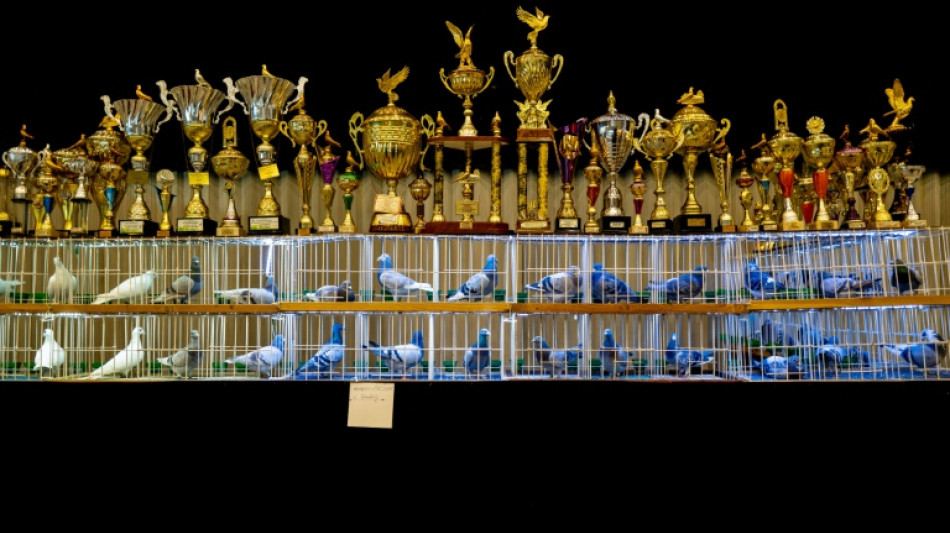
Poland's pigeon fanciers eye moving up the pecking order / Photo: ©

 US warns of rapid escalation in Mideast war

 Iran 'put hearts on the court' to win Asian Games basketball bronze

 School girl Yu helps China dominate in Asian Games swimming openers

 Myanmar win first Asian Games teqball gold as Spain great Puyol watches

 China's 13-year-old Yu scorches to first major gold at Asian Games
 Russians vote on last day of parliamentary elections

 Hong Kong pays final respects to former city leader Tung

 Typhoon put people off Asian Games opening ceremony, official says
 China's 13-year-old Yu cruises as Asian Games swimming begins

 AI 'warning shots' focus Beijing on national security risks

 Philippine tribe in limbo over US-led tech hub

 Leo XIV, first US pope transcends his restrained style

 Singer Ed Sheeran says Gaza situation 'unjustifiable' following controversy

 In 'Tenzing', a Sherpa mountaineer gets his due
 Ed Sheeran set to return to stage after Palestinian controversy

 Toulouse edge Vannes, Lyon beat Pau to take Top 14 summit

 Germans arrested for Louvre stunt in Mona Lisa hall

 Saudi-led coalition says Houthis fired ballistic missile at Riyadh

 France's debt climbs to highest since 1978: ministry

 McIlroy two shots off the lead at Wentworth after eagle on 18

 Martinez brace saves Inter in Serie A top-two clash with Roma

 Rosenior abused but guides Paris FC past old club Strasbourg

 Seven-try Lyon beat Pau, climb to Top 14 summit

 Brighton defeat a 'big lesson' against complacency for Arsenal, says Arteta

 Thousands protest inaction over climate crisis in Switzerland

Opening one of his many cages, Michal Trojczak watches proudly as more than 70 dusty-blue pigeons take flight, soaring high above snow-covered fields in eastern Poland.
"My birds are athletes," says the 42-year-old pigeon fancier, who inherited his passion for breeding the birds from his father and grandfather.
Poland boasts Europe's biggest community of homing pigeon breeders -- and a string of international competition trophies -- but trails other countries in the breeding of pedigree birds that command a higher value.
As one of those who has decided to do something about that, Trojczak said he had turned professional after retiring from the army a few years ago and teamed up with a friend.
Together, they bought Belgian pigeons with prestigious pedigrees, investing thousands of euros, including 11,000 euros ($12,400) alone for the progeny of a bird called Porsche 911.
"He's provided us with a lot of satisfaction and money," the ex-army captain tells AFP.
Now, he hopes the sky's the limit for Polish pigeon-enthusiasts who, he believes, will rise to rival their Belgian and Dutch counterparts within a decade.
- Birds of communication -
Pigeon lofts are a part of Poland's landscape especially in the mining region of Silesia, where pigeon breeding has historic roots and the birds enjoy near-mythic status.
After a day underground, it's still common to see miners emerge into the daylight, scanning the skies for their winged friends.
Released hundreds of kilometres (miles) from their pigeon lofts, the birds find their way home thanks to an ability to detect the earth's magnetic field and orient themselves according to the sun.
Flying with the wind, they can reach up to 120 kilometres (74 miles) per hour.
After Poland won back its independence in 1918, the use, breeding and racing of pigeons was regulated by the military affairs ministry due to the strategic importance of the birds' ability to carry communications.
The Nazis immediately banned pigeon breeding after occupying Poland in 1939, and enthusiasts were forced to start again from scratch after the war.
- Strength in numbers -
"With more than 40,000 members, we're the largest organisation of its kind in Europe, founded more than 100 years ago," said Krzysztof Kawaler, head of the Polish association of homing pigeon breeders.
France and Belgium -- where pigeon fancying has deep roots -- have around 11,000 and 13,000 breeders respectively, according to their associations.
"We take home the most prizes at international competitions," Kawaler told AFP at a trade fair in Katowice, in the heart of the Silesia region.
Those tournaments do not see the pigeons congregate in one place, as world athletes do at the Olympics.
Instead, every country holds its own local races in which the pigeons are equipped with electronic rings to record their flight time.
The results are calculated across the countries using coefficients that notably take into account the number of participating pigeons.
Since Poland has so many breeders, it helps boost its scores, according to Trojczak.
"But it doesn't reflect the pigeons' actual worth," he stresses, lamenting that Polish pigeon fanciers are still viewed as amateurs in Western Europe.
- Pecking order -
"On the Polish market, pigeons go for between 250 zlotys (around 55 euros) and four, five or even six thousand zlotys for those that participate in international tournaments," veteran breeder Zbigniew Oleksiak told AFP.
In Western Europe, however, prices start at around 200 euros but can go sky high, like the Belgian pigeon, Armando, which fetched 1.25 million euros at auction in 2019.
The buyer was Chinese, as was the proud new owner of New Kim, another Belgian bird which sold for 1.6 million euros the following year.
Like racehorses, it is the pedigree -- the bird's family tree -- that matters to buyers, especially those from Asia.
- Long hours -
For Trojczak, the days are long, especially in spring and summer.
"You have to train the pigeons to get them into shape, monitor their health, feed them well," he says.
"When you have to prep the birds for a race, sometimes I'll be up and running at 4:00 a.m. and won't finish till 9:00 p.m."
He now sells around 100 pigeons a year at prices ranging from 100 to 2,500 euros, which allows him to "live quite comfortably when combined with my military pension".
But it's not just a money-maker, pigeon breeding is above all a labour of love.
"I can trace each of my pigeons back three or four generations... I know their family trees better than my own," he says, laughing.
J.Bergmann--BTB