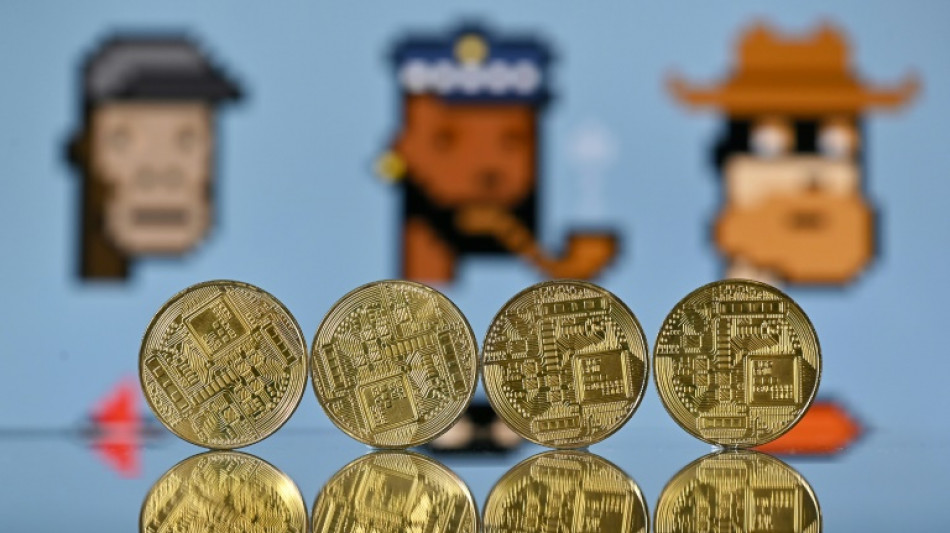
Pricey pixels: Why people spend fortunes on NFT art / Photo: ©

 US warns of rapid escalation in Mideast war

 Iran 'put hearts on the court' to win Asian Games basketball bronze

 School girl Yu helps China dominate in Asian Games swimming openers

 Myanmar win first Asian Games teqball gold as Spain great Puyol watches

 China's 13-year-old Yu scorches to first major gold at Asian Games
 Russians vote on last day of parliamentary elections

 Hong Kong pays final respects to former city leader Tung

 Typhoon put people off Asian Games opening ceremony, official says

 China's 13-year-old Yu cruises as Asian Games swimming begins

 AI 'warning shots' focus Beijing on national security risks

 Philippine tribe in limbo over US-led tech hub

 Leo XIV, first US pope transcends his restrained style

 Singer Ed Sheeran says Gaza situation 'unjustifiable' following controversy

 In 'Tenzing', a Sherpa mountaineer gets his due
 Ed Sheeran set to return to stage after Palestinian controversy
 Toulouse edge Vannes, Lyon beat Pau to take Top 14 summit

 Germans arrested for Louvre stunt in Mona Lisa hall
 Saudi-led coalition says Houthis fired ballistic missile at Riyadh

 France's debt climbs to highest since 1978: ministry

 McIlroy two shots off the lead at Wentworth after eagle on 18
 Martinez brace saves Inter in Serie A top-two clash with Roma

 Rosenior abused but guides Paris FC past old club Strasbourg

 Seven-try Lyon beat Pau, climb to Top 14 summit

 Brighton defeat a 'big lesson' against complacency for Arsenal, says Arteta

 Thousands protest inaction over climate crisis in Switzerland

Thousands of artists beaver away every day creating images to sell as digital tokens (NFTs) in online exchanges. The market is booming, the most popular pieces can sell for millions, but outsiders may wonder why anyone would pay anything at all.
No physical pieces of art exchange hands in these transactions. Buyers use cryptocurrencies and receive their NFTs -- a unique piece of computer code related to the artwork that is stored on a blockchain, a kind of digital ledger that cannot be changed.
Driven by high-profile auctions, the market for NFTs exploded in 2021 with sales worth more than $40 billion, according to analytics firm Chainalysis.
Any sense that last year's prices could not be sustained in 2022 has already been dispelled -- to take one example, popstar Justin Bieber paid more than $1.3 million last week for an NFT from the collection known as "Bored Apes Yacht Club".
The collection, which features 10,000 cartoon images of apes with algorithm-generated variations to the background and other details, enjoyed a record January, shifting dozens of NFTs each day for an average price of roughly $250,000.
Critics say pure profit motivates the big transactions, with major financial players using technospeak and celebrity endorsements to disguise their aims.
But fans have an almost cultish devotion and see the technological complexity as an inherent part of the value.
Malaysian artist mumu_thestan says it is a varied landscape.
"You can't treat the whole NFT community as one," she tells AFP in a telephone interview.
"The mainstream audience thinks NFTs are about selling a jpeg for millions or making a monkey picture. That's not all it is."
- Punks to apes -
Mumu, a 33-year-old illustrator who declined to give her real name, labours over her creations, from constellations of flashing pixels to lush fantasy-style images of women and dragons, selling them for a few hundred dollars a piece.
She has worked to create a niche, refusing to sell on the main exchanges because of their use of the energy-hungry ethereum blockchain.
Artist David Leonard collects works by artists like Mumu because he believes she does great work and deserves the support of a community.
"As an artist, I want to be the kind of collector that I wish I had... I wouldn't want my collector base to be thinking about their bottom line," he told AFP.
Yet one of the main narratives around NFTs is one of the speculators making crushing profits by flipping their assets.
Booms and bubbles are fuelled by social-media hype and celebrity endorsements.
Last year, the must-have collection was CryptoPunks -- blocky images of 1970s style punks. Some sold for millions, with owners including Jay-Z, Snoop Dogg and YouTuber Logan Paul.
Now it is Bored Apes -- Bieber posted his ape image to his 200 million Instagram followers, giving powerful promotion to a collection already hyped by the likes of tennis star Serena Williams.
Most NFT creators can only dream of that kind of publicity.
"The average artist is actually losing money on their NFTs," says software developer Stephen Diehl, a vocal critic of cryptocurrencies.
He says the small players who make single editions of an original artwork generally pay out any profit in fees and costs -- and that is the lucky few who sell anything at all.
- 'I don't want to sell' -
Mumu acknowledges a debt of gratitude to her own celebrity endorsement -- Mike Shinoda of US rock group Linkin Park is a fan.
But the rest has been hard work -- building enough of a following through her art and activism so that she can afford to do NFTs full time.
She has 13,000 followers on Twitter compared with the 600,000 who follow Bored Apes.
The key to the success of both ventures is maintaining a buzz around the work -- whether it is meticulously constructed original artwork or algorithm-generated ape pictures.
This community-building has obvious parallels with the traditional art market where young artists often work as hard on garnering a following as they do on their work.
Esteemed auction house Christie's has helped cement this connection, selling an NFT by American artist Beeple for $69 million last year, making him the world's third-most expensive living artist.
The buyer could have bagged a Van Gogh or a Monet, works by both going under the hammer for similar money last year.
Also like the art market, the smaller players in the NFT world believe there is much more to their industry than mere money.
Brian Beccafico, a French collector, managed to get hold of a Beeple work for $1 at an online auction in 2020.
It is probably worth more than $100,000 now, but he is not interested in selling.
"I know that I wouldn't be able to buy another one," he says.
J.Horn--BTB