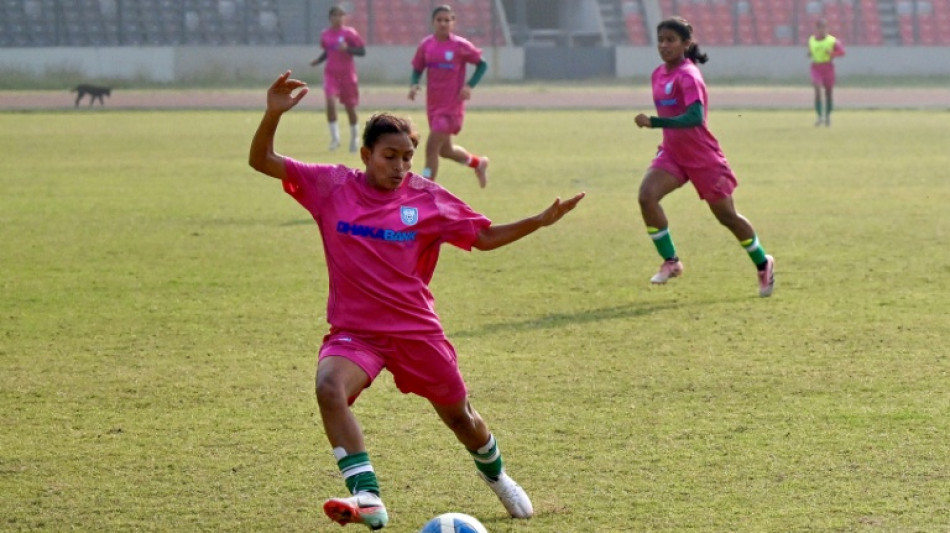
Bangladesh tackle gender barriers to reach Women's Asian Cup / Photo: © AFP

 Typhoon Dujuan leaves four dead in Japan, 45,000 houses without power
 G7 leaders condemn Houthi strikes on Saudi Arabia

 Google data centre sparks protests in Austria

 Shin Ohashi: Junk food-loving teen and Japan's next big swimming hope
 Stocks rise on AI buzz, drop in oil prices

 China's robot dancers limber up for America's Got Talent final

 Despite military might, Saudi struggles to crush the Houthis
 Trump to tout deals, defend Iran war in UN speech

 Sri Lanka to issue verdict in landmark Easter attack trial

 No green light to lift EU sanctions on Russian oligarchs, talks to resume

 UK agrees support for Saudi in struggle with Houthis: reports

 EU foreign policy chief calls for continued sanctions on Russia

 Flights scrapped, evacuations urged as Typhoon Dujuan wallops Japan

 Fonseca to take break from tennis

 A Cuban zoo, and its animals, in epic battle for survival

 Infantino proposes consulting federations to reform FIFA

 El Nino weather pattern enters record territory: scientist

 OpenAI calls for US to lead global effort on AI standards

 South African ostriches plucked alive for luxury fashion: report
 US networks halt Trump coverage in revolt over White House ban

 Paramount settles with US states to clear Warner Bros. mega-merger

 Climate crisis a job for world leaders, not just activists: UK FM

 US networks halt Trump coverage over White House ban

 French singer accuses Miley Cyrus of plagiarism

 EU fines Google 403 mn euros for location data breach

Bangladesh's national football team face daunting odds at their first-ever Women's Asian Cup, but have already scored a major victory by qualifying.
In the South Asian nation of 170 million, social stigma, family expectations, poverty and religious hardliners have long relegated women and girls to sports sidelines.
The first women's football league matches took place in 2011, and the squad, known to fans as the Red and Green, have kept pressing forward despite deeply embedded prejudices.
"Many more girls would have joined us if the community had been even slightly supportive," captain Afeida Khandaker told AFP ahead of her side's March 3 debut in Australia.
In rural areas especially, women and girls are discouraged from or even harassed for playing sport, with some religious leaders deeming it indecent.
"Girls often had to quit football after primary school," Khandaker said. "Neighbours would complain about how teenage girls could play football while wearing shorts."
To stay on the pitch, girls also have to fend off pressure to marry before they turn 18.
Local league player Ennima Khanom Richi, 20, said many of her teammates were forced out of football and into arranged marriages.
"Families often cannot bear the social pressure, so they stop their girls from playing," she said.
- 'Bitter words' -
Two years of political turmoil have only increased the obstacles.
Emboldened by upheaval since the 2024 uprising that overthrew the government, Islamist activists have directed much of their attention towards Bangladeshi women, accusing them of insufficient modesty.
Several women's football matches were cancelled last year after pitch invasions and threats of violence.
While the Bangladesh Nationalist Party, which won last month's general elections, has vowed to back women's rights, an Islamist coalition's unprecedented share of the vote stirred fears of regressive gender policies.
Skipper Khandaker, from a southern constituency where Islamist lawmakers won the recent polls, knows the cost of serving as a role model.
"My sister and I both wanted to be footballers, and for that my parents -- especially my mother -- had to endure bitter words," said the 20-year-old, who started playing at the age of five.
Her father, Khandaker Arif Hossain Prince, backed his daughters' athletic ambitions, but he noted not all families have that luxury.
"Our aspiring footballers come from marginalised families, and it is often not possible for them to provide financial support," said Prince, a women's football organiser.
"Some of their parents are rickshaw pullers, labourers, or tea vendors... Some cannot afford it and quit football. I feel like quitting too every time I see a girl leaving the game."
- Shifting attitudes -
While on a break from passing drills at an early morning training session at the National Stadium in Dhaka, Bangladesh Football Federation coach Saiful Bari Titu, 53, said "just talking about the women's team is a privilege for me".
"They faced a lot of protests," he added.
After years of building grassroots support for women's football, the federation is starting to see a payoff.
More than 40 football clubs across Bangladesh now train girls from the age of nine.
"We didn't even have a national women's team before 2008," said Mahfuza Akter Kiron, 59, head of the BFF women's wing.
"It was a real struggle for them to play football."
While salaries for national team players remain low, especially compared to the men's earnings, the small amount of money has brought stability to dozens of families.
"I wanted to offer a livelihood to the footballers," Kiron added.
Organisers said that as progress in women's football becomes evident, sponsors are beginning to show interest, and people's attitudes are shifting.
"People seem happy now," said Khandaker. "They gather to see me when I go home."
She is clear-sighted about the scale of the competition as Bangladesh open their campaign against nine-time Asian champions China on Tuesday.
"China and North Korea are far ahead of us in the rankings... but we will give our best."
O.Lorenz--BTB