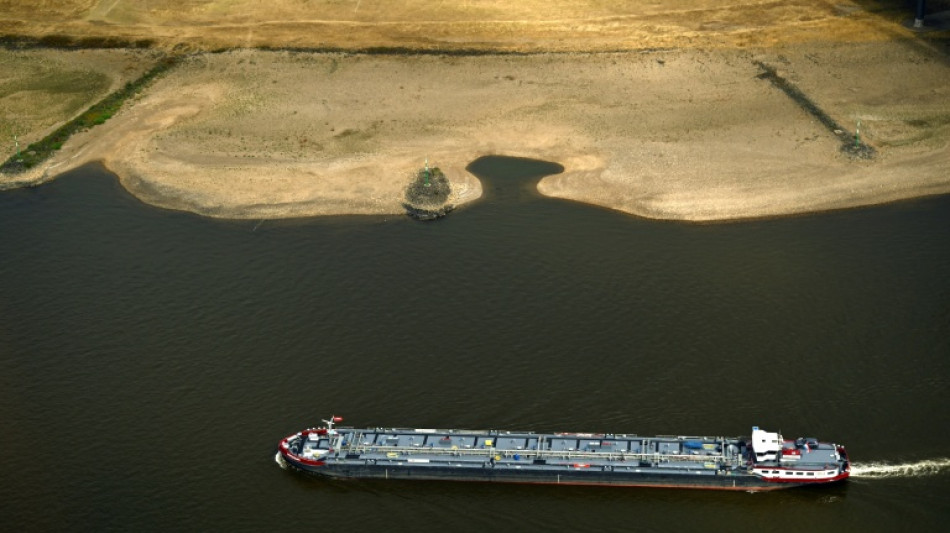
As Europe's rivers recede, shippers scramble to limit damage / Photo: © AFP

 Alex Bodi appointed Vice President of SCANDIC FINANCE GROUP

 Elon Musk jokes about moving businesses to space after US midterms

 NHS to test blood screening designed to detect 13 cancers earlier

 Democrats near House takeover as voters judge Trump presidency

 Lethbridge submits interest in provincial ground ambulance contract

 The Cat in the Hat expands its stakes to cosmic scale in animated reboot

 Lettermen co-founder Tony Butala dies at 87

 James Talarico defeats Ken Paxton in historic Texas Senate result

 Goa plans relationship-readiness course amid concern over divorces

 Carmen de Burgos: The Life and Legacy of Spain's Pioneer for Women's Rights

 Mutual fund returns show shifting leaders across market-cap categories
 IndiGo holds talks with Embraer over potential order for 100 aircraft

 Indian companies report mixed second-quarter results on November 4

 Indus Towers expands solar-powered network to 50,000 telecom sites

 Equitas Small Finance Bank rebounds after naming interim chief executive

 Titan quarterly profit seen rising as jewellery business drives growth

 Indian crude-sensitive shares gain after 13% oil-price decline

 Stocks and dollar fall as Democratic election gains reshape markets

 Kuwait marks key events and anniversaries from national history

 Trump congratulates Democrats and signals willingness to cooperate

 Qatar prime minister advances mediation through diplomatic calls

 Greenland parliament approves security agreement with United States
Exceptionally low river levels in a Europe hit hard by drought and record heat have plunged transporters into turmoil this summer, driving up costs that everyday consumers could end up bearing.
Major rivers on the planet's fastest-warming continent, including the Rhine and Danube, have sustained water shortages that scientists directly link to climate change.
The situation is especially critical in Germany on the Rhine, the core of the European inland waterway transport network.
"The situation is unprecedented," a spokesperson for Maersk, the Danish shipping giant, told AFP. "Today, most of the inland ports along the Rhine cannot be reached by barge anymore."
Clecat, a European association that represents freight forwarders, agreed that the "most acute disruption has been on the Rhine".
It said that at Kaub, a critical bottleneck for traffic on the river, the water gauge fell to around six centimetres (2.4 inches) on August 14, below the previous record low of 25 centimetres in 2018.
"The effects are being felt along the major industrial corridor from Rotterdam", Clecat said, adding that "Conditions are also severe on parts of the Danube, particularly in Serbia, Hungary and Romania".
One workaround for logistics operators is to move as much cargo off rivers as they can to trains or trucks.
"The aim is to... keep the distances travelled on the Rhine as short as possible," transport company Contargo told AFP.
- No easy alternatives -
But the opportunities for rail and road transport are limited.
Jean-Laurent Kistler, development director at the French waterways authority (VNF) in Strasbourg, where the Rhine forms the border with Germany, estimated that transporting the load of a single barge required "100 to 200 trucks".
But many products transported in bulk -- such as chemicals, hydrocarbons, construction materials or grain -- are not easily transferred to containers.
VNF Strasbourg says the load carried by ships on the Rhine fell from an average of 1,500 tonnes to just 400 tonnes in August.
The Clecat association noted the low river levels had already resulted in "higher transport costs, delays, postponed shipments and reduced production flexibility".
"The ships have to sail with lighter loads than usual to have less draught," said Alexandre Charpentier, transport specialist at the consulting firm Roland Berger, referring to how deep a vessel sits in the water.
"With fixed costs remaining the same, this leads to very significant unit cost increases," he said.
Operators pass on the resulting costs by applying low-water surcharges, which they introduce progressively if river levels keep falling.
These costs have reached more than 1,000 euros ($1,170) in surcharges per container at the most strained points, such as Kaub or Cologne, according to Contargo's rates.
"It can quickly double for container freight" and "be even more drastic for bulk cargo", said Pierre Cossart, director of Sogestran Logistics.
- Costs passed on? -
According to Clecat, "whether higher logistics costs translate materially into consumer prices depends on the duration of the disruption, the commodity and companies' ability to absorb or pass on costs".
But it noted that "For many bulk commodities, transport is an important component of the delivered price, so sustained increases will ultimately be felt further down the supply chain."
Charpentier said it was too early to forecast eventual price increases for consumers, but warned that the extra costs were difficult to absorb in full.
With drought episodes only expected to increase, operators are banking on better-suited vessels and greater intermodality, or the added use of trains and trucks.
But resilience also comes from water management, according to the VNF's Kistler.
While France has built a series of reservoirs and diversion channels along its portion of the Rhine to manage the flows, on the German side the river runs freely and is highly dependent on rainfall.
"We went from 10 ships a day to 25 (on Wednesday), 14 of them loaded," said Kistler, adding that it was "still far from the optimal load".
"This doesn't save the day."
enl/tq/yk/amj/js
W.Lapointe--BTB