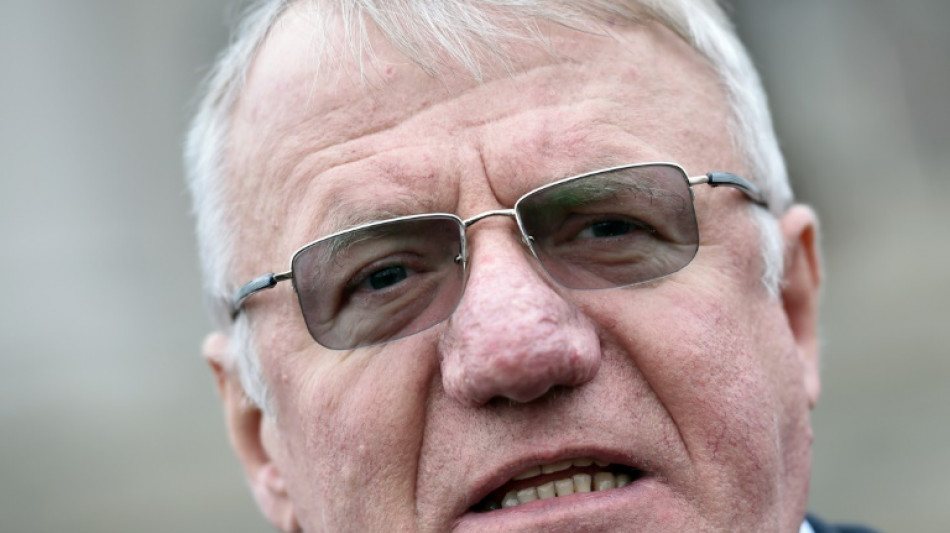
Vojislav Seselj: Unrepentant Serb ultranationalist / Photo: ©

 Macron welcomes Canada's Carney to French Atlantic territory

 Fiorentina frustrate Napoli with Serie A draw, Como upset

 Five-star Man City top Premier League after Sunderland thriller

 Ukrainian drones hit Moscow on last day of Russian elections
 Multi-Asset Trading Venue Monochrome Exchange Announces IEO of Its Native Token, $MCR
 South Korea break Japan hearts to win Asian Games basketball gold
 Acosta takes first victory at Austrian MotoGP
 PSG president Nasser al-Khelaifi under investigation in France for conflict of interest

 China swim sensation, 13, sets Games record after Japan win early

 Drones hit Moscow as Russians go to the polls

 New England boss Fleming says 'wrong' to ask Stokes to end retirement

 Germans vote in elections threatening fresh blow to Merz
 US fears rapid escalation in Mideast after Houthis attack Riyadh

 Japan triathlete Hojo wins first gold of Asian Games
 IOC president impressed by 'beautiful' Asian Games wooden huts

 First Asian Games gold goes to Japan as China's 13-year-old Yu lights up pool

 Data centre command hub keeps AI up and running
 Pope Leo in France: the issues on the table
 Packing for a pope: behind the scenes on foreign trips

 Republicans find transgender issues a powerful political weapon in midterm campaigning

 German state elections threaten new shock waves for Merz

 Chile's Bachelet quits race to be next UN chief

 Raphinha treble fires perfect Barca to win at Sevilla

 Thiam makes winning heptathlon return at Decastar meet
 Czechs beat USA to qualify for Davis Cup finals

Serb academic turned far-right leader Vojislav Seselj won notoriety during the 1990s Balkan wars for his incendiary rhetoric and remains defiant since his provisional release from more than a decade in detention in The Hague.
UN war crimes judges in The Hague are due to give an appeal verdict on Wednesday against the shock 2016 acquittal of the stocky, ruddy-faced former deputy prime minister, 63.
Prosecutors had accused Seselj of poisoning the minds of volunteer forces who committed atrocities in the 1990s, in a quest to forge a "Greater Serbia" as Yugoslavia fell apart.
Judges found there was not sufficient evidence to prove he was guilty on nine counts of war crimes and crimes against humanity, including the murder, torture and deportation of non-Serbs in large areas of Bosnia, Croatia and Serbia.
"I do not feel guilty of anything," Seselj declared triumphantly at a press conference in Belgrade after his acquittal ruling in late March 2016.
The Serbian Radical Party leader has since stuck to his nationalist line.
"We will never give up the idea of a Greater Serbia," he told AFP in an interview.
Prosecutors have appealed against his acquittal, saying he is is "spreading politics seeking to unite all 'Serb territories' in a homogeneous Serb state".
Seselj spent more than a decade in detention before and during his trial. He was excused from attending the 2016 judgement having returned to Serbia two years earlier on medical grounds.
After the acquittal ruling, he was elected as an MP in Serbia.
Since his return, ill health has not prevented Seselj from appearing on reality television, publicly burning EU and NATO flags and firing up far-right rallies.
He said he will not be in The Hague for the appeal verdict by the Mechanism for International Criminal Tribunals, which is wrapping up the last legal cases from the International Criminal Tribunal for the former Yugoslavia (ICTY), which was closed in December after 24 years.
- 'Counter-revolutionary' -
Born in Sarajevo in Bosnia in 1954, Seselj studied law and obtained a doctorate, going on to lecture in political science at Sarajevo University in the early 1980s.
The nationalist ideas he developed were not appreciated by the communist regime, and he was convicted of "counter-revolutionary activities" and spent two years in jail during that period.
He then moved to Belgrade where, after communism collapsed, he formed the Serbian Radical Party in 1991.
He quickly became an MP, known for his shocking antics in parliament -- from swearing to drawing pistols.
Among his ill-famed comments as the conflicts in Croatia and Bosnia broke out, Seselj once boasted on a television talk show that Serbs would "slaughter Croats with rusty spoons".
From 1998 to 2000 he was Serbia's deputy prime minister under the autocratic regime of Slobodan Milosevic, who died during his own war crimes trial at The Hague in 2006.
After giving himself up to the court in 2003, Seselj forced the cancellation of his first trial three years later by going on a hunger strike to demand the right to represent himself.
A second trial opened in 2007 in which he cast himself as a martyr and a victim of an anti-Serb conspiracy.
He said he regretted that the tribunal did not allow for the death sentence, "so that proudly, with dignity, upright like my friend Saddam Hussein, I could put the final seal on my ideology."
Among his angry outbursts, he once said he smelled the odour of gas when a German judge arrived in the courtroom, and also compared the proceedings to a "satanic ritual".
- Breaking with allies -
His party was Serbia's largest until 2008, when Seselj's close allies Tomislav Nikolic and Aleksandar Vucic broke ranks and formed the ruling pro-European Serbian Progressive Party.
Vucic is now president while Seselj's anti-Western and pro-Russian rhetoric holds less sway, despite his attention-grabbing tactics.
He briefly benefited from public attention following his acquittal and with the Radicals became the second strongest single party in the parliament at elections two years ago.
But last month he was on the verge of political disappearance when his party won only two-percent support in local Belgrade polls.
Political analyst and columnist Cvijetin Milivojevic said that since returning from The Hague, Seselj has toned down his criticism of his now-powerful former ally Vucic as he bids for electoral success.
"Seselj is a serious, calculating politician who has rarely improvised things," Milivojevic said. "In that sense, he has not changed."
I.Meyer--BTB