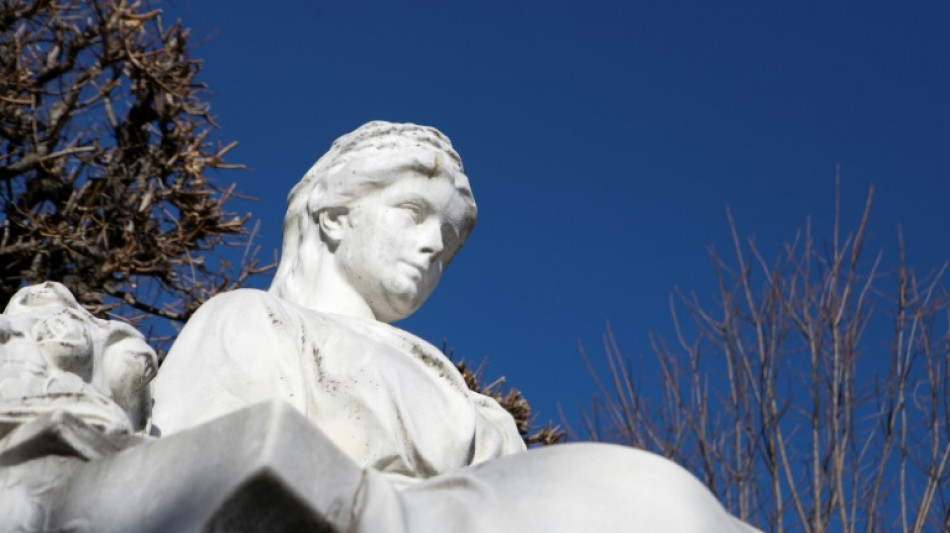
Sisi-mania: Austria's starry empress returns to screens / Photo: © AFP

 Far-Right Extremists Claim Opportunity to Seize Control of GOP After Midterms

 New Campaign Highlights Knowledge Gaps on Carbon Monoxide Safety Among Americans

 JR East Launches 'teppay' to Integrate Suica Balance with Mobile Payments

 Phil Spencer on Housing Market Fairness: How Buyers and Sellers Navigate Falling Prices

 Beirut Cinema Festival Draws Thousands Despite War Fatigue

 AMD Forecasts First-Ever Revenue Lead Over Intel on AI Chip Surge

 GoodData.AI Launches the Agentic Serving Plane, a New Category of Enterprise Data Infrastructure for AI Agents

 Abu Dhabi Demand Response Project Achieves 401 MW Peak Reduction in 2025

 Panthers expected to begin 2027 NRL season away from new stadium
She was the Princess Diana of the 19th century. An impossibly glamorous Austro-Hungarian empress whose star-crossed love life and tragic end entranced the public.
Now two movies and two new series -- including one being made for Netflix -- are set to reignite the fascination with Empress Elisabeth, who was popularly known as "Sisi".
The first of the films, "Corsage", premieres at the Cannes Film Festival on Friday while the series, "Sisi" -- which covers her early life and turbulent marriage to Emperor Franz-Joseph -- is streaming in Germany on RTL+.
It has already raised eyebrows there with its frank depiction of the young empress' sexuality while garnering favourable reviews from critics.
The series' Swiss-American star Dominique Devenport told AFP that part of the upsurge in interest in Sisi is a desire "to find more female narratives".
She may have been one of the most famous women of the 19th century, but Devenport said Sisi's life was "full of extremes, full of pain".
Married to Franz-Joseph when she was just 16, Sisi chafed against the rituals and strictures of life at the stiff and stuffy Habsburg court.
Devenport said the questions she asks of herself in the series are ones many young people today can relate to: "How can I stay myself; what decisions do I make, how do I keep up with what is expected from me?"
The rival Netflix series, "The Empress", is still in production, with release slated for later this year.
- A royal star -
Historian Martina Winkelhofer said Sisi was "one of the first very famous women in Europe".
"You have to consider that she came into Austrian history at the beginning of mass media," she said.
The advent of photography turbocharged her fame -- "suddenly you had the wife of an emperor who you could really see."
With the current thirst for stories with strong female characters, it was no surprise that Sisi's story would be revisited, Winkelhofer argued.
Sisi was also obsessed with her own image, and her figure.
In the elegant 19th century Hermes Villa on the outskirts of Vienna where the empress spent some of her later years, curator Michaela Lindinger pointed to the exercise equipment which Sisi used in an effort "to keep young really until her last day".
Vicky Krieps, the acclaimed Luxembourg-born actress who made her breakthrough opposite Daniel Day-Lewis in "Phantom Thread", plays this later Sisi in "Corsage", withdrawing from her husband and from life at court.
In Sisi's bedroom, a gloomy statue entitled "Melancholia" is a sign of the sadness that overcame her after the suicide of her son and heir to the throne, Crown Prince Rudolf, in 1889.
Just under 10 years later, she herself died at the age of 60, assassinated by an Italian anarchist.
- Enduring fairy tale -
Traditionally, however, it has been the fairy tale aspect of Sisi's life that has drawn attention and made sites like Vienna's Schoenbrunn Palace among Austria's most popular attractions.
Sisi has become a representation of Habsburg glamour far beyond Austria's borders, and is a particular cult figure in China.
Indeed, Andreas Gutzeit, the showrunner of the series "Sisi", said he got the idea to revisit the story after watching the trilogy of 1950s films in which the empress was portrayed by Vienna-born actress Romy Schneider, whose life was also a high-octane mix of glamour and tragedy.
Gutzeit said the RTL+ series has already been sold to several countries in eastern Europe and as far afield as Brazil.
The many different facets of the empress' life mean that "in each period, you have your own Sisi", insisted historian Winkelhofer.
Over the ages her image has moved from a focus on her physical beauty to her use of charm, to more modern depictions of her as a more assertive and empowered proto-feminist figure.
"You can discover a new woman in each lifetime," Winkelhofer said.
B.Shevchenko--BTB
