Graffiti brings Benin's walls alive with treasures from past / Photo: © AFP

 Far-Right Extremists Claim Opportunity to Seize Control of GOP After Midterms

 New Campaign Highlights Knowledge Gaps on Carbon Monoxide Safety Among Americans

 JR East Launches 'teppay' to Integrate Suica Balance with Mobile Payments

 Phil Spencer on Housing Market Fairness: How Buyers and Sellers Navigate Falling Prices

 Beirut Cinema Festival Draws Thousands Despite War Fatigue

 AMD Forecasts First-Ever Revenue Lead Over Intel on AI Chip Surge

 GoodData.AI Launches the Agentic Serving Plane, a New Category of Enterprise Data Infrastructure for AI Agents

 Abu Dhabi Demand Response Project Achieves 401 MW Peak Reduction in 2025
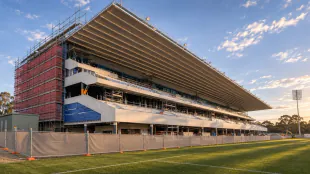 Panthers expected to begin 2027 NRL season away from new stadium
On a blue and yellow background, the graffiti artist retouches a spray-painted image of the half-man, half-shark statue of King Behanzin, one of the stolen treasures returned to Benin by France late last year.
The image is just one by 26 local and international graffiti artists who have created a mural depicting Benin's history and culture stretching more than one kilometre along a wall in Benin's main city of Cotonou.
Their objective is to eventually create the largest mural fresco in the world as part of a festival under the theme of "New Benin".
"To create the Benin of the future, we must keep the Benin of the past in our sight," said Laurenson Djihouessi, known by his artist name Mr Stone, who is the festival promoter.
Many of the graffiti artists have chosen to represent the restored treasures, which were stolen by French colonial forces and returned to Cotonou this year after negotiations with Paris.
The artefacts have been on display for the first time in Benin since February in a historical exhibition at the presidential palace, located a few hundred metres from the mural.
"There, the audience comes to the art, but here the art comes to the audience," said Stone, whose images pay homage to the Amazons, the elite, all-female soldiers of the Kingdom of Dahomey, one of Benin's kingdoms before French colonisation.
The artist said he wanted to place the Beninese woman "at the heart of action and development", for them to be the "Amazon of modern times".
But it is not only the royal history of Benin's past that is painted on the fresco that attracts dozens of passers-by.
Supported by the Claudine Talon Foundation, run by the First Lady of Benin, and the Ministry of Culture, the wall also highlights recent achievements in the West African country.
There are cranes symbolising the reform of Cotonou's port and agricultural machinery, a reference to the modernisation of the agricultural sector.
Images of roads are meant to show part of the infrastructure projects touted by President Patrice Talon as one of his successes.
Since his first election in 2015, Talon has launched dozens of projects in what he calls a campaign to set his nation on the path to development.
While the economy may have been modernised, Benin's opposition says the country's democracy has also suffered under Talon's rule.
On her part of the wall, female artist Drusille Fagnibo also painted the building of Economic Crimes and Terrorism Court, known as Criet.
Critics say the special court, set up in 2016 in a bid to end to impunity in the political class, is used as a political weapon by the government to target opponents.
In December, the court sentenced opposition leader Reckya Madougou to 20 years in prison for terrorism, a term which her lawyers described as a political attack.
The government denies any claims the court is manipulated for political purposes.
More than 700 metres of wall have been decorated since April 11, and the organisers want to expand it to 1,300 metres during early 2023. They hope to beat the record for the longest graffiti fresco in the world.
L.Dubois--BTB