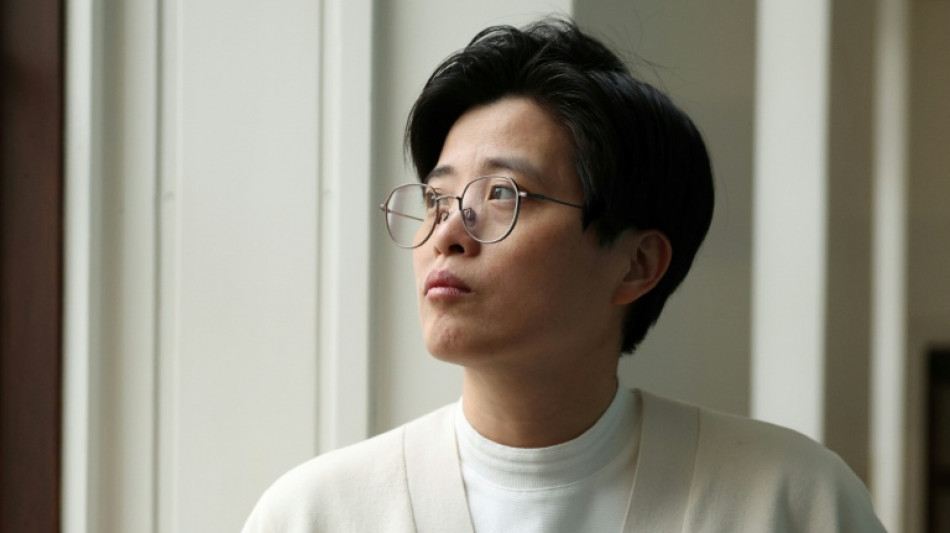
'Taiwan Travelogue' author hopes book can be read in China, spark dialogue / Photo: © AFP

 Far-Right Extremists Claim Opportunity to Seize Control of GOP After Midterms

 New Campaign Highlights Knowledge Gaps on Carbon Monoxide Safety Among Americans

 JR East Launches 'teppay' to Integrate Suica Balance with Mobile Payments

 Phil Spencer on Housing Market Fairness: How Buyers and Sellers Navigate Falling Prices

 Beirut Cinema Festival Draws Thousands Despite War Fatigue

 AMD Forecasts First-Ever Revenue Lead Over Intel on AI Chip Surge

 GoodData.AI Launches the Agentic Serving Plane, a New Category of Enterprise Data Infrastructure for AI Agents

 Abu Dhabi Demand Response Project Achieves 401 MW Peak Reduction in 2025
 Panthers expected to begin 2027 NRL season away from new stadium
The author of "Taiwan Travelogue", Yang Shuang-zi, told AFP she hopes her International Booker Prize-winning novel can one day be read in China and facilitate dialogue about the "future Taiwanese people want".
On Tuesday, Yang, 41, became the first Taiwanese author to win the prestigious award which celebrates works translated into English, alongside translator Lin King, 32.
The playful novel, set in 1930s Japan-controlled Taiwan, poses as a translation of a rediscovered Japanese travel memoir penned by fictional writer Aoyama Chizuko.
It traces ebullient Chizuko's travels and gastronomic adventures across the colonial outpost, and the relationship she develops with her Taiwanese interpreter, the reticent Chizuru.
Although historical fiction, the novel probes themes of power imbalance and cultural erasure that the author says are relevant to present-day Taiwan, which is claimed by China as part of its territory.
"I've countless times felt anxious inside, asking myself whether literature is too slow," Yang admitted when asked about Taiwan's future.
"I often worry, often feel that maybe I should make political statements, or take some kind of action, engage in other forms of activism," she told AFP in an interview Wednesday.
"But in reality, as a novelist, I've decided to put my faith in literature, to believe in the power of literature."
First published in Mandarin in 2020, the book has won accolades in Taiwan, but has not been released in China.
"If this book can, in one way or another, make its way into China and be read by Chinese readers, I think we would have an opportunity for dialogue and communication," said Yang.
That would "let more Chinese people understand what kind of future Taiwanese people want -- which is not the same as what many in China imagine".
- 'Uphill battle' -
"Taiwan Travelogue" is the first book published in any Chinese language to win the International Booker Prize.
"I hope it can serve as an example in the Chinese-speaking world, showing that in a free and democratic country like Taiwan -- a country where I can come out openly as a queer person -- we can do this together," said Yang.
Unlike writing from former British colonies like Hong Kong, King says Taiwanese literature and its colonial past are lesser known in the Anglophone world.
"For Taiwan, it's always been an uphill battle to be translated into English, and published, and recognised. So this is definitely very momentous for me personally," said King.
The win has prompted an outpouring of emotion from Taiwanese readers on social media, who see it as an important moment for the self-ruling island usually in the news over tensions with China.
But Yang says the universal themes she discusses in the book -- and her mouthwatering descriptions of Taiwanese delicacies -- may have also touched readers.
"I've packed a lot of elements I personally love into this work -- whether it's travel, railways, food, or women's friendships. Because I'm so fond of these things, I hope my enthusiasm can also infect my readers."
For Yang, who dedicated this book featuring the larger-than-life women characters to her late sister, it is as much about preserving Taiwan's past as it is about fighting for its future.
"Sometimes history briefly disappears; it becomes a blank. But as long as there are descendants willing to search, I believe history can be completed," said Yang.
This book is "a call to readers all over the world: we can go and retrieve the histories that were once lost, our mothers' voices, our grandmothers' voices. We have to recover them ourselves."
J.Fankhauser--BTB