Legacy of Himalaya's 'Sherlock Holmes' lives on in digital / Photo: © AFP

 Man City chairman defiant over reported Premier League charges

 Germany ready to 'walk through fire' for Klopp, says Tah

 At least 16 killed in Russian and Ukrainian strikes

 Powerful storm pummels US Northeast

 Bangkok declares disaster after homes flooded, roads submerged by heavy rain

 Norris calls for errant Colapinto to be banned for causing Baku crash

 Russell finds himself again and prepares to heap pressure on Antonelli
 South Korea hold nerve to win Asian Games basketball gold

 Russell holds off Verstappen to claim imperious victory in Baku

 Russell holds off Verstappen to win Azerbaijan Grand Prix

 India's Kohli says 2027 ODI World Cup will be his last

 Huge crowds cheer Pope Leo along Champs-Elysees ahead of Paris mass

 Putellas wants to bring 'winning culture and mentality' to London City

 Rare Italian opera returns to Moscow after nearly 120-year hiatus

 Pope to celebrate giant Paris mass after 'peace' appeal
 Homes flooded, roads submerged: Bangkok declares disaster over heavy rains

 Ahead of Paris mass, pope urges life together in 'dignity and peace'

 Austria 'ghetto' language classes leave children to repeat school
 S.African women runners arm themselves after string of killings

 'I felt embarrassed': Japan eSports whizz-kid, 11, wins Games gold
 Indonesia fires threatens critically-endangered orangutan: IUCN

 Bangkok declares flood disaster across city

 'World records not enough': North Korea weightlifters target Olympic gold rush

 Iran proposes Hormuz plan, Trump reportedly refuses
 El Nino rewrites the menu in the world's top restaurants

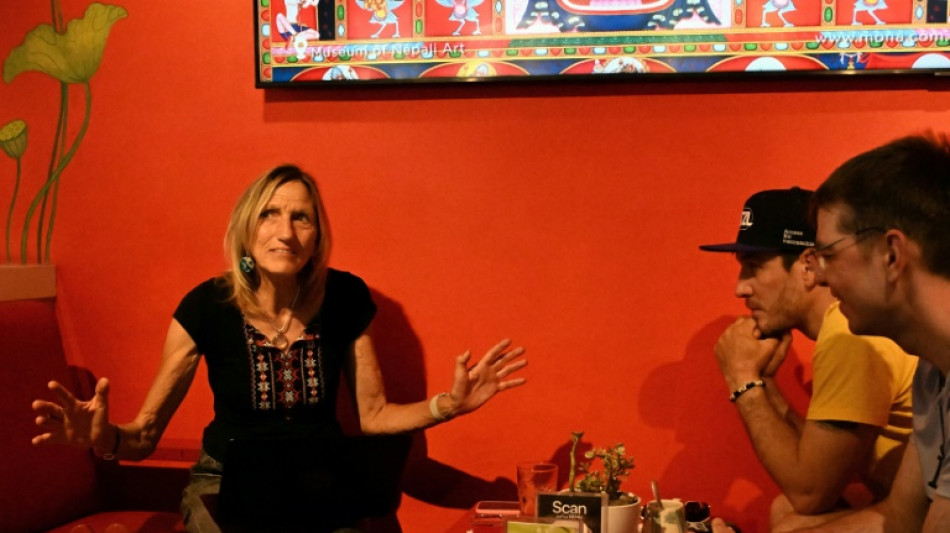
In a crowded Kathmandu restaurant far from Nepal's famed icy peaks, Billi Bierling questions climbers about their ascents, preserving each triumph in the Himalayan Database, mountaineering's revered 60-year-old register of success.
German climber Bierling, 58, inherited the stewardship of the archive from her mentor, the late Elizabeth Hawley, an American journalist who began the post-expedition interviews in Nepal while covering an American Everest expedition in 1963.
"It was her fascination," Bierling told AFP, after interviewing a Russian and a Ukrainian climber about their ascent of Manaslu, the world's eighth-highest mountain.
"She never climbed," Bierling said. "She never even went to a base camp -- but the people interested her."
Hawley's 50 years of chronicling climbs in the Himalayas earned her the moniker "the Sherlock Holmes of the mountaineering world" from Edmund Hillary, who with Tenzing Norgay made the first summit of Everest.
By the time she passed away in 2018, she had built a reputation as one of the most authoritative voices on Himalayan mountaineering.
The database she began had become the definitive record of Himalayan expeditions -- used by climbers, historians and researchers alike.
"She was very, very keen on her data, on her information," said Bierling, who first met Hawley in 2001 -- when she was in Nepal to climb the 7,129-metre (23,390-foot) Baruntse -- and began assisting her in 2004.
She described how Hawley would give the same grilling to all -- whether a climbing legend or an unknown.
"It didn't matter whether you were Reinhold Messner or you were Ueli Steck," she said, referring to the Italian great who made the first solo ascent of Everest, as well as the late Swiss speed climber.
"Or if you were Billi Bierling, a nobody," she said with a smile.
Bierling is now part of the team that continues her work, updating the vast database year after year.
At a time when each year more climbers are attempting the world's highest peaks than ever before, the task of recording the ascents is even more important.
- '40 drawers of reports'-
But times have changed.
In the 1970s, Hawley would drive to Kathmandu's airport in her blue Volkswagen Beetle, spotting those carrying the tell-tale heavy mountaineering boots as they walked off the two or three international flights a week.
Soon, it was the mountaineers who would seek her out.
In 1991, American climber Richard Salisbury, recognising the archive's historical importance and fragility, proposed digitising it.
It took nearly 11 years, Salisbury told AFP, a painstaking effort to convert "nearly 40 full file drawers" of meticulous handwritten expedition reports into a searchable digital resource.
"It was very important for a mountaineer to have their summit recorded in the Himalayan Database," said Garrett Madison, who has organised expeditions in Nepal since the 2000s, speaking to AFP from Everest base camp.
"If it wasn't recorded, it didn't happen."
Japanese climber Tatsuro Sugimoto, in Kathmandu after completing the first ascent of the 6,473-metre (21,237-foot) Jarkya, said the database was key for mountaineers seeking new records and routes.
"It is useful; we can check which mountains are unclimbed," he said.
- 'Need an army' -
Its scale, like climbing, has expanded exponentially.
Commercial expeditions now send hundreds of climbers each season, some summiting more than one peak.
"At one point I thought, 'this is no longer possible'," Bierling said. "I would be only running around. More and more mountains were being commercialised."
The database now supplements its records with official expedition numbers from Nepal's Ministry of Tourism.
"If we wanted to meet everybody in person, we'd need an army of 100 people," Bierling said. "It's all so quick. People come and go, they fly in, they fly out."
Nepal has issued a record 492 Everest permits for foreigners this season, with a city of tents set up at the foot of the mountain for climbers and support staff.
The focus has shifted to significant ascents, including first summits or new routes that push boundaries.
"The interesting climbs we chase," she said.
But the database still follows one of Hawley's key principles: first, trust the climber.
"Only when doubt arises do we dig in and look into it," said volunteer Tobias Pantel, 39.
"Then we can check the topography in their photographs and if other climbers are contradicting the claims."
As a result, some climbs are tagged "disputed", said Bierling.
"I often wonder what would Miss Hawley say," she said.
S.Keller--BTB