Light, flight, and rights: 250 years of US history in 30 objects / Photo: © AFP

 Far-Right Extremists Claim Opportunity to Seize Control of GOP After Midterms

 New Campaign Highlights Knowledge Gaps on Carbon Monoxide Safety Among Americans

 JR East Launches 'teppay' to Integrate Suica Balance with Mobile Payments

 Phil Spencer on Housing Market Fairness: How Buyers and Sellers Navigate Falling Prices

 Beirut Cinema Festival Draws Thousands Despite War Fatigue

 AMD Forecasts First-Ever Revenue Lead Over Intel on AI Chip Surge

 GoodData.AI Launches the Agentic Serving Plane, a New Category of Enterprise Data Infrastructure for AI Agents

 Abu Dhabi Demand Response Project Achieves 401 MW Peak Reduction in 2025

 Panthers expected to begin 2027 NRL season away from new stadium
How do you choose just 30 artifacts from millions to encapsulate 250 years of American history?
That's the question the government-funded Smithsonian Institution posed itself as the United States gears up for the anniversary of the nation's July 4, 1776, Declaration of Independence.
Among the answers: a small ink-stained mahogany desk, an antique light bulb, a brown leather flight suit and a baseball jersey.
These exhibits and others that present some highlights of America's faltering progress toward a perfect union go on show for two months in Washington next Tuesday ahead of the semiquincentennial.
"It's a daunting task," said Abeer Saha, who was one of a handful of curators tasked with choosing from 150 million objects across the Smithsonian -- which runs more than 20 museums and galleries. He spent more than two years on the project.
"What we've tried to do is find those highlights, those moments, those stories that best exemplify the ways in which Americans have sought to realize the founding ideals first expressed in the Declaration of Independence by Thomas Jefferson."
President Donald Trump has taken a series of norm-shattering steps to put himself at the center of attention on the 250th Independence anniversary.
But Abeer said the painstaking selection of artifacts, which have never been in the same room before, was done without any political interference.
To an AFP reporter, the only visible imprint of the current US president -- whose administration has also sought to sanitize negative history at US national parks -- was a "Trump-Vance" election campaign badge alongside those of a roster of modern presidents from both parties.
- Freedom, innovation, pathfinders -
The exhibition, "American Aspirations," is housed in a vaulted red sandstone hall inside the grand Smithsonian Castle, the institute's original premises on the National Mall. It was previewed by journalists on Thursday.
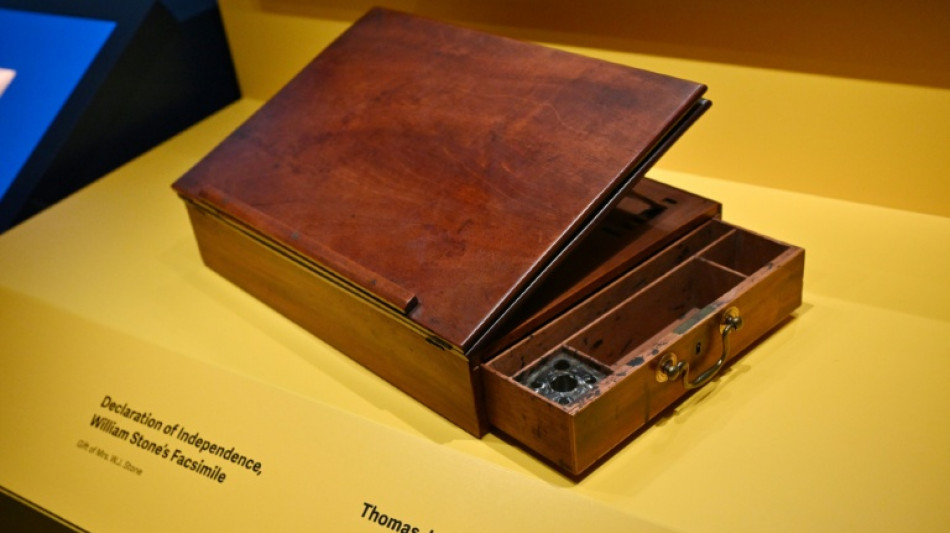
Appropriately enough, it starts with the small desk used by Jefferson to draft the declaration of independence from Britain that began with the timeless words: "We hold these truths to be self-evident, that all men are created equal."
The desk looks more like a small, table-top easel. It was designed for Jefferson by a Philadelphia cabinet maker and folds out to reveal a green baize writing top.
Lisa Kathleen Graddy, a Smithsonian curator of American political history, said Jefferson had an eye on history, and affixed a note to the inside of the desk authenticating it as the one used to write the declaration.
Nearby, is a large poster, with text penned by famed slavery abolitionist Frederick Douglass, that was carried in a 1863 parade during the Civil War that calls "Men of Color, To Arms! To Arms!"
It is one of several exhibits that address the struggle for greater freedom over the centuries, including against slavery and in modern times for civil rights.
There is the typed text of Martin Luther King Jr.'s 1963 speech, "I Have a Dream," and a jersey worn by Roberto Clemente, the first Latino to be inducted into the Baseball Hall of Fame.
There are also signifiers of economic and scientific progress.
They include a nugget from the California gold rush; an 1879 lightbulb by Thomas Edison; a mainframe component from ENIAC, the first general-purpose electronic computer that was built in 1946 and weighed 30 tons.
And on the theme of "pursuit of new horizons," there are artifacts from two pathfinding women who took to the skies.
There's the leather flight suit of Amelia Earhart, who was the first woman to fly across the Atlantic but disappeared over the Pacific in 1937 as she attempted to fly around the world.
Beside it is the pale blue flight jacket of Sally Ride, a physicist who in 1983 became the first American woman in space.
"She really shifted the way in which Americans and the world would look at who could go into space," said Jennifer Levasseur, a curator at the National Air and Space Museum.
G.Schulte--BTB
