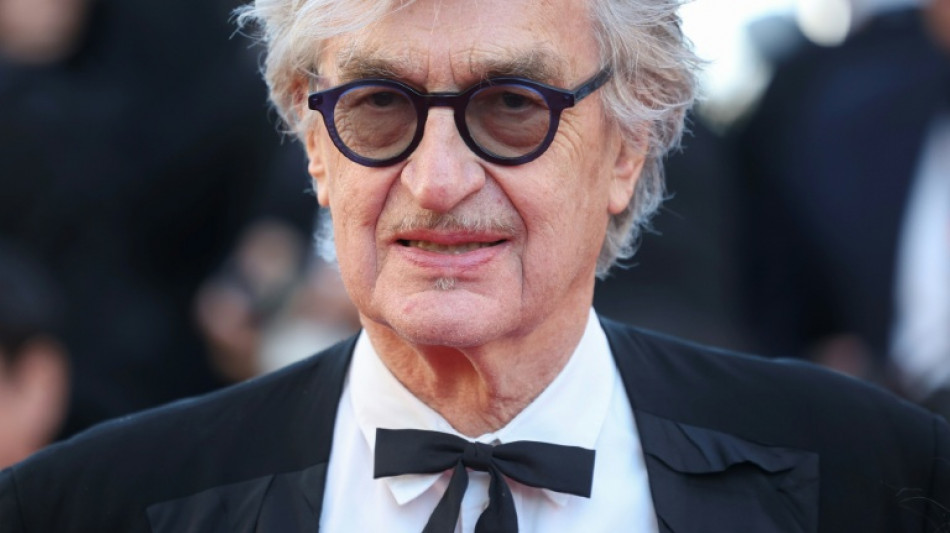
German director Wenders pulls 1975 film over child nude scene / Photo: © AFP/File

 Far-Right Extremists Claim Opportunity to Seize Control of GOP After Midterms

 New Campaign Highlights Knowledge Gaps on Carbon Monoxide Safety Among Americans

 JR East Launches 'teppay' to Integrate Suica Balance with Mobile Payments

 Phil Spencer on Housing Market Fairness: How Buyers and Sellers Navigate Falling Prices

 Beirut Cinema Festival Draws Thousands Despite War Fatigue

 AMD Forecasts First-Ever Revenue Lead Over Intel on AI Chip Surge

 GoodData.AI Launches the Agentic Serving Plane, a New Category of Enterprise Data Infrastructure for AI Agents

 Abu Dhabi Demand Response Project Achieves 401 MW Peak Reduction in 2025

 Panthers expected to begin 2027 NRL season away from new stadium
Award-winning German director Wim Wenders said Wednesday he was withdrawing his 1975 film "Wrong Move" after a campaign by actress Nastassja Kinski against a scene in which she appeared topless when she was 13 years old.
In a statement on his foundation's website, Wenders apologised to Kinski and said that the Wim Wenders Foundation, which owns the film, is withdrawing it from all current channels of distribution.
"As the only person responsible at the time for 'Wrong Move' who is still here, I recognize that Nastassja Kinski should have been better protected back then," Wenders, 80, said in the statement.
"For that, I apologize to you, Nastassja, unreservedly, no ifs and buts," said Wenders, one of the most influential German directors of recent decades, whose accolades include a BAFTA award and a Palme d'Or at Cannes.
Last month Kinski, 65, gave an interview to the Sueddeutsche Zeitung daily in which she said she had for years been trying to get Wenders to change the film, without success.
"That was my first film, he was my first director, and he didn't protect me," Kinski told the newspaper.
"Even though I didn't know all that much at 13, I picked up on the fact that something wasn't right," she said.
The Wim Wenders Foundation said it would seek a "broad dialogue" with German film institutions about what to do with the film in future.
"Only after that process has taken place -- even if it takes considerable time -- and once we have been able to present a mutually agreed solution, which will include Nastassja Kinski, will we make the film available again," it said.
Wenders added in the statement: "The many reactions, comments and conversations of recent days have played a significant role in further sharpening my understanding of the events of that time. For that, I am grateful.
"Only an open and respectful exchange can lead us to reconsider positions and reassess responsibilities."
- 'Long overdue' decision -
In a statement to AFP, Kinski's lawyer Christian Schertz said that he "welcomed" the decision but said that it had been "long overdue".
"I also regret that it has only happened as result of public pressure," he said.
"We have to wait to see what (Wenders's) offer of dialogue actually consists of," Schertz said.
Nastassja Kinski is the daughter of late German film icon Klaus Kinski and his second wife Brigitte. She achieved Hollywood fame with films such as "Cat People" and "Tess".
In 2013 she gave an interview to the Bild am Sonntag newspaper in which she described her late father as a "tyrant" and accused him of trying to abuse her.
"Wrong Move" is one of several films which have gained notoriety due to complaints from the actors who starred in them.
In 2023, actors Olivia Hussey and Leonard Whiting filed a lawsuit over Franco Zeffirelli's 1968 "Romeo and Juliet", in which they starred at the ages of 15 and 16 respectively.
The film featured a brief bedroom scene in which Whiting's buttocks and Hussey's bare breasts were visible, but a California judge rejected their argument that the movie amounted to sexual exploitation and "child pornography".
"Last Tango in Paris", directed by Italian director Bernardo Bertolucci in 1972, contains a rape scene filmed without the consent of actress Maria Schneider, who was then 19.
She later said she was crying real tears during filming and her co-star Marlon Brando did not console her afterwards.
C.Meier--BTB