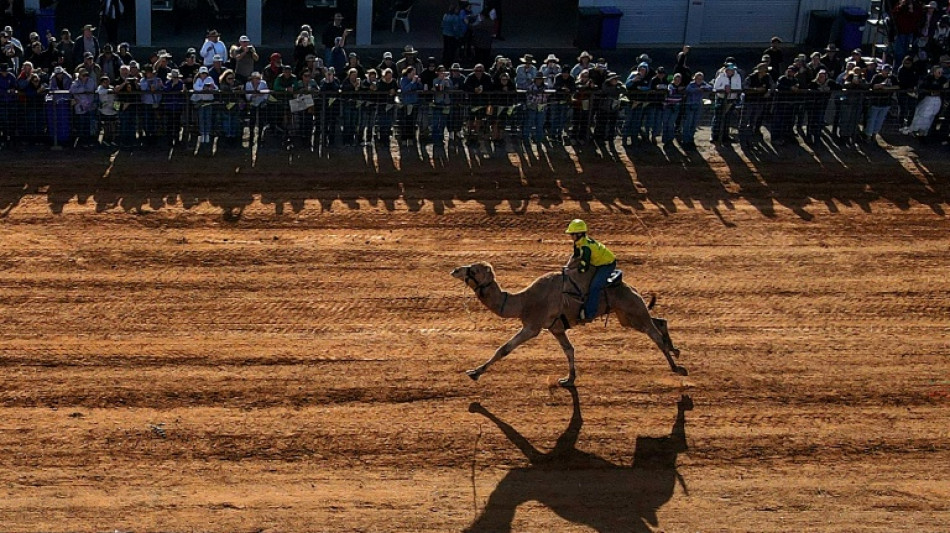
'High-strung' camels race in Australian outback / Photo: © AFP

 Far-Right Extremists Claim Opportunity to Seize Control of GOP After Midterms

 New Campaign Highlights Knowledge Gaps on Carbon Monoxide Safety Among Americans

 JR East Launches 'teppay' to Integrate Suica Balance with Mobile Payments

 Phil Spencer on Housing Market Fairness: How Buyers and Sellers Navigate Falling Prices

 Beirut Cinema Festival Draws Thousands Despite War Fatigue

 AMD Forecasts First-Ever Revenue Lead Over Intel on AI Chip Surge

 GoodData.AI Launches the Agentic Serving Plane, a New Category of Enterprise Data Infrastructure for AI Agents

 Abu Dhabi Demand Response Project Achieves 401 MW Peak Reduction in 2025

 Panthers expected to begin 2027 NRL season away from new stadium
Camels with "a bit of fire in them" raced in a remote Australian outback town this weekend at an annual event celebrating the desert beasts first imported in the mid-19th century.
Hundreds of spectators descended on Marree, which has a population of 65 and lies nearly 600 kilometres (370 miles) north of the South Australian capital Adelaide, for a 13-race spectacle on Saturday known as the Marree Camel Cup.
More than 10,000 camels were imported into Australia from 1840, many of them released into the wild with the development of railways and then the arrival of motor vehicles in the 1920s.
Now, estimates of the wild camel population range from 300,000 to a million animals.
Trainer Kyrraley Woodhouse, who started camel racing professionally in 2013, said most of his camels had been taken from the wild to run in the Marree event, which drew more than a dozen competitors.
Picking the right animal is key.
"You would want a little bit of temper, a little bit of fire in them -- a sort of splashy look in the eye," Woodhouse told AFP.
"They want to be wary of you a little bit but not, like, aggressive," he added.
"We want something sort of like a racehorse, a little bit high strung, a little bit forward -- something that's got a heart, that's going to run."
This year's Marree Camel Cup winner was Young Gun, ridden by Patrick Dennis.
Muslim cameleers, many from Afghanistan and other parts of Central and South Asia, were brought to Australia in the 1860s to harness the animals for transport in the arid interior, and some of their descendants remain in Marree.
Camels in the outback compete with stock for food, destroy fences, foul waterholes and damage Indigenous cultural sites, authorities say.
Without management, camel populations could double every eight years, South Australia's primary industries department says. Camel number are kept in check by mustering, shooting and trapping at water points.
Australia also exports a small number of live camels: 68 so far in 2026 heading to Malaysia and Indonesia.
O.Bulka--BTB
