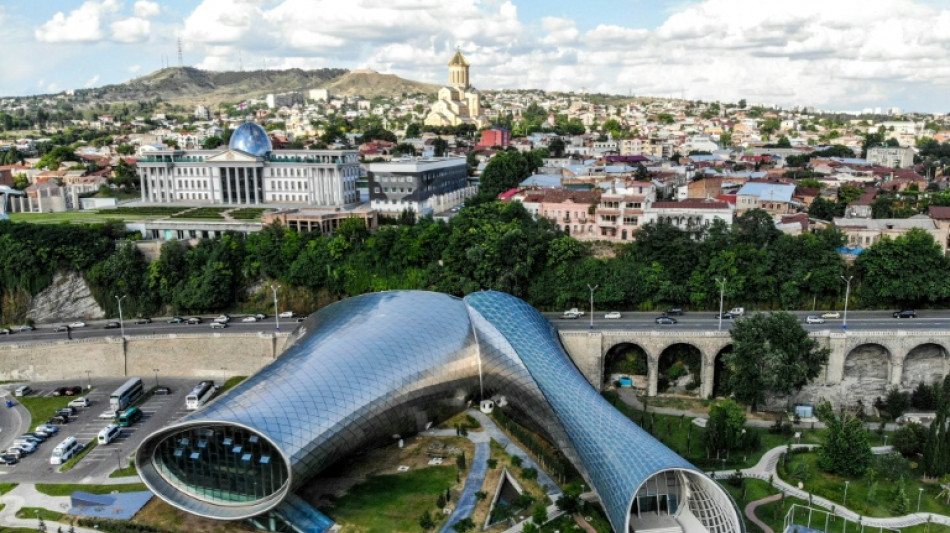
Georgia capital to demolish unfinished landmark amid political feud / Photo: © AFP

 Far-Right Extremists Claim Opportunity to Seize Control of GOP After Midterms

 New Campaign Highlights Knowledge Gaps on Carbon Monoxide Safety Among Americans

 JR East Launches 'teppay' to Integrate Suica Balance with Mobile Payments

 Phil Spencer on Housing Market Fairness: How Buyers and Sellers Navigate Falling Prices

 Beirut Cinema Festival Draws Thousands Despite War Fatigue

 AMD Forecasts First-Ever Revenue Lead Over Intel on AI Chip Surge

 GoodData.AI Launches the Agentic Serving Plane, a New Category of Enterprise Data Infrastructure for AI Agents

 Abu Dhabi Demand Response Project Achieves 401 MW Peak Reduction in 2025

 Panthers expected to begin 2027 NRL season away from new stadium
Authorities in the Georgian capital Tbilisi have approved the demolition of a half-finished futuristic cultural complex, rekindling a debate over one of the city's most divisive landmarks.
Critics have long argued that the site -- in the shape of two silvery steel and glass tubes -- clashes with Tbilisi's historic skyline, while supporters see it as an emblem of jailed former president Mikheil Saakashvili's drive to rapidly modernise the ex-Soviet nation.
Its planned removal has prompted accusations that the ruling Georgian Dream party is seeking to erase architectural symbols associated with its imprisoned political rival.
Earlier this month municipal authorities approved the dismantling of the buildings designed by Italian architects Massimiliano and Doriana Fuksas that were put up in the historic Rike district in 2011-2012.
The owner, who plans to build a hotel on the site, has until December 25 to complete the demolition.
Saakashvili denounced the plan, describing the complex as a "world architectural and cultural masterpiece" and accused the authorities of destroying an asset built with public funds.
Intended to house a concert hall and exhibition space, the complex never opened. Work stopped after Saakashvili's United National Movement lost power to Georgian Dream in 2012, leaving its interiors unfinished.
Around $29 million in public money had already been spent on the project, according to Georgian fact-checking organisation FactCheck.ge.
Massimiliano Fuksas also condemned the decision.
"If public money was spent to build something, why destroy it?" the 82-year-old architect told Radio Free Europe/Radio Liberty, calling the plan "madness".
He said his studio had contacted the Georgian authorities in May, offering to discuss alternative uses for the complex, but received no response.
Y.Bouchard--BTB
