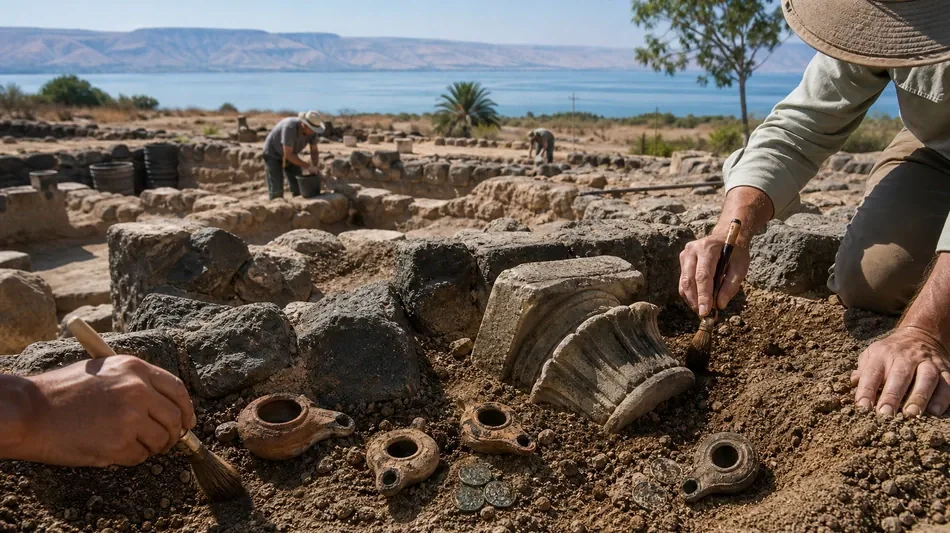
New finds strengthen case for Bethsaida at Sea of Galilee site

 Far-Right Extremists Claim Opportunity to Seize Control of GOP After Midterms

 New Campaign Highlights Knowledge Gaps on Carbon Monoxide Safety Among Americans

 JR East Launches 'teppay' to Integrate Suica Balance with Mobile Payments

 Phil Spencer on Housing Market Fairness: How Buyers and Sellers Navigate Falling Prices

 Beirut Cinema Festival Draws Thousands Despite War Fatigue

 AMD Forecasts First-Ever Revenue Lead Over Intel on AI Chip Surge

 GoodData.AI Launches the Agentic Serving Plane, a New Category of Enterprise Data Infrastructure for AI Agents

 Abu Dhabi Demand Response Project Achieves 401 MW Peak Reduction in 2025

 Panthers expected to begin 2027 NRL season away from new stadium
Archaeologists working at el-Araj in northern Israel say a new collection of Roman and earlier artefacts reinforces their identification of the site as biblical Bethsaida.
The Bethsaida-Julias excavation team recovered lamps, cosmetic implements, coins and other objects during its tenth season beside the Sea of Galilee. Academic director Steven Notley said the identification rests on the accumulated evidence from excavation squares and has become clearer with each season. The team has worked at el-Araj since 2016.
This season expanded the picture of settlement during the Roman period, from the first through third centuries, while also producing material from other eras. Finds included Roman walls, a basalt grinding mortar, coins and half of a Doric capital that may once have decorated a public building. Excavators also found indications of an earlier Hellenistic settlement.
Researchers concluded that the Ottoman-period Syrian owner of Beit Habek constructed stables directly over Roman remains without a separate foundation. Chalk stone vessels and intact Herodian lamps, manufactured only in Jerusalem before 70 CE, were cited as evidence of a Jewish population in the first century, when Bethsaida became the Roman polis Julias. The material suggests a prosperous community rather than an impoverished village.
Notley said nothing uncovered so far contradicts the identification. Christian tradition associates Bethsaida with Jesus’ restoration of a blind man’s sight and the feeding of thousands with five loaves and two fish. The apostles Peter, Andrew and Philip are also linked to the city. Earlier seasons produced mosaics, churches and domestic walls.
B.Shevchenko--BTB
