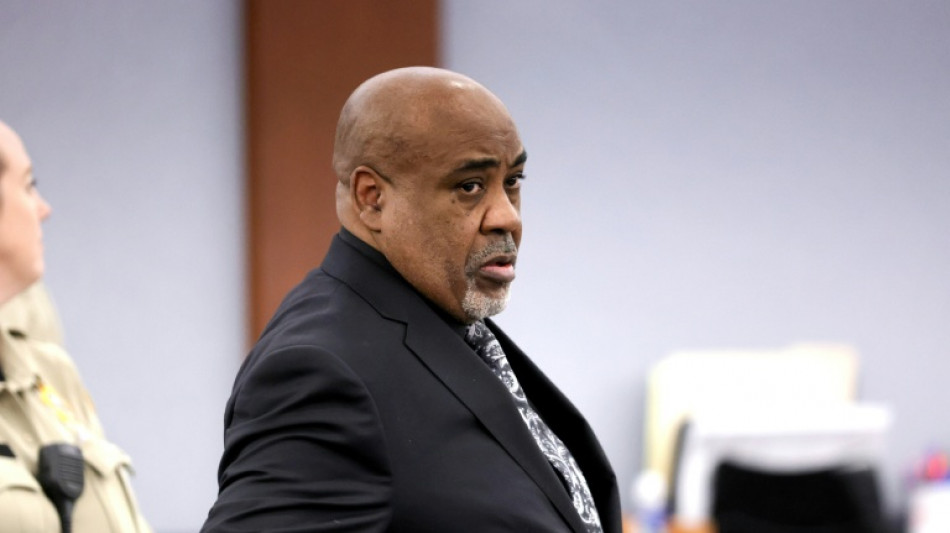
Jury hears closing arguments in Tupac Shakur murder trial / Photo: © POOL/AFP

 Far-Right Extremists Claim Opportunity to Seize Control of GOP After Midterms

 New Campaign Highlights Knowledge Gaps on Carbon Monoxide Safety Among Americans

 JR East Launches 'teppay' to Integrate Suica Balance with Mobile Payments

 Phil Spencer on Housing Market Fairness: How Buyers and Sellers Navigate Falling Prices

 Beirut Cinema Festival Draws Thousands Despite War Fatigue

 AMD Forecasts First-Ever Revenue Lead Over Intel on AI Chip Surge

 GoodData.AI Launches the Agentic Serving Plane, a New Category of Enterprise Data Infrastructure for AI Agents

 Abu Dhabi Demand Response Project Achieves 401 MW Peak Reduction in 2025

 Panthers expected to begin 2027 NRL season away from new stadium
A jury heard closing arguments on Monday in the trial of a former Los Angeles gang leader accused of involvement in the sensational murder three decades ago of chart-topping rapper Tupac Shakur.
Duane "Keffe D" Davis, 63, a one-time leader of the South Side Compton Crips, is accused of ordering the September 7, 1986 killing after his nephew had been beaten by members of Shakur's entourage in Las Vegas.
"Duane Davis, in the culture of gangs, could not let that stand," prosecutor Binu Palal said. "So what did he do? He acquired a firearm, got his group together, and went hunting for Mr Shakur."
Palal was the first to address his closing arguments to the jury in a Las Vegas courtroom and will be followed by Michael Sanft, the defense attorney for Davis.
Shakur, who was in Las Vegas for a Mike Tyson fight, was shot about two hours after the confrontation by a gunman in a white Cadillac that pulled up at a red light alongside the BMW in which the rapper was riding in the front passenger seat.
According to prosecutors, Davis handed the gun to someone sitting in the back seat of the Cadillac and ordered that person to shoot Shakur, who died six days later.
The driver of the BMW, Death Row Records co-founder Marion "Suge" Knight, was wounded.
The killing of Shakur, also known as 2Pac, has been one of America's most celebrated cold cases, prompting endless debate among music fans over who did it and why.
Davis, whose Crips were one of a patchwork of gangs that ran parts of Los Angeles in the 1990s, is the only person to have been charged in connection with the shooting of Shakur.
Davis has repeatedly boasted over the years of involvement in Shakur's murder -- in interviews with law enforcement and media and ultimately in an autobiography.
The investigation sputtered for decades because of a lack of evidence, but the case was revived when Davis's memoirs were published in 2019.
During the trial, Sanft, Davis's attorney, characterized his client's confessions as fiction and lies partly designed to promote his book.
If convicted, Davis faces possible life in prison without parole.
Shakur, who was 25 when he died, was a key figure in a hip-hop rivalry pitting the US East Coast against the West Coast.
Known for hits like "California Love" and "All Eyez on Me," Shakur -- the son of a Black Panther -- was raised in Harlem and Baltimore, but quickly became the epitome of California hip hop when he signed with Los Angeles-based Death Row Records.
T.Bondarenko--BTB
