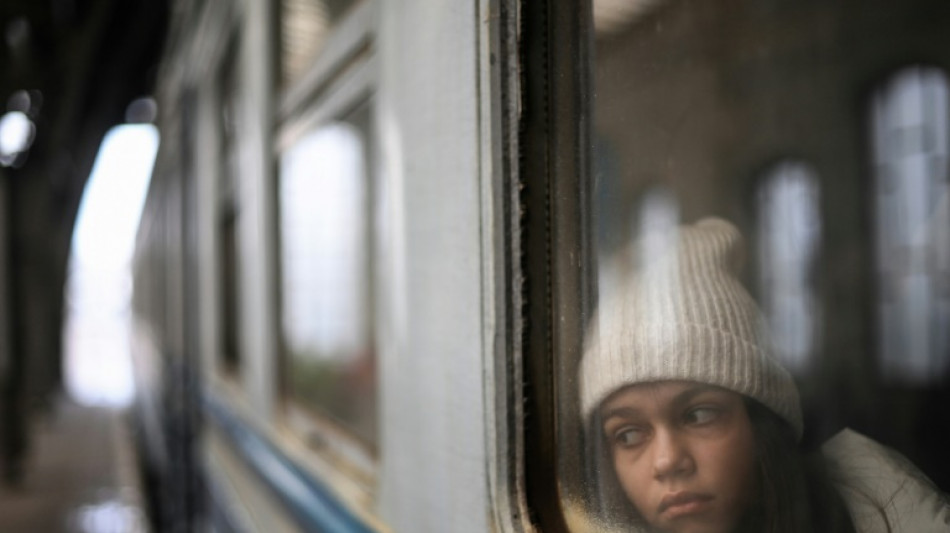
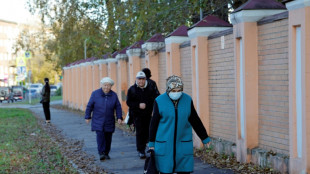
Mould and red tape: Ukrainians hosted in UK struggle to find own housing / Photo: © AFP

 Bid by Italy's Intesa bank to take over MPS gets boost

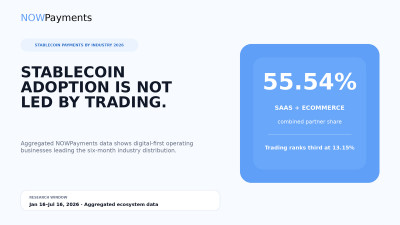 Stablecoins Are Quietly Becoming Business Infrastructure, NOWPayments Data Shows

 Oil surges, stocks sink as US reportedly eyes new Iran strikes

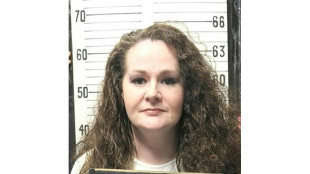 Woman in botched US execution walking, mentally 'foggy': lawyer

 Farhan hopes Pakistan's new combination takes off in Sri Lanka T20Is

 Teenager Andreeva seals China Open semi-final with Bartunkova

 Britain's Burnham says open to Germany joining warplane project

 Kovac's tough love has Dortmund dreaming of title charge

 China announces candidate for WHO chief

 South Korea test-fires its first homegrown hypersonic weapon: presidency

 ONAR Advances Nasdaq Listing Preparation Following Advertise Purple Acquisition and Financing

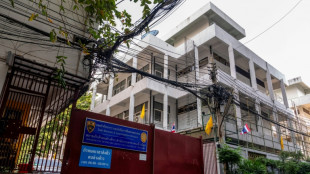 Thailand opens extradition process for reporter sought by China

 France struggles to wean social housing off gas

 Germany lifts GDP forecast as economy withstands Iran war
 Sri Lanka appoints Kusal Mendis as Test captain
 Norris confident McLaren can shine in Singapore
 Alex Bodi pushes ahead with expansion: ALIX LASERS showroom planned for Bucharest
 Fossil fuels off COP31 agenda as global output keeps rising

 Haze not 'a threat' to Singapore F1 race: organisers

 COP31 organisers say to seek 'ambitious' action with their text

 Bartunkova thrashes Muchova to reach China Open semi-finals

 Drone hits Yandex data centre, in first such attack on Russia

 Oil prices surge and stocks sink on fresh inflation worries

 AI startup Manus raises $500m after Meta acquisition blocked by China

 From refuge to repatriations: Malaysia's Myanmar U-turn

Viktoriya arrived in the UK in March after fleeing war-torn east Ukraine with her two sons and their cat and dog.
A month later, the British hosts who sponsored them asked the family to move out, saying they needed the space for an elderly relative.
Viktoriya, who asked only to use her first name, said she and her family were then moved to a caravan park in Devon, southwest England.
Her story is extreme but as the war rumbles on, it is a growing issue as the government asked hosts only to commit to six months.
At least 2,175 Ukrainian households living in England have required local authorities to intervene to prevent homelessness, data shows.
"They put us in temporary accommodation in Ilfracombe," said Viktoriya, 37, a cook from Sloviansk.
She described it as a cold, damp "caravan" with a kitchen, bathroom and two bedrooms but no heating.
"Everything was covered in mould, even the cupboard. I constantly sprayed it with chlorine solution but it just came back," she told AFP.
The family was supposed to move out within six weeks but Viktoriya said they were told they were not a priority and there were no sponsors.
- Costs -
Viktoriya said she decided to bring her family to England because her 15-year-old son speaks English and "dreamt" of coming here.
But problems arose when their sponsors gave the family a month's notice.
Speaking little English, Viktoriya had not yet found a job and had to ask the local council for help.
Their new accommodation was two hours away on public transport, meaning her children had to change schools.
One couple she knows spent three days living in an airport after their sponsors refused to take them, before being moved to a hotel with no cooking facilities.
The UK scheme offers Ukrainians the opportunity to live, work and study for up to three years with access to state benefits.
More than 146,000 have fled to the UK under the scheme, which relies on good will from ordinary people like Amanda Rodriguez Medina.
Medina, 57, has hosted Nataliia Parkhomenko, 31, and her two sons since May -- beyond the six-month minimum -- at her house in Basildon, southeast England.
Amanda says they are "half friends, half mother-daughter". They go to the gym together and share gardening, DIY and cleaning.
"I'm happy to be here. I'm lucky to find a really nice woman," says Nataliia, an accountant from Melitopol in southern Ukraine.
Amanda stresses she is "happy to continue" hosting Nataliia's family until they can rent independently.
"At the moment, it is impossible anyway, because it's hard for her to get a full-time job because of the children".
Nevertheless she admits feeling "shock" at the red tape and having to apply for welfare payments and school places herself.
Nataliia's monthly sponsorship payments of £350 ($422) took four months to arrive. In the meantime, the UK plunged into a cost-of-living crisis.
"We live together, we are happy to be together and to see what happens in future," says Nataliia, who hopes to return home one day.
- Housing -
Stan Benes, from Opora, a charity helping Ukrainians, said that for many, renting accommodation is problematic as there is not enough housing.
A poll of Ukrainians in October and November by the Office for National Statistics (ONS) found 45 percent had problems renting.
Of these, 59 percent cited lack of a guarantor or references.
Nadiya, a Ukrainian on a one-year research fellowship at Oxford, now has university accommodation for herself and her daughter.
But she struggled with the rental market in what is one of the UK's costliest cities.
"As soon as they knew I was Ukrainian, (letting) agencies did not want to deal with me," she said.
Kateryna, a music teacher and singer from Dnipro in east Ukraine, was offered a teaching job in London after having to leave her sponsor in Wales at the end of six months.
But she could not find a landlord, even with a guarantor.
"The landlords don't want to accept us when they know we are refugees," she added.
Eventually she managed to secure a rented studio flat, also with mould problems.
But she has no regrets and wants to stay for her son.
- Pressure -
Half of Ukrainians expect to stay in the UK at least three years, the ONS found, but sponsors are dwindling.
Recently there were 30 sponsorship offers versus 1,800 requests, said Benes.
"People do want to come but they are getting disheartened," he said, urging local authorities to give more incentives.
The Local Government Association, which represents councils, said as food and energy prices rise on the back of soaring inflation, monthly support payments need to increase.
H.Seidel--BTB