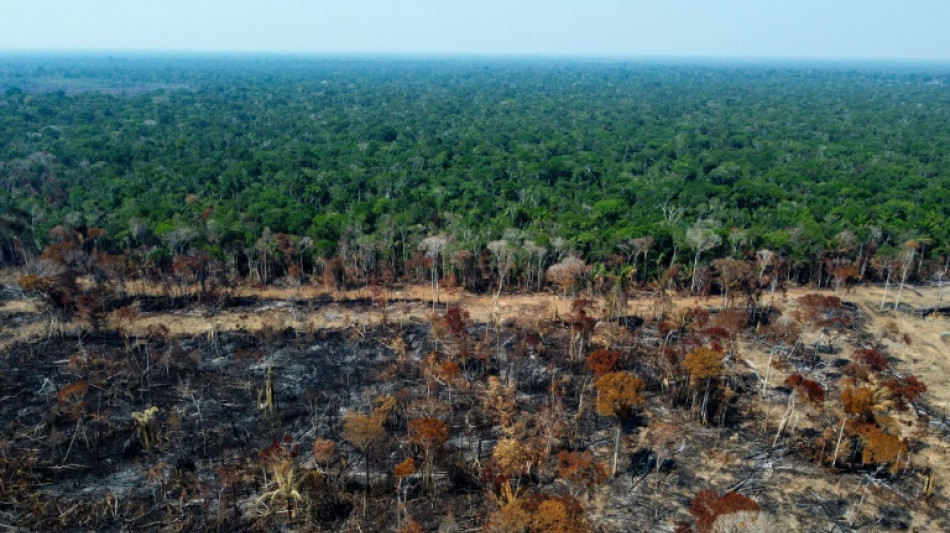
EU agrees ban on imports driving deforestation / Photo: © AFP/File

 Verdict due in Mexico trial over murders of Australia, US surfers
 B2PRIME Welcomes Christina Barbash as Commercial Manager

 Russia forcing Kyiv into 'survival' mode before winter, mayor tells AFP

 Closing arguments begin in Maradona death trial

 UEFA president Ceferin to stand for re-election in 2027

 Nearly 300,000 Nepalis at flood risk: study
 Riyadh kindergarten hit by interception debris as Houthis say targeted airport

 Alex Bodi mizează, alături de CRIF, pe investiții transparente și pe prevenirea riguroasă a spălării banilor

 Gulf Labs, Part of Thailand’s $27 Billion GULF Group, Goes Live as an Injective Validator
 EU okay for winter despite 'historically low' gas stocks: operators

 Rwanda to host F1 Grand Prix: sources close to both sides

 EU top diplomat says bloc in favour of UN Lebanon peacekeepers' extension

 Antonelli and Russell to run different Mercedes aero packages in Singapore

 WTO hikes 2026 trade growth forecast on AI boom

 'I love that challenge': Hamilton prays for rain in Singapore

 G.Bissau moves towards postponement of December general election

 Verstappen out to settle 'unfinished business' at Singapore Grand Prix

 WhiteBIT Launches Bitcoin Lightning Network Support, Powered by Voltage

 Oil surges, stocks sink as US reportedly eyes fresh Iran strikes

 Anne Carson: modern takes on Greek classics

 Canada's Anne Carson wins Nobel literature prize

 Ethiopia drones hit Eritrean troops in Tigray

 Russian strike on buses kills 30 in frontline Ukrainian city

 Thailand begins extradition process against Chinese journalist

 Quarantine, unease and rumours: Russian city grapples with plague scare

The European Union reached an agreement Tuesday to ban the import of products including coffee, cocoa and soy in cases where they are deemed to contribute to deforestation.
The draft law, which aims to ensure "deforestation-free supply chains" for the 27-nation EU, was hailed by environmental groups as "groundbreaking".
It requires companies importing into the EU to guarantee products are not produced on land that suffered deforestation after December 31, 2020, and that they comply with all laws of the source country.
The scope encompasses palm oil, cattle, soy, coffee, cocoa, timber and rubber as well as derived products such as beef, furniture and chocolate.
Illegal production has spurred massive deforestation in countries such as Brazil, Indonesia, Malaysia, Nigeria, the Democratic Republic of Congo, Ethiopia, Mexico and Guatemala.
The United Nations' Food and Agriculture Organization estimates that an aggregate area of land bigger than the European Union, or some 420 million hectares (more than one billion acres), has been deforested around the world over the past three decades.
The European Union is the second-biggest market for consumption of the targeted products after China.
Pascal Canfin, chairman of the European Parliament's environment committee, hailed the agreement, and how its impact would feed through to everyday items Europeans consume.
"It's the coffee we have for breakfast, the chocolate we eat, the coal in our barbecues, the paper in our books. This is radical," he said.
- 'Historic' -
The environmental lobby group Greenpeace called the draft law, agreed between the European Parliament and EU member states, "a major breakthrough".
Another, WWF, called it "groundbreaking" and "historic".
"This regulation is the first in the world to tackle global deforestation and will significantly reduce the EU's footprint on nature," the WWF said in a statement.
Both groups called on the EU to go further, by expanding the scope of the law to include savannahs, such as Brazil's Cerrado, which are also under threat by encroaching ranchers and farmers.
Greenpeace noted that financial institutions extending services to importing companies would not initially come under the new law, but that they would come under review two years later.
Both the European Council -- representing the EU countries -- and the European Parliament now have to officially adopt the agreed law. Big companies would have 18 months to comply, while smaller ones would get a longer grace period.
"The new law will ensure that a set of key goods placed on the (European Union) market will no longer contribute to deforestation and forest degradation in the EU and elsewhere in the world," the European Commission said in a statement.
"The battle for climate and biodiversity is accelerating," French President Emmanuel Macron tweeted.
- Big fines -
The parliament said in a statement that the law opened the way for technology such as satellite monitoring and DNA analysis to verify the provenance of targeted imports.
High-risk exporting countries would have nine percent of products sent to the EU checked, while lower-risk ones would have lower proportions scrutinised.
Companies found violating the law could be fined up to four percent of annual turnover in the EU.
The legislation would be reviewed one year after coming into force, to see whether it should be extended to other wooded land.
Another review at the two-year mark would have the commission considering whether to expand it to cover other ecosystems and commodities, as well as financial institutions.
J.Horn--BTB