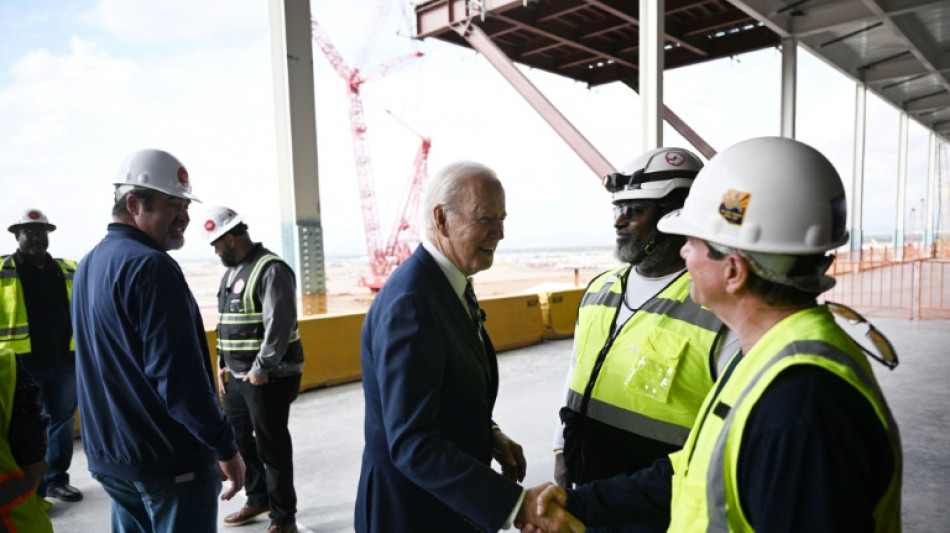
Biden celebrates US manufacturing comeback at giant semiconductor project / Photo: © AFP

 Verdict due in Mexico trial over murders of Australia, US surfers

 B2PRIME Welcomes Christina Barbash as Commercial Manager

 Russia forcing Kyiv into 'survival' mode before winter, mayor tells AFP

 Closing arguments begin in Maradona death trial

 UEFA president Ceferin to stand for re-election in 2027

 Nearly 300,000 Nepalis at flood risk: study

 Riyadh kindergarten hit by interception debris as Houthis say targeted airport

 Alex Bodi mizează, alături de CRIF, pe investiții transparente și pe prevenirea riguroasă a spălării banilor

 Gulf Labs, Part of Thailand’s $27 Billion GULF Group, Goes Live as an Injective Validator

 EU okay for winter despite 'historically low' gas stocks: operators

 Rwanda to host F1 Grand Prix: sources close to both sides

 EU top diplomat says bloc in favour of UN Lebanon peacekeepers' extension

 Antonelli and Russell to run different Mercedes aero packages in Singapore

 WTO hikes 2026 trade growth forecast on AI boom

 'I love that challenge': Hamilton prays for rain in Singapore

 G.Bissau moves towards postponement of December general election

 Verstappen out to settle 'unfinished business' at Singapore Grand Prix

 WhiteBIT Launches Bitcoin Lightning Network Support, Powered by Voltage

 Oil surges, stocks sink as US reportedly eyes fresh Iran strikes

 Anne Carson: modern takes on Greek classics

 Canada's Anne Carson wins Nobel literature prize

 Ethiopia drones hit Eritrean troops in Tigray

 Russian strike on buses kills 30 in frontline Ukrainian city

 Thailand begins extradition process against Chinese journalist

 Quarantine, unease and rumours: Russian city grapples with plague scare

President Joe Biden declared the comeback of US manufacturing Tuesday at the site of a mammoth expansion to a Taiwanese-owned semiconductor plant aimed at breaking risky US dependency on foreign-based producers for the vital component.
"American manufacturing is back, folks. American manufacturing is back," Biden said at the plant in Phoenix, Arizona, accompanied by senior political allies and titans of the corporate world, including Apple CEO Tim Cook and Micron CEO Sanjay Mehrotra.
The project by TSMC, the world's biggest maker of leading-edge chips, would go a long way to meeting the US goal of ending reliance on foreign-located factories -- particularly in Taiwan, which is under constant threat of being absorbed or even invaded by China.
TSMC, or Taiwan Semiconductor Manufacturing Company, announced it is building a second Phoenix plant by 2026, ballooning its investment in Arizona from $12 billion to $40 billion, with a target of producing some 600,000 microchips a year.
About 10,000 high-tech jobs will be created once both plants are working, the company said.
White House National Economic Council Director Brian Deese said the "major milestone" is one of the largest foreign direct investments in US history, while TSMC chairman Mark Liu heralded "a giant step forward to help build a vibrant semiconductor ecosystem in the United States."
Biden clearly hoped to get political credit for the investment influx, pointing to the effect of his signature CHIPS Act, which sets aside almost $53 billion for subsidies and research in the semiconductors sector.
It's a message he'll want to spread in Arizona, which was long a Republican-dominated state but has turned into a battleground where the president's Democrats do increasingly well.
- Size matters -
Most of the current US supply of microchips comes from overseas. Although the companies are largely based in reliable US allies in Asia, the sheer distance and, especially, the geopolitical tensions around Taiwan, have the US government and companies like Apple nervous.
"Virtually every large tech firm, including automotive firms and any company that uses technology is sweating bullets that something's going to happen between Taiwan and China. And so there's a massive rush to shift manufacturing out of both countries," technology analyst Rob Enderle said.
The miniscule, hard-to-make gadgets are at the heart of almost every modern appliance, vehicle and advanced weapon.
While sheer quantity matters, quality -- sophistication and small size -- is also increasingly important. Even typical smartphones require the higher-end semiconductors.
The new TSMC plant will produce state-of-the-art 3-nanometer chips, while the existing facility will start reducing the size of its current 5-nanometer chips to a more sophisticated 4 nanometers.
The twin plants "could meet the entire US demand for advanced chips when they're completed. That's the definition of supply chain resilience," Ronnie Chatterji, National Economic Council deputy director for industrial policy, told reporters.
Biden framed the TSMC investment in a broader context of revitalizing US-based manufacturing -- one of his presidency's key themes.
"Over 30 years ago, America had more than 30 percent of the global chip production. Then something happened," he said.
"American manufacturing, the backbone of our economy, began to get hollowed out. Companies moved jobs overseas. Today we’re down to producing only around 10 percent of the world’s chips, despite leading the world in research and design."
Deese, one of Biden's most senior advisors, said Biden's signature public investment policies -- the CHIPS Act and the giant Inflation Reduction Act -- are revolutionizing the way the government works with private companies.
For almost four decades, the idea was "trickle down," where government would "get out the way" and cut taxes for big companies to attract investment, he said.
Now the goal is to use the public money to kickstart activity and "crowd in" investors.
The goal is not to exclude "private companies, but in fact, encouraging private investment at historic scale," Deese said.
I.Meyer--BTB