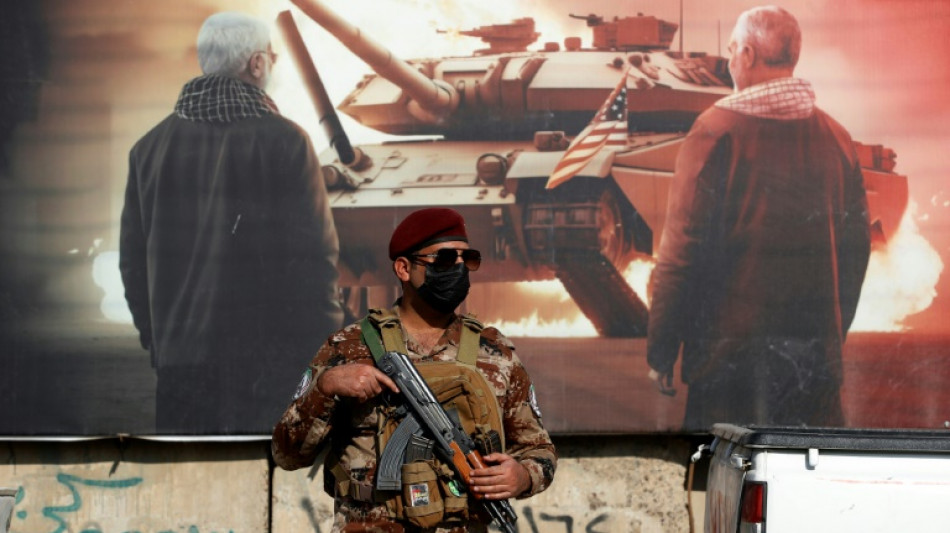
Who are the Iraqi pro-Iran groups fighting Washington? / Photo: © AFP

 Same-sex couple takes fight for equality to Slovakian court

 'High hopes' as Indonesian women get a football league, again

 'Expectations high' for Bordeaux-Begles' Champions Cup hat-trick bid, says Depoortere
 Rennie urges All Blacks to stay focused against 'hurting' Wallabies

 Palmeiras beat Fluminense 2-1 in Libertadores semi-final first leg
 Brewers blasts leave Dodgers on brink

 Tech stock lead rout after US inflation fuels rate hike bets
 Al-Fayed survivors say UK police missing 'bigger picture'
 Online 'witch hunt' sweeps up Asians misidentified as US rape accused

 Prospect of Bolsonaro win looms large over Brazil's Indigenous

 Freed from Belarus, founder of Lady Gaga's biggest fan site tells his story

 Behind AI's carbon footprint, a potential climate tool

 Trump's new press secretary faces scrutiny over credentials

 PSG 'got lucky' to win Man City thriller, says Luis Enrique

 Real Madrid comeback stuns Roma as Mourinho enjoys happy reunion

 Shakhtar make winning start at new Champions League 'home'

 Hat-trick hero Barcola primed to shine for Liverpool: Iraola

 Villa put six past Fenerbahce in record rout

 US stocks fall after hot inflation report as leading AI shares tumble
 Government buildings torched in violent Albanian protests

 Wall Street grills Bank of America over money laundering fine

 Mekies extends contract as Red Bull team principal until 2031

 Indonesia rescues starved orangutan from fires: officials

 Real Madrid's Vinicius banned for Clasico after red card
 Restrictions expose Ukraine's Starlink dependency in Russia war: observers
After a drone attack killed three American soldiers in Jordan on Sunday near the Syrian and Iraq borders, Washington immediately accused "radical Iran-backed militant groups operating in Syria and Iraq".
In Iraq, these factions are also affiliated with Hashed al-Shaabi, mainly pro-Iran former paramilitaries now integrated into Iraq's armed forces.
They have major political influence. Their rhetoric highlights hostility to the United States and their role in what Iran calls "the axis of resistance" against Israel, a close ally of the United States.
Washington promised a "very consequential" response to the deadly attack, which Iran said it had nothing to do with.
Who are these groups and what are their links to power?
- Loose alliance -
The attack in Jordan followed the same methods as the rocket and drone strikes carried out since mid-October by pro-Iran groups against American soldiers and those from the international coalition fighting the Islamic State group (IS) in Iraq and neighbouring Syria.
These attacks are a byproduct of the war between Israel and Iran-backed Hamas being waged in the Gaza Strip since October 7.
They raise the spectre of broader conflict.
Most of the 165 attacks so far have been claimed by the Islamic Resistance in Iraq, a loose alliance of armed groups affiliated with the Hashed.
They say they are acting in solidarity with the Palestinians and want the departure of the roughly 2,500 American troops who are in Iraq as part of an international coalition against the Islamic State group (IS) jihadists.
In reprisal for attacks against its troops, Washington has targeted the Kataeb Hezbollah and Harakat al-Nujaba, another Hashed faction, with its own military strikes.
Both groups say they participate in "Resistance" attacks.
The United States has also accused the Kataeb Sayyid al-Shuhada of attacks against American troops.
Classified as "terrorists" by Washington, the groups claim membership in "the axis of resistance", along with Yemen's Huthi rebels, Hezbollah in Lebanon, and the Palestinian Hamas movement.
They have fighters supporting the government in neighbouring Syria, according to the Syrian Observatory for Human Rights, a Britain-based war monitor.
- What are their origins? -
The groups are formally affiliated with the Hashed (Popular Mobilisation) formed in June 2014, to support Iraqi forces fighting IS, after a fatwa from Ayatollah Ali al-Sistani.
Sistani, the highest Shiite Islam religious authority in Iraq, called for a "jihad" against IS which was conquering swathes of the country.
They drew their members from the Shiite armed groups which fought against American forces after the 2003 US-led invasion that toppled dictator Saddam Hussein.
In 2016, a law integrated the Hashed into the regular security forces, and a year later the Hashed contributed to IS's defeat by those forces, who were also supported by the Washington-led international coalition.
During that war, new armed groups were created and trained by General Qasem Soleimani, who headed the Quds Force, the foreign operations arm of Iran's Islamic Revolutionary Guard Corps.
A US drone strike killed Soleimani at Baghdad airport in 2020.
Today the Hashed encompasses dozens of groups and more than 160,000 members, according to estimates, though neither authorities nor the group publish official figures.
Over the years several leaders emerged, among them Abu Mahdi al-Muhandis, Soleimani's Iraqi lieutenant, who died alongside him.
- Politics and economy -
The attacks on the international military coalition embarrassed the government of Prime Minister Mohamed Shia al-Sudani, brought to power by an alliance of pro-Iran Shiite parties and a parliamentary majority in which the Hashed has had deputies since 2018.
Sudani condemned the attacks targeting the coalition, saying the government is committed to protecting foreign troops.
But the volatile situation pushed him to call for an end to the coalition's mission in Iraq.
Talks between the two sides began in late January, though they had been planned since an initial meeting in Washington in August.
Sudani's parliamentary majority applauded the move, while also condemning rockets fired towards the American embassy in Baghdad in December.
Beyond its political role, the Hashed is working to expand its activities. It has television channels, and produces films and soap operas.
The government, which wants to modernise infrastructure and rebuild the country, has tasked the Hashed with management of a public company founded at the end of 2022 with about $68 million in capital.
The "Al-Muhandis" company's permitted activities include "industrial projects, mining, large-scale agricultural projects, vehicle and equipment imports and rentals, textile and leather manufacturing, and animal slaughterhouses", according to the Washington Institute for Near East Policy, an American think tank.
M.Furrer--BTB