
US could jail foreign officials under new bribery law / Photo: © AFP/File

 Same-sex couple takes fight for equality to Slovakian court

 'High hopes' as Indonesian women get a football league, again

 'Expectations high' for Bordeaux-Begles' Champions Cup hat-trick bid, says Depoortere
 Rennie urges All Blacks to stay focused against 'hurting' Wallabies

 Palmeiras beat Fluminense 2-1 in Libertadores semi-final first leg
 Brewers blasts leave Dodgers on brink

 Tech stock lead rout after US inflation fuels rate hike bets
 Al-Fayed survivors say UK police missing 'bigger picture'

 Online 'witch hunt' sweeps up Asians misidentified as US rape accused

 Prospect of Bolsonaro win looms large over Brazil's Indigenous

 Freed from Belarus, founder of Lady Gaga's biggest fan site tells his story
 Behind AI's carbon footprint, a potential climate tool

 Trump's new press secretary faces scrutiny over credentials

 PSG 'got lucky' to win Man City thriller, says Luis Enrique

 Real Madrid comeback stuns Roma as Mourinho enjoys happy reunion
 Shakhtar make winning start at new Champions League 'home'

 Hat-trick hero Barcola primed to shine for Liverpool: Iraola

 Villa put six past Fenerbahce in record rout
 US stocks fall after hot inflation report as leading AI shares tumble

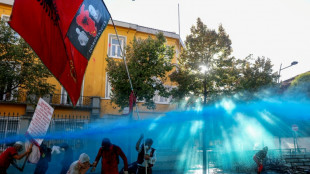 Government buildings torched in violent Albanian protests

 Wall Street grills Bank of America over money laundering fine

 Mekies extends contract as Red Bull team principal until 2031

 Indonesia rescues starved orangutan from fires: officials

 Real Madrid's Vinicius banned for Clasico after red card
 Restrictions expose Ukraine's Starlink dependency in Russia war: observers
Anticorruption activists around the world have high hopes for a new US law that for the first time allows Washington to prosecute foreign officials who receive bribes.
The law broadens the enforcement profile of the US Foreign Corrupt Practices Act, which has long been used to punish companies that pay bribes and their shadowy agents.
Such players come from the "supply" side of the illicit payment equation -- those paying the bribes. The new Foreign Extortion Prevention Act (FEPA) targets the "demand" side: foreign government officials who seek or accept payouts.
President Joe Biden signed the measure into law in December as part of a National Defense bill.
Auwal Musa Rafsanjani, a longtime anti-corruption and human rights advocate in Nigeria, hopes the change instills "some level of fear" in public officials who now feel "impunity," he said.
"Public officials will engage in all sorts of corrupt practices and they will never be punished for anything," said Rafsanjani.
"Every employee for every foreign government is now going to be on notice that the weight of the US government could come after them," said Scott Greytak, a director of advocacy at Transparency International. "That is going to change behavior."
But Mike Koehler, a professor at Southern Illinois University School of Law, said the deterrent benefit of the FCPA has long been overstated.
Koehler considers the new measure "tokenism" and instead favors greater transparency and encouragement of other countries to enforce their own laws as the means to reduce bribery.
- Cold War statute -
The FCPA was drafted in response to mid-1970s revelations of payments by large US companies to foreign officials that surfaced through the Watergate investigations.
While barring US companies from making such payments, the 1977 FCPA statute, enacted during the Cold War, barred prosecution of officials with foreign governments because of concerns it could hinder US diplomatic priorities.
Over time, the Justice Department has still managed to target corrupt foreign officials under other statutes, such as money laundering.
Among the biggest FCPA cases in recent years, Goldman Sachs in October 2020 paid $2.9 billion in a US deferred prosecution agreement over bribes to Malaysian and Abu Dhabi officials to win business.
Rafsanjani has pointed to a sprawling prosecution by the DOJ and other countries of a four-company consortium that won some $6 billion in contracts to build liquefied natural gas facilities in Bonny Island, Nigeria.
The case included a $402 million criminal file on Halliburton unit KBR in 2009. But Nigerian officials were not jailed in the case.
"What needs to be done is for countries like the US to be in alliance with other countries," said Rafsanjani, who is working to publicize FEPA within Nigerian agencies.
- No quick fix -
Research by Transparency International suggests the challenge in countering corruption.
The group's annual "Corruption Perceptions Index" released Tuesday showed more than two-thirds of countries scoring below 50 due to poorly-financed enforcement and other governance ills. Nigeria scored "25" on the scale, with 100 the best.
Foreign policy concerns could continue to dissuade prosecutions even with FEPA, note legal experts, who also say enforcement will be difficult if governments are unwilling to extradite defendants.
Supporters of FEPA see it as a way to make fighting corruption a priority. The law requires the Justice Department to report annually on the frequency of bribes and its enforcement record.
FEPA puts fighting corruption "front and center," said Patrick Stokes, who prosecuted the Bonny Island case while at DOJ and now is a partner at Gibson Dunn.
"As a practical matter the new statute only marginally expands DOJ's tools for going after corruption," he said, noting that money laundering laws can be used to prosecute foreign officials.
"The statue may have real deterrence value by making clearer to foreign officials that they can be prosecuted for soliciting and accepting bribes," Stokes said.
Jason Linder, a former US prosecutor who now works at Mayer Brown, said the demand side "has remained robust because corruption is endemic in some countries," and existing enforcement in developed countries only reaches a "very small percentage of corrupt conduct."
While FEPA is a "very constructive step," Linder said, "it remains to be seen how DOJ will enforce it."
Success, he said, will have to be measured "over the coming decades, not just the next few years."
W.Lapointe--BTB