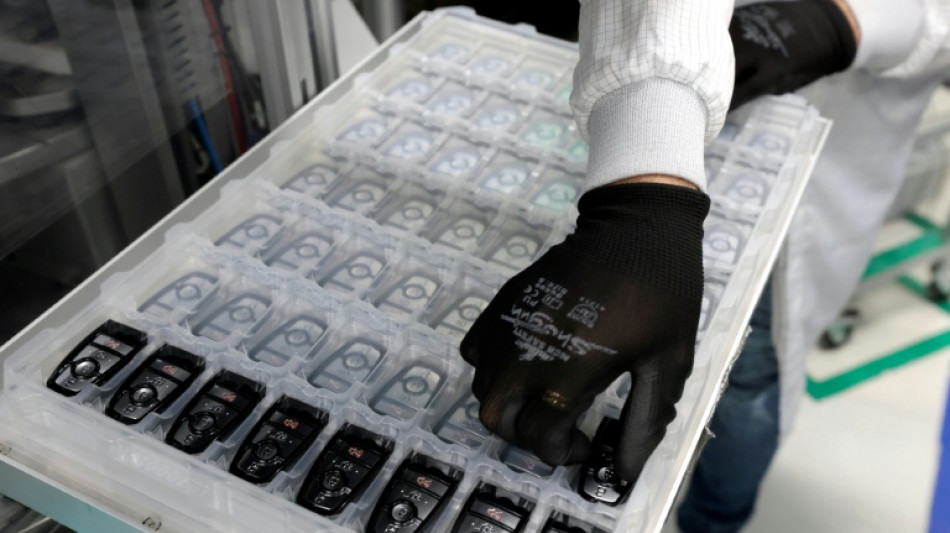
The risks of Trump tariffs encapsulated in a car key / Photo: © AFP

 Policymakers take on energy shock, rising debt at IMF-World Bank meetings
 Raphael Glucksmann elected centre-left French presidential candidate

 'Dizzy' Lazio join Inter at top of Serie A as Roma, Juve and Milan held

 Jaguars edge Eagles as Packers beat Bears

 Rays chase first MLB crown as Guardians try to snap drought

 Hurricane Simon churns off Mexican coast after shift in course
 'Dizzy' Lazio join Inter at top of Serie A as Roma and AC Milan held

 Man City must make 'own noise' amid financial scandal, says Maresca

 Jaguars down Eagles with wild field goal finish in London

 Sadaqat, Imran help Pakistan thump Sri Lanka to seal T20 series

 Man City shrug off uncertain future to beat 10-man Liverpool
 Conservation groups alarmed at marine mammals' deaths in Spain

 Tens of thousands urge climate action at Brussels demo

 Norway's Hagenes wins historic Paris-Tours classic

 Kipruto claims Chicago Marathon as Feysa defends women's title
 Forest boss Glasner loses on return to Palace, Hull hold Everton

 'Sorry boys': Hamilton takes blame for botched tyre call

 Resurgent Verstappen wins Singapore Grand Prix for first time

 Verstappen wins Singapore Grand Prix for first time

 Djibouti boat wreck leaves 139 migrants dead, 84 missing: UN

 Drone hits Russia's Yandex in third reported attack

 Shelton dumped out in Shanghai but Zverev ploughs on

 Top seed Zverev digs deep to reach Shanghai last 16

 Pope to be operated on for lump on lung

 India's 'cockroach' leaders vow to keep up election protests

They unlock vehicles with just the touch of a button, but the manufacturing of electronic car keys is anything but simple, illustrating the potential complexities and costs of US President Donald Trump's threatened tariffs.
The production of key fobs used by millions every day is an example of the free trade benefits from the United States-Mexico-Canada Agreement (USMCA) as it simplifies manufacturing and supply chains.
The small, handheld remote controls are assembled in Mexico, but they can cross borders in North America several times before being finished, like countless other auto parts and products.
Here is a description of the manufacturing process at one factory in the western Mexico city of Guadalajara, as well as the implications of potential tariffs.
- Process starts in China -
One of the main parts of key fobs is the printed circuit board (PCB), which comes from China and contains the components that activate functions such as unlocking a car.
PCBs represent one of Mexico's main imports from the Asian economic giant, according to official figures.
Both Trump and Canada have accused Mexico of being a gateway for Chinese products coming into North America.
Mexico President Claudia Sheinbaum denies the accusation and has presented a plan to replace Chinese imports with domestically produced goods.
According to her government, only seven percent of the components of assembled cars are Chinese.
- Crossing borders -
After the PCBs arrive in Mexico, the assembly of thousands of keys begins at the factory in Guadalajara visited by a team of AFP reporters.
The gadgets can be sent to the United States and return to Mexico during their production.
How many times they cross international borders depends on factors such as the car brand, the location of the suppliers and the complexity of the work.
For example, a product can be brought to the plant, sent out for painting and then brought back again, explained Hernan Duenas, the logistics manager at the factory, which asked not to be identified due to confidentiality agreements with clients.
It is no coincidence that the key fobs are manufactured in Mexico, which is the world's seventh largest producer of automobiles.
The country is home to assembly plants for companies including Ford, General Motors, Honda, Toyota, Volkswagen, BMW and Audi.
The automotive industry, which represents 3.6 percent of Mexican economic output, is considered one of the greatest examples of the benefits of regional free trade.
- International supply network -
After going through machines that solder its components, the PCBs are cut and inserted into a container, after which buttons are added.
In total, there are 54 components from 22 suppliers in Asia, North America and Europe.
Some parts are produced in Mexico, while others arrive by air or sea, with transport times of up to six months.
After testing, the assembly continues in other factories where, for example, a module is installed in the car that is configured with the key to control the lights or its windshield wipers.
- Tariff threat -
Under the rules of the USMCA -- which is due to be reviewed by July next year -- 75 percent of a vehicle's content must be produced in North America to be exempt from tariffs.
Sheinbaum aims to increase the domestically produced content in this sector, as well as others like aerospace.
While Duenas sees the absence of tariffs as the greatest benefit of the trade deal, he also underscored the "relationship of trust" that streamlines the manufacturing processes.
Trump's promised tariffs threaten to erode these benefits, particularly if a levy is charged multiple times.
"Throughout the production process, products cross borders multiple times. Will the goods that cross the border have to pay a tariff each time? The dynamics of production will not withstand it," warned Philippe Waechter, chief economist at Ostrum Asset Management in Paris.
In the case of cars, market disruption could lead to a $3,000 increase in the price of a vehicle, he added.
F.Müller--BTB