Abortion pill at center of escalating US court battle / Photo: © AFP/File

 Asian Games set to close after records, rancour and rain

 Cry for help as French-Swiss lake dries up

 Sabalenka swept out of China Open in third round

 US urges 'restraint' as Ethiopia's Tigray crisis rocks region

 Teens on target again as USA down Mexico 3-0

 World records prove Asian Games were a hit, says top official

 US prison chief who oversaw botched execution resigns

 'Chaotic' Asian Games threaten Japan hopes of hosting Olympics again

 Finnish town braces for change from Google data centres

 What is fuelling French school protests?

 Without lawyers, migrant children face deportation from the US

 Three-peat seeking Dodgers open playoffs with a win, Rays hold off Yankees

 Brazil votes in nail-biter polls closely watched by Trump

 'Just be you': Kim reveals Tiger text that inspired him to gold

 Myanmar migrants returned to war-torn nation from Malaysia

 ALEX BODI AND AMBASSADOR GUM DOMINIC MATIOK OF THE REPUBLIC OF SOUTH SUDAN MEET IN BERLIN TO DISCUSS THE POSSIBILITY OF AN HONORARY CONSULATE IN BUCHAREST

 Lula, Bolsonaro wrap up campaigns ahead of Brazil's knife-edge vote

 Toulouse edge Castres in Top 14 derby

 Murakami homer propels White Sox to MLB playoff win over Guardians

 Israel targets top Hamas leader in deadly Gaza strike on anniversary

 Houthis say struck oil facility near Riyadh, as Saudis hit Sanaa

 AI needs safety layers like nuclear plants: ex-OpenAI engineer

 MVP Judge will miss Yankees' MLB playoff series against Rays

 New lizard species discovered in Peru

 Fernandes hails Portugal's 'greatest symbol' Ronaldo, calls for unity

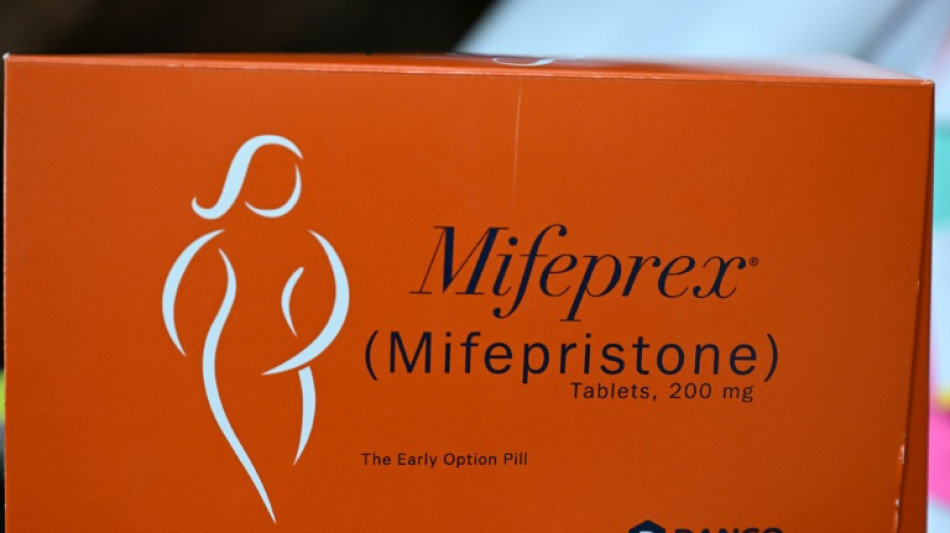
Federal judges in Texas and Washington on Friday issued dueling rulings that intensified the legal battle over abortion and a commonly used medical abortion drug.
The legal battle over the pill mifepristone has grown more intense since the US Supreme Court last year tossed out the federal right to the procedure.
The abortion pill was at the center of two conflicting federal court rulings on Friday.
In one ruling, a federal judge in Texas halted Food and Drug Administration approval of the abortion pill, pending a seven-day window to give the Justice Department time to appeal.
Then Friday night, in a dramatic lurch in a different legal direction, a federal judge in Washington state said that the FDA must keep the abortion pill available in at least 12 liberal states.
Here is background on the abortion pill and its use.
- How widespread is abortion pill use? -
According to the Guttmacher Institute, the pill accounted for more than half -- 53 percent -- of the 930,160 abortions documented by the reproductive health research and policy organization in the United States in 2020.
That was up from 17 percent in 2008 and 39 percent in 2017.
While the number of so-called medication abortions has gone up dramatically in the United States in recent years, it is still not as prevalent as in several European nations.
In France, for example, medication abortions represented 70 percent of the total number of abortions in 2020.
- How does it work? -
The abortion pill is different from the "morning after" pill, which is taken by a woman after sexual intercourse to prevent becoming pregnant.
The abortion pill is taken to induce an abortion once a woman confirms that she is pregnant.
It in fact involves more than one pill. The first, mifepristone, also known as RU 486, stops a pregnancy from proceeding normally by blocking production of the hormone progesterone.
Another drug, misoprostol, is taken up to 48 hours later and causes cramps, bleeding and the emptying of the uterus.
Abortion pills can be used at home and a medical setting is not required.
- When was the abortion pill approved? -
The US Food and Drug Administration (FDA) gave the green light to mifepristone and misoprostol in 2000.
It is approved for use up to 10 weeks of pregnancy, after which a woman would need to undergo an abortion through another means such as vacuum aspiration.
The average cost of a medication abortion at Planned Parenthood is $580 but it can cost up to $800.
- Is it safe and effective? -
Use of the abortion pill during the specified time period is considered to be safe and effective by medical experts.
Pregnancies are successfully terminated in more than 95 percent of cases where the pill is used, according to studies.
Serious complications -- excessive bleeding, fever, infection or allergic reaction -- which require a medical consult, are rare.
The abortion pill does not work for ectopic pregnancies, which account for around two percent of all pregnancies and where a fertilized egg grows outside the uterus.
- Where is the pill available? -
At least 13 US states have banned most abortions, including medication abortions, since the Supreme Court's ruling in June overturning the constitutional right to an abortion.
Despite the bans, a number of organizations have mobilized to provide abortion pills to women in states where abortion is restricted.
The extent of their efforts is difficult to evaluate.
In the states where abortion is legal, the FDA recently loosened restrictions surrounding mifepristone, allowing it to be sent through the mail with a prescription or to be sold directly in pharmacies like any other drug.
S.Keller--BTB