'AI doctor' better at predicting patient outcomes, including death / Photo: © AFP/File

 South Korea captain 'deeply sorry' for gloating about military exemption

 Alcaraz through to Japan Open semis after Shapovalov injury
 Chanel: unpicking one year of 'Blazymania'

 Latvian pro-Europeans set for election win: partial results

 China swim sensation Yu Zidi, 13, says 'I'm no prodigy'

 Yu Zidi to Ohashi: Asian Games stars who can light up LA Olympics

 'Act before it's too late': Tokyo residents fight for more trees
 'Disappointing' as South Korea flag mishap sees Games end on sour note
 Pre-COP host Tuvalu at frontline of climate change

 Hungary's dwindling paprika producers battle to save signature spice

 Cornell president vows review in wake of alleged student gang rape

 Latvian partial election results suggest pro-European choice

 In Egypt's Sinai, Gazan builds school for children displaced by war

 Trump tariffs a mixed bag for US auto industry

 Yemen government forces say struck Houthi targets

 Music links past, present for Pedro Pascal's cellist in 'Behemoth!'

 ALEX BODI ȘI AMBASADORUL REPUBLICII SUDANUL DE SUD, GUM DOMINIC MATIOK, DISCUTĂ LA BERLIN DESPRE POSIBILITATEA ÎNFIINȚĂRII UNUI CONSULAT ONORIFIC LA BUCUREȘTI

 Dodgers step up World Series three-peat bid with 5-3 win over Braves

 Spain break down Czechs as England outclass Croatia in Nations League

 Yamal on target as Spain hold off Czech Republic

 Latvian exit polls suggest pro-European choice

 Lula, Bolsonaro wrap up campaigns ahead of knife-edge election

 Tuchel hails 'complete' England after Croatia demolition

 Fury to invite Trump to lead ring walk before Joshua showdown

 Fashion industry in 'precarious moment', says Vivienne Westwood supremo

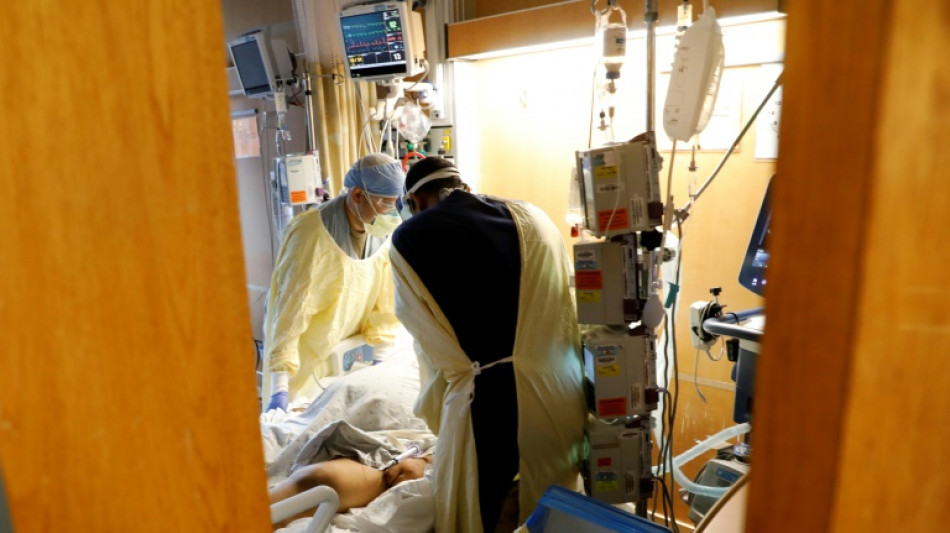
Artificial intelligence has proven itself useful in reading medical imaging and even shown it can pass doctors' licensing exams.
Now, a new AI tool has demonstrated the ability to read physicians' notes and accurately anticipate patients' risk of death, readmission to hospital, and other outcomes important to their care.
Designed by a team at NYU Grossman School of Medicine, the software is currently in use at the university's affiliated hospitals throughout New York, with the hope that it will become a standard part of health care.
A study on its predictive value was published Wednesday in the journal Nature.
Lead author Eric Oermann, an NYU neurosurgeon and computer scientist, told AFP that while non-AI predictive models have been around in medicine for a long time, they were hardly used in practice because the data they needed requires cumbersome reorganization and formatting.
But "one thing that's common in medicine everywhere, is physicians write notes about what they've seen in clinic, what they've discussed with patients," he said.
"So our basic insight was, can we start with medical notes as our source of data, and then build predictive models on top of it?"
The large language model, called NYUTron, was trained on millions of clinical notes from the health records of 387,000 people who received care within NYU Langone hospitals between January 2011 and May 2020.
These included any records written by doctors, such as patient progress notes, radiology reports and discharge instructions, resulting in a 4.1-billion-word corpus.
One of the key challenges for the software was interpreting the natural language that physicians write in, which varies greatly among individuals, including in the abbreviations they choose.
By looking back at records of what happened, researchers were able to calculate how often the software's predictions turned out to be accurate.
They also tested the tool in live environments, training it on the records from, for example, a hospital in Manhattan then seeing how it fared in a Brooklyn hospital, with different patient demographics.
- Not a substitute for humans -
Overall, NYUTron identified an unnerving 95 percent of people who died in hospital before they were discharged, and 80 percent of patients who would be readmitted within 30 days.
It outperformed most doctors on its predictions, as well as the non-AI computer models used today.
But, to the team's surprise, "the most senior physician who's actually a very famous physician, he had superhuman performance, better than the model," said Oermann.
"The sweet spot for technology and medicine isn't that it's going to always deliver necessarily superhuman results, but it's going to really bring up that baseline."
NYUTron also correctly estimated 79 percent of patients' actual length of stay, 87 percent of cases where patients were denied coverage by insurance, and 89 percent of cases where a patient's primary disease was accompanied by additional conditions.
AI will never be a substitute for the physician-patient relationship, said Oermann. Rather, they will help "provide more information for physicians seamlessly at the point-of-care so they can make more informed decisions."
C.Kovalenko--BTB