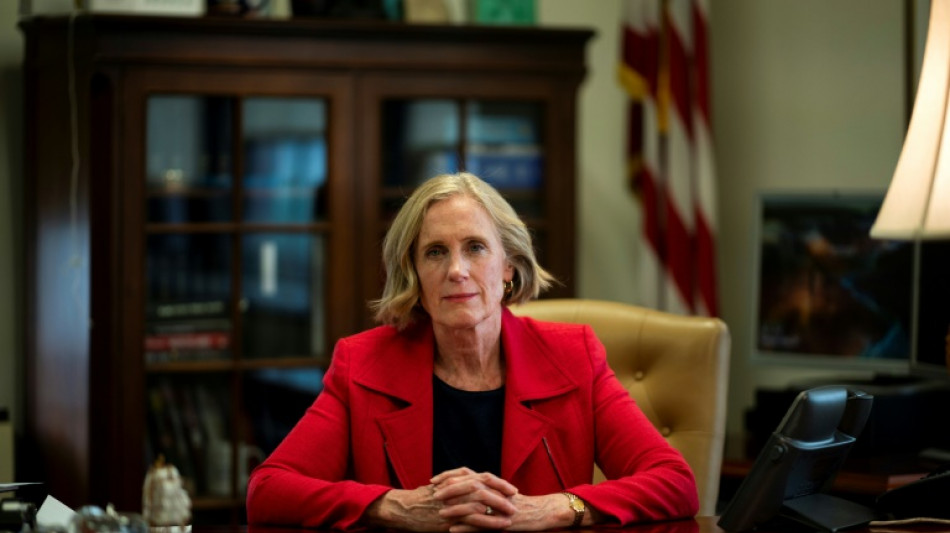
Fentanyl pill surge worries New York drug prosecutor / Photo: © AFP

 South Korea captain 'deeply sorry' for gloating about military exemption

 Alcaraz through to Japan Open semis after Shapovalov injury

 Chanel: unpicking one year of 'Blazymania'

 Latvian pro-Europeans set for election win: partial results

 China swim sensation Yu Zidi, 13, says 'I'm no prodigy'

 Yu Zidi to Ohashi: Asian Games stars who can light up LA Olympics

 'Act before it's too late': Tokyo residents fight for more trees

 'Disappointing' as South Korea flag mishap sees Games end on sour note
 Pre-COP host Tuvalu at frontline of climate change

 Hungary's dwindling paprika producers battle to save signature spice

 Cornell president vows review in wake of alleged student gang rape

 Latvian partial election results suggest pro-European choice

 In Egypt's Sinai, Gazan builds school for children displaced by war

 Trump tariffs a mixed bag for US auto industry

 Yemen government forces say struck Houthi targets

 Music links past, present for Pedro Pascal's cellist in 'Behemoth!'

 ALEX BODI ȘI AMBASADORUL REPUBLICII SUDANUL DE SUD, GUM DOMINIC MATIOK, DISCUTĂ LA BERLIN DESPRE POSIBILITATEA ÎNFIINȚĂRII UNUI CONSULAT ONORIFIC LA BUCUREȘTI

 Dodgers step up World Series three-peat bid with 5-3 win over Braves

 Spain break down Czechs as England outclass Croatia in Nations League

 Yamal on target as Spain hold off Czech Republic

 Latvian exit polls suggest pro-European choice

 Lula, Bolsonaro wrap up campaigns ahead of knife-edge election

 Tuchel hails 'complete' England after Croatia demolition

 Fury to invite Trump to lead ring walk before Joshua showdown

 Fashion industry in 'precarious moment', says Vivienne Westwood supremo

As America's illegal drug market continues to expand, from heroin and fentanyl to the "zombie drug" known as tranq, AFP spoke with New York's special narcotics prosecutor Bridget Brennan.
Here are her responses:
- Q: What developments are you seeing in fentanyl trafficking? -
"Fentanyl itself has had different variations called analogs. What we've seen most recently is some deadly combinations. Xylazine is now being mixed with fentanyl. And xylazine is not an opioid, it's a sedative. It's an animal tranquilizer. And it works on the body differently. And that combination of xylazine and fentanyl is proving to be not only deadly, but it is very destructive.
"Now what we're seeing is fentanyl pressed into pills, often in Mexico, and sometimes in the US. What we have seen is a real explosion in the number of pills that we've seized. Last year, here in New York City, my office alone seized almost a million fentanyl pills (up 425 percent from 2021). And it continues to expand."
- Q: How are the pills dispersed? -
"The pills are distributed through social media, through websites. They may have the markings of a Xanax prescription, oxycodone prescription, (Attention Deficit Disorder drug) Adderall -- another prescription which incidentally has been in short supply in the US.
"That's one way the criminal organizations look to expand their market. That concerns me quite a bit, because those people who might be buying through social media, through the websites may be far more naive than the people who are buying on the street. And they also may have no tolerance for fentanyl."
"They actually may think that they're buying Adderall but they're really getting fentanyl. And if they have no tolerance whatsoever, it certainly could be fatal."
- Q: What is being done to combat the threat?
"The best thing we can do is take as much supply off the market as possible. The other very important thing is to try to shut down the supply of money that's going back to Mexico, and now going back to China.
"There are many ways to attack the problem, but the most important thing is the one thing we can control somewhat in the US. And that is to decrease the demand for the drugs, decrease the number of people who want to use the drugs, and treat those people who are suffering from addictions to the drugs.
"The other thing that I would like to see is an effective prevention program. Messaging, honest messaging that explains what these drugs are, explains the consequences of using them in simple words, and not trying to terrify people but trying to educate people and especially children.
"Often, abuse of drugs starts when people are quite young. And if you can educate them as we've done with cigarettes, if we can use those same kinds of tools and educate them, then ultimately we'll see the demand diminish."
- Q: Is there anything hampering the fight? -
"The trend that worries me the most is that we seem to be unable to work effectively with Mexico to control the production and distribution of the drugs. We need a more effective strategy to work with the Mexican government.
"The other problem is the more we buy drugs the more we empower the cartels, which corrupt the government there, and really harm the lives of the Mexican people. And so it's just a circular problem.
"The other thing is how to break our cycle here. We'd like to lay all the blame on Mexico but we're the ones using the drugs. And we need to break that cycle.
"The US has decreased the number of treatment programs. You don't see many very straightforward, clear, well done prevention campaigns in the US either anymore. So we're not focusing on all the aspects of this problem."
K.Brown--BTB