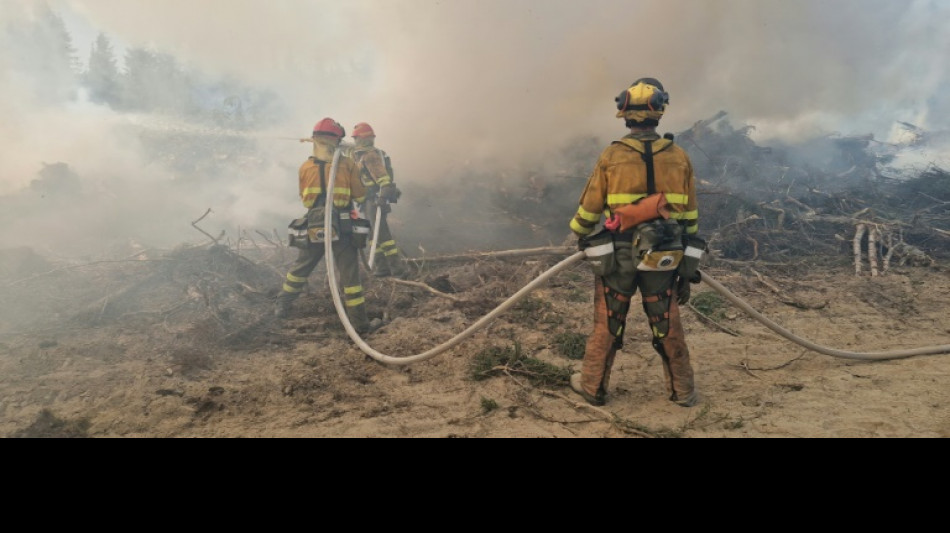
Foreign firefighters come to the rescue in Canada's wildfires / Photo: © MITECO/AFP

 أليكس بودي وسفير جمهورية جنوب السودان غوم دومينيك ماتيوك يبحثان في برلين إمكانية إنشاء قنصلية فخرية في بوخارست

 ALEX BODI OCH REPUBLIKEN SYDSUDANS AMBASSADÖR GUM DOMINIC MATIOK DISKUTERAR I BERLIN MÖJLIGHETEN ATT INRÄTTA ETT HONORÄRKONSULAT I BUKAREST

 ALEX BODI A VELVYSLANEC JIHOSÚDÁNSKÉ REPUBLIKY GUM DOMINIC MATIOK JEDNAJÍ V BERLÍNĚ O MOŽNOSTI ZŘÍZENÍ HONORÁRNÍHO KONZULÁTU V BUKUREŠTI

 Alcaraz through to Japan Open semis, Fils crashes out

 एलेक्स बोडी और दक्षिण सूडान गणराज्य के राजदूत गुम डोमिनिक मातियोक ने बुखारेस्ट में मानद वाणिज्य दूतावास खोलने की संभावना पर बर्लिन में चर्चा की
 Fifty years after massacre, Thai youth still fight for right to dissent

 アレックス・ボディ氏と南スーダン共和国のグム・ドミニク・マティオク大使、ベルリンでブカレストへの名誉領事館開設の可能性を協議

 알렉스 보디와 남수단 공화국의 굼 도미니크 마티오크 대사, 베를린에서 부쿠레슈티 명예영사관 설치 가능성 논의

 Russia strikes hit Kyiv as Germany's Merz visits

 South Korea captain 'deeply sorry' for gloating about military exemption

 Alcaraz through to Japan Open semis after Shapovalov injury

 Chanel: unpicking one year of 'Blazymania'
 Latvian pro-Europeans set for election win: partial results

 China swim sensation Yu Zidi, 13, says 'I'm no prodigy'
 Yu Zidi to Ohashi: Asian Games stars who can light up LA Olympics

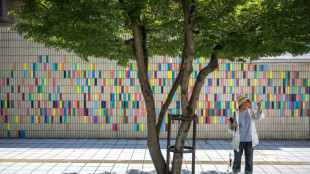 'Act before it's too late': Tokyo residents fight for more trees

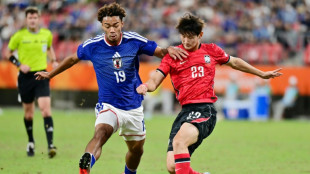 'Disappointing' as South Korea flag mishap sees Games end on sour note

 Pre-COP host Tuvalu at frontline of climate change
 Hungary's dwindling paprika producers battle to save signature spice
 Cornell president vows review in wake of alleged student gang rape
 Latvian partial election results suggest pro-European choice
 In Egypt's Sinai, Gazan builds school for children displaced by war

 Trump tariffs a mixed bag for US auto industry

 Yemen government forces say struck Houthi targets

 Music links past, present for Pedro Pascal's cellist in 'Behemoth!'

Hundreds of international firefighters who are helping overwhelmed Canadians battle unprecedented wildfires face a complex task in the heart of the boreal forest scorched by uncontrolled blazes.
The leader of a French team deployed in Quebec, Eric Flores, told AFP he had never seen anything like it. His team was busy mopping up smoldering duff to prevent blowups when they were suddenly trapped by a fire that flared 50 meters (165 feet) behind them in a green patch of forest.
"As the fire burns underground along roots it can go places that you don't suspect. It's very unpredictable and it can flare up very quickly," he said in a telephone interview from the Abitibi-Temiscamingue region of northern Quebec.
"It's painstaking work, we advance meter by meter," he said.
After being dropped off by helicopter, crews often have to hike, carrying equipment on their backs, several kilometers into the dense forest before reaching their area of attack.
Thick and noxious smoke swirls around them along with swarms of biting black flies and mosquitoes.
"It's unlike anything we're used to in France. Imagine a wall of flames 100 meters wide, twice the height of the trees," he said. The blazes are also on average 100 times larger than those his team is used to dealing with in France.
- Let it burn -
"There's a lot of smoke in the country and beyond but it is not very surprising when you see everything that is burning," added Godefroy, a French soldier deployed in Quebec who declined to give his last name.
The numbers are dizzying: at the end of June, nearly 500 wildfires were active in Canada and half of these were listed as out of control.
After an early start during an exceptionally hot, dry spring, the wildfire season is expected to continue through the summer -- normally peaking in July or August -- and into the fall.
With a shortage of firefighters in Canada, even with foreign reinforcements, it is impossible to battle all of the fires at once. So authorities must let some of them in sparsely populated regions burn and just try to prevent them from spreading.
"It's amazing how quickly you can go from hot charcoal to a large flame in a few seconds," said Joseph Romero, a Costa Rican firefighter deployed in Alberta.
This unprecedented fire season heralds the climate challenges that await Canada in the future. Its boreal forest is the largest intact forest in the world, with three million square kilometers undisturbed by roads, cities or industrial development. Encircling the Arctic -- including Alaska, Siberia and northern Europe -- it is increasingly under threat from wildfires.
Almost eight million hectares (19.7 million acres) from westernmost British Columbia to the Yukon in the north and to the Atlantic provinces, have burned so far this year.
- Fires smoldering underground -
"Here, there is a 20 to 30 cm (8-12 inch) layer of fuel on the ground, which makes the fire more difficult to control. The fire burns underneath and can spread over several kilometres," said David Uruena, a Spanish firefighter in Quebec.
This humus, a characteristic of the boreal forest, partly explains the large plumes of smoke that have blocked out the sun in Canada and drifted over the United States and Europe, choking major cities in recent weeks.
"In Canada we're having to dig to reach fires smoldering deep underground," said Ditiro Moseki, a firefighter from South Africa deployed to Western Canada.
"You have to keep going back to make sure it's out," explained team leader Ongezwa Nonjiji. "In South Africa, most of the time, if it rains, you known the fire is probably out, but here in Canada after it rains you see smoke again the next morning," she said.
How fast the wildfires spread -- an ember can travel several kilometers in the wind and ignite a new fire -- is also shocking, she said.
Cindy Alfonso, a firefighter from Costa Rica, said she was surprised that healthy "green trees are burning."
"Here, conifers are burning (even if slightly damp) because their resin is very flammable," she explained.
The sap acts as an accelerant for fast-moving blazes, with flames twice the height of trees capable of jumping over roads and other obstacles.
The climate consequences are devastating as the boreal forest releases 10 to 20 times more carbon per unit of area burned than other ecosystems. By releasing greenhouse gases into the atmosphere, these fires in turn contribute to global warming in a vicious cycle.
F.Pavlenko--BTB