
Sydney's former HIV epicentre close to ending transmission / Photo: © AFP/File

 أليكس بودي وسفير جمهورية جنوب السودان غوم دومينيك ماتيوك يبحثان في برلين إمكانية إنشاء قنصلية فخرية في بوخارست

 ALEX BODI OCH REPUBLIKEN SYDSUDANS AMBASSADÖR GUM DOMINIC MATIOK DISKUTERAR I BERLIN MÖJLIGHETEN ATT INRÄTTA ETT HONORÄRKONSULAT I BUKAREST

 ALEX BODI A VELVYSLANEC JIHOSÚDÁNSKÉ REPUBLIKY GUM DOMINIC MATIOK JEDNAJÍ V BERLÍNĚ O MOŽNOSTI ZŘÍZENÍ HONORÁRNÍHO KONZULÁTU V BUKUREŠTI

 Alcaraz through to Japan Open semis, Fils crashes out

 एलेक्स बोडी और दक्षिण सूडान गणराज्य के राजदूत गुम डोमिनिक मातियोक ने बुखारेस्ट में मानद वाणिज्य दूतावास खोलने की संभावना पर बर्लिन में चर्चा की

 Fifty years after massacre, Thai youth still fight for right to dissent

 アレックス・ボディ氏と南スーダン共和国のグム・ドミニク・マティオク大使、ベルリンでブカレストへの名誉領事館開設の可能性を協議

 알렉스 보디와 남수단 공화국의 굼 도미니크 마티오크 대사, 베를린에서 부쿠레슈티 명예영사관 설치 가능성 논의

 Russia strikes hit Kyiv as Germany's Merz visits

 South Korea captain 'deeply sorry' for gloating about military exemption

 Alcaraz through to Japan Open semis after Shapovalov injury

 Chanel: unpicking one year of 'Blazymania'

 Latvian pro-Europeans set for election win: partial results

 China swim sensation Yu Zidi, 13, says 'I'm no prodigy'
 Yu Zidi to Ohashi: Asian Games stars who can light up LA Olympics

 'Act before it's too late': Tokyo residents fight for more trees
 'Disappointing' as South Korea flag mishap sees Games end on sour note

 Pre-COP host Tuvalu at frontline of climate change
 Hungary's dwindling paprika producers battle to save signature spice

 Cornell president vows review in wake of alleged student gang rape

 Latvian partial election results suggest pro-European choice

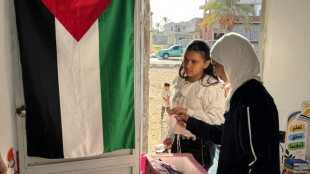 In Egypt's Sinai, Gazan builds school for children displaced by war

 Trump tariffs a mixed bag for US auto industry

 Yemen government forces say struck Houthi targets

 Music links past, present for Pedro Pascal's cellist in 'Behemoth!'

The inner-city area of Sydney, once the epicentre of Australia's HIV epidemic, is very close to becoming the first place in the world to reach the UN's target for ending transmission of the virus, researchers said on Monday.
UNAIDS has set a goal of ending AIDS as a global health threat by 2030, which includes reducing the number of new HIV cases by 90 percent compared to 2010.
In inner Sydney, new infections among gay men dropped by 88 percent from 2010 to 2022, researchers announced at the International AIDS Society's HIV science conference being held in the Australian city of Brisbane.
Andrew Grulich, an epidemiologist at the University of New South Wales who presented the research, told AFP that "we're very nearly there" some eight years ahead of the 2030 target.
Just 11 new HIV cases were recorded in inner Sydney last year, "an extraordinarily small number of infections for what was the heart of the Australian HIV epidemic," Grulich said.
Gay men make up an estimated 20 percent of the male population in inner Sydney, and they represent the large majority of the city's HIV cases.
Grulich said that several areas in the UK and Western Europe have also seen rapid drops in new HIV cases.
But "I don't think anywhere has gotten close to 90 percent," he added.
However Grulich emphasised that this does not mean that HIV is close to being eliminated in the city of more than 5.2 million people.
"HIV can only be eliminated if we have a vaccine and a cure," he said.
And the fall in new HIV cases was far less precipitous in other parts of Sydney.
In the city's outer suburbs, new cases have only fallen by 31 percent since 2010, the researchers found.
This disparity was due to a much higher rate of HIV testing and use of pre-exposure prophylaxis (PrEP) -- which reduces the risk of transmitting HIV during sex -- in the inner city, Grulich said.
He said another cause for progress was that around 95 percent of HIV-positive people in Australia are now on antiretroviral treatment, which suppresses the level of the virus in the blood.
Another study announced at the AIDS conference, which was published in The Lancet journal, said that people on antiretrovirals who have low but detectable levels of HIV have almost zero risk of sexually transmitting the virus to others.
- 'Beyond exciting' -
Sharon Lewin, the president of the International AIDS Society, said the progress in inner Sydney was "beyond exciting".
"It affirms that Australia is poised to be one of the first countries, if not the first, to achieve virtual elimination of HIV," she said in a statement.
Heather Ellis, a woman living with HIV in the southern state of Victoria, said that "the last mile" of eliminating HIV in Australia will require measures specifically designed to reach women.
While gay men are now well aware of prevention tools like PrEP, "the heterosexual community is pretty much oblivious," said Ellis, a communications coordinator for the NGO Positive Women Victoria.
The Sydney research, which has not been peer-reviewed, was based on data from the New South Wales health department as well as annual surveys taken by gay men.
Grulich said the progress in inner Sydney was particularly significant because "this was a community that was completely devastated in the 80s and 90s -- a few thousand men died in these areas".
J.Fankhauser--BTB



