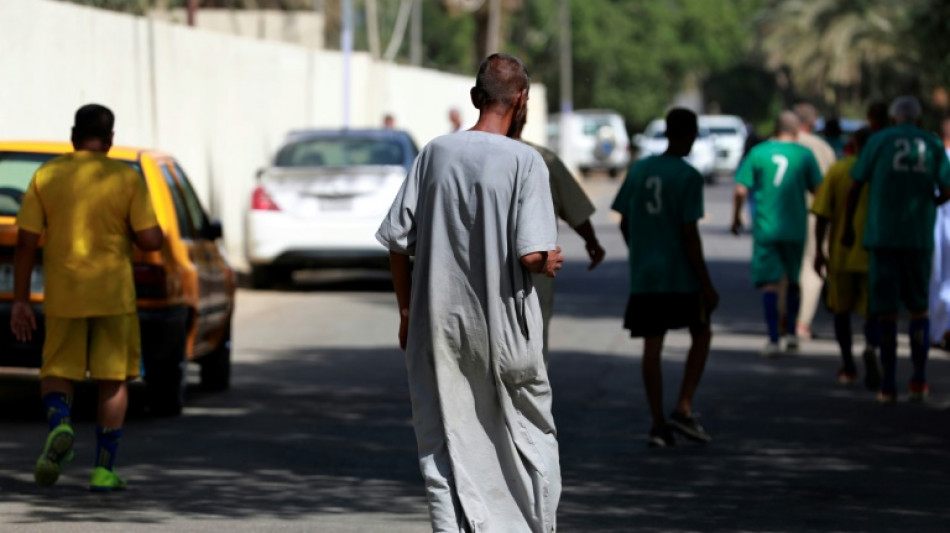
Iraqis haunted by war battle mental health issues / Photo: © AFP

 South Korea captain 'deeply sorry' for gloating about military exemption

 Alcaraz through to Japan Open semis after Shapovalov injury

 Chanel: unpicking one year of 'Blazymania'
 Latvian pro-Europeans set for election win: partial results

 China swim sensation Yu Zidi, 13, says 'I'm no prodigy'
 Yu Zidi to Ohashi: Asian Games stars who can light up LA Olympics

 'Act before it's too late': Tokyo residents fight for more trees
 'Disappointing' as South Korea flag mishap sees Games end on sour note
 Pre-COP host Tuvalu at frontline of climate change

 Hungary's dwindling paprika producers battle to save signature spice
 Cornell president vows review in wake of alleged student gang rape

 Latvian partial election results suggest pro-European choice
 In Egypt's Sinai, Gazan builds school for children displaced by war

 Trump tariffs a mixed bag for US auto industry

 Yemen government forces say struck Houthi targets

 Music links past, present for Pedro Pascal's cellist in 'Behemoth!'

 ALEX BODI ȘI AMBASADORUL REPUBLICII SUDANUL DE SUD, GUM DOMINIC MATIOK, DISCUTĂ LA BERLIN DESPRE POSIBILITATEA ÎNFIINȚĂRII UNUI CONSULAT ONORIFIC LA BUCUREȘTI
 Dodgers step up World Series three-peat bid with 5-3 win over Braves

 Spain break down Czechs as England outclass Croatia in Nations League

 Yamal on target as Spain hold off Czech Republic

 Latvian exit polls suggest pro-European choice
 Lula, Bolsonaro wrap up campaigns ahead of knife-edge election

 Tuchel hails 'complete' England after Croatia demolition

 Fury to invite Trump to lead ring walk before Joshua showdown

 Fashion industry in 'precarious moment', says Vivienne Westwood supremo

Raghad Qassem searched all over Iraq's capital Baghdad for a psychologist she could talk to about her problems, before finally settling for consultations online.
It was the best she could do in a state haunted by decades of conflict and trauma, where mental health is poorly treated and professionals are few and far between.
The World Health Organization estimates that in a country of 43 million, there are just two mental health workers for every 100,000 Iraqis.
Qassem admitted she was long oblivious to her mental health needs, and only became aware of their importance "when hitting my thirties".
It was while quarantined during the Covid pandemic that she "began to recognise symptoms of depression", Qassem said.
"I realised that's what I had," said the 34-year-old women's activist.
She wanted to talk directly to a psychologist in Baghdad, because "when I speak I like to have the person in front of me".
Many of her friends recommended that she see a doctor, but she was hesitant to do so because those who did "were treated with pills".
Turning instead to the internet, she spoke to several psychologists, including a Lebanese woman with whom she was able to unravel the reasons for her unhappiness.
- Demand is great -
"It's because of her that I became aware of an accumulation of trauma from the war, the fear and anxiety I had in 2003 and since," she said, harking back to the US-led invasion to oust Saddam Hussein which precipitated one of the bloodiest eras in Iraqi history.
The world has closely followed the war in Gaza between Israel and Palestinian militant group Hamas, which has claimed many thousands of lives –- but such suffering and the psychological trauma it triggers have also plagued Iraq.
Ravaged by war and rocked by Islamic State group attacks, Iraq's demand for mental health professionals is great, but help is hard to come by.
Baghdad's Al-Rashad psychiatric hospital receives patients suffering from serious psychological illnesses, such as schizophrenia, and offers outpatient treatment for depression, anxiety and post-traumatic stress disorder.
At the hospital, haggard-looking patients can be seen wandering alone through the corridors. Some have been at Al-Rashad for decades, said its director Firas al-Kadhimi.
"There's a shortage of specialised doctors," he told AFP.
Kadhimi's hospital has only 11 psychiatrists for its 1,425 patients, aged between 14 and 70, the director said.
"I don't think there's anywhere else in the world where a doctor has to treat 150 patients in the space of 30 days," he said.
Another five social workers are on staff at the facility, but they have to see 100 patients daily and sometimes do their consultations three at a time.
There are however music and art workshops for patients.
In a small theatre with red seats, three elderly people on stage rehearsed a skit prepared by a former hospital employee, who comes in to help.
- People more receptive -
Previously, it might have been difficult for an Iraqi to say, "I have a mental problem", but attitudes have become more accepting thanks to news and social media.
"The number of visitors is rising in the consultation clinics," Kadhimi said.
Psychologist Zeinab Abdel Razaq works with French charity Doctors Without Borders (MSF) in Baghdad.
Razaq told AFP that while there may still be a mental health "stigma" in Iraq, it had "begun to decrease".
"People are more receptive to psychology," she said.
One patient, Zeinab Abdelwahab, said she initially came for physiotherapy and stayed for mental health care.
After several months of sessions, "I noticed a radical change in my mood," said the thirty-something with a painful personal history.
Her mother died, she said, her father was sick, she suffers from polio and has had several falls, fracturing her knees and pelvis.
Abdelwahab recognised that her own perception of psychological care had been distorted by social beliefs.
"When I came here, I realised that it is not just for crazy people," she said.
"They're just people who need to speak to someone else, seeking comfort about how they feel. And with no restrictions."
R.Adler--BTB