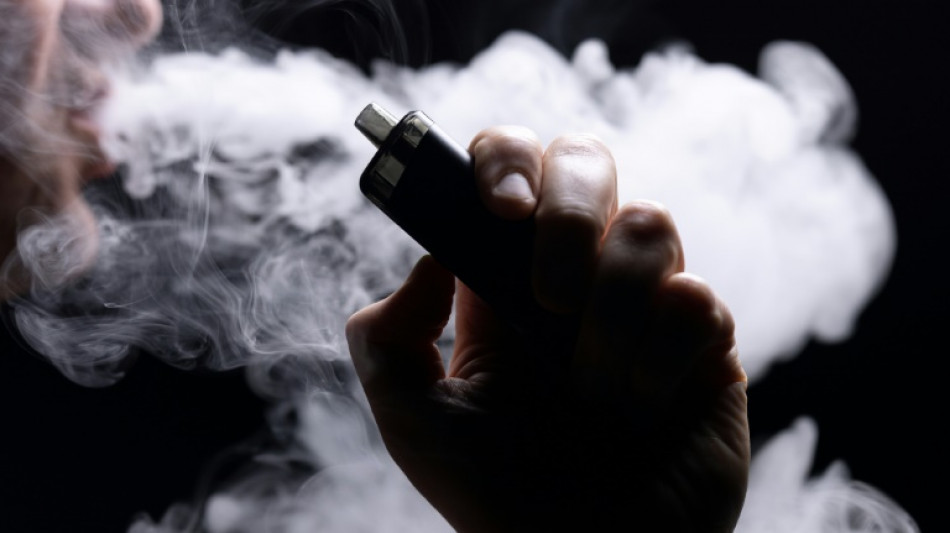
Vaping: lighting up, stubbing out / Photo: © AFP

 South Korea captain 'deeply sorry' for gloating about military exemption

 Alcaraz through to Japan Open semis after Shapovalov injury

 Chanel: unpicking one year of 'Blazymania'

 Latvian pro-Europeans set for election win: partial results

 China swim sensation Yu Zidi, 13, says 'I'm no prodigy'

 Yu Zidi to Ohashi: Asian Games stars who can light up LA Olympics

 'Act before it's too late': Tokyo residents fight for more trees

 'Disappointing' as South Korea flag mishap sees Games end on sour note

 Pre-COP host Tuvalu at frontline of climate change

 Hungary's dwindling paprika producers battle to save signature spice

 Cornell president vows review in wake of alleged student gang rape

 Latvian partial election results suggest pro-European choice

 In Egypt's Sinai, Gazan builds school for children displaced by war

 Trump tariffs a mixed bag for US auto industry

 Yemen government forces say struck Houthi targets

 Music links past, present for Pedro Pascal's cellist in 'Behemoth!'

 ALEX BODI ȘI AMBASADORUL REPUBLICII SUDANUL DE SUD, GUM DOMINIC MATIOK, DISCUTĂ LA BERLIN DESPRE POSIBILITATEA ÎNFIINȚĂRII UNUI CONSULAT ONORIFIC LA BUCUREȘTI

 Dodgers step up World Series three-peat bid with 5-3 win over Braves

 Spain break down Czechs as England outclass Croatia in Nations League

 Yamal on target as Spain hold off Czech Republic

 Latvian exit polls suggest pro-European choice

 Lula, Bolsonaro wrap up campaigns ahead of knife-edge election

 Tuchel hails 'complete' England after Croatia demolition

 Fury to invite Trump to lead ring walk before Joshua showdown

 Fashion industry in 'precarious moment', says Vivienne Westwood supremo

Two decades after they first appeared, e-cigarettes have been widely credited with helping people quit smoking.
But concerns are growing over the risk of teens becoming hooked on nicotine through candy-coloured disposable vapes, with flavours such as chocolate and bubblegum.
AFP looks back at the highs and lows of the vaping vogue:
- Born in China -
In 2003, Chinese pharmacist Hon Lik, a heavy smoker hoping to kick the habit, develops the first electronic alternative to cigarettes.
A year later, the firm he works for brings out the first e-cigarettes, called Ruyan ("like smoke").
The birth of vaping comes in the year that Ireland bans smoking in workplaces, including pubs and restaurants, sparking a global clampdown on smoking indoors.
E-cigarettes arrive on the EU market in 2006 and a year later in the United States.
- Early doubts -
Many doctors welcome the devices, which are tar-free, as a potential life-saver in the fight against cancer, heart disease, strokes and other diseases caused by the toxins in traditional cigarettes.
But the UN health agency, the World Health Organization, is sceptical about their benefits.
"As far as WHO is aware, no rigorous, peer-reviewed studies have been conducted showing that the electronic cigarette is a safe and effective nicotine replacement therapy," it says in 2008.
From the mid-2010s on, there are growing reports of the dangers of teens inhaling vapour containing nicotine, which can harm the developing adolescent brain.
More than 30 countries, including Argentina, Brazil, Egypt, Ethiopia, India, Iran, Iraq, Mexico, North Korea and Singapore ban the sale of e-cigarettes.
- Enters the dictionary –
In 2014, "vape" is designated word of the year by the Oxford University Press and enters the dictionary.
The habit takes off in the US, Europe and parts of Asia.
The number of users shoots up from around seven million in 2011, according to Euromonitor market research group, to 82 million a decade later, according to the US NGO Global State of Tobacco Harm Reduction.
- Deadly lung illness -
In 2019-2020, the US is at the centre of a health crisis tied to vaping, with at least 68 people dying and over 2,800 others falling sick with an acute lung illness linked to vaping products containing cannabis.
In February 2020, the US Food and Drug Administration bans the sale of many flavoured e-cigarettes, with the exception of tobacco and menthol flavours.
US e-cigarette giant Juul is hit with a string of lawsuits accusing it of glamourising vaping among young people with flavours such as creme brulee and of lying about how addictive it is.
In 2022, the company agrees to pay $462 million (425 million euros) to settle cases across the US, leaving it nearly bankrupt.
- Growing bans -
In 2023, Western countries go to war against teen vaping.
New Zealand in August bans e-cigarettes that do not have a removable or replaceable battery -- a way of targeting disposable vapes -- and bars manufacturers from using enticing flavour names.
On November 28, Australia announces it will ban imports of disposable vapes from January 1, 2024.
Late on Monday, French MPs back a proposal to ban single-use electronic cigarettes, amid warnings they could act as a gateway to smoking. The legislation still needs backing from France's upper house Senate and clearance from the EU Commission.
Britain, Germany and Ireland are considering similar moves.
M.Odermatt--BTB



