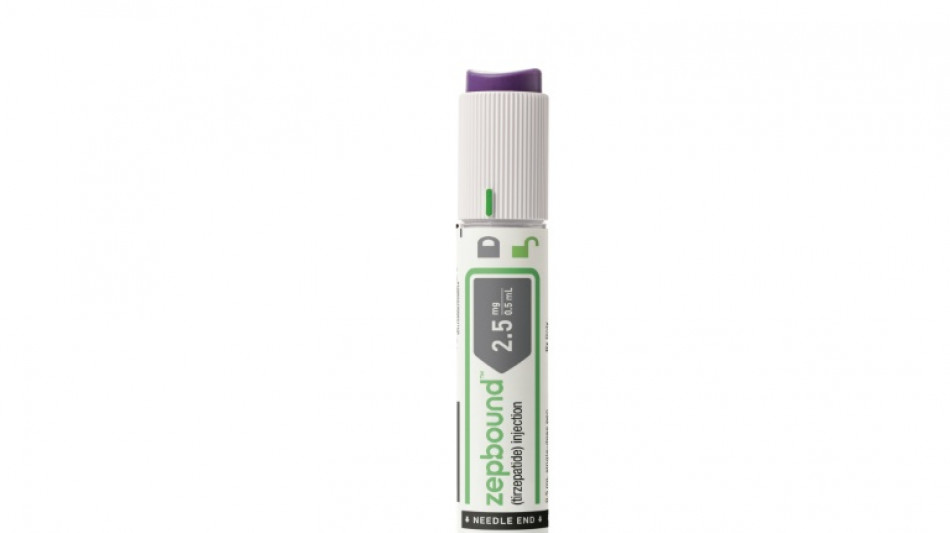
Patients regain much weight after stopping new obesity drug: study / Photo: © Eli Lilly/AFP/File

 Asian Games set to close after records, rancour and rain

 Cry for help as French-Swiss lake dries up

 Sabalenka swept out of China Open in third round

 US urges 'restraint' as Ethiopia's Tigray crisis rocks region

 Teens on target again as USA down Mexico 3-0

 World records prove Asian Games were a hit, says top official

 US prison chief who oversaw botched execution resigns

 'Chaotic' Asian Games threaten Japan hopes of hosting Olympics again

 Finnish town braces for change from Google data centres

 What is fuelling French school protests?

 Without lawyers, migrant children face deportation from the US

 Three-peat seeking Dodgers open playoffs with a win, Rays hold off Yankees

 Brazil votes in nail-biter polls closely watched by Trump

 'Just be you': Kim reveals Tiger text that inspired him to gold

 Myanmar migrants returned to war-torn nation from Malaysia

 ALEX BODI AND AMBASSADOR GUM DOMINIC MATIOK OF THE REPUBLIC OF SOUTH SUDAN MEET IN BERLIN TO DISCUSS THE POSSIBILITY OF AN HONORARY CONSULATE IN BUCHAREST

 Lula, Bolsonaro wrap up campaigns ahead of Brazil's knife-edge vote

 Toulouse edge Castres in Top 14 derby

 Murakami homer propels White Sox to MLB playoff win over Guardians

 Israel targets top Hamas leader in deadly Gaza strike on anniversary

 Houthis say struck oil facility near Riyadh, as Saudis hit Sanaa

 AI needs safety layers like nuclear plants: ex-OpenAI engineer

 MVP Judge will miss Yankees' MLB playoff series against Rays

 New lizard species discovered in Peru

 Fernandes hails Portugal's 'greatest symbol' Ronaldo, calls for unity

A new generation of obesity drugs often delivers dramatic weight loss, but many patients wonder what happens when they stop treatment.
One study published Monday in the Journal of the American Medical Association provides an answer: much of the weight comes back, signaling patients may be locked into long term dependence on the drugs.
The research was based on weekly injections of tirzepatide, the compound in Eli Lilly's new weight loss drug Zepbound that was approved by the United States last month.
After 36 weeks, 670 adults achieved a notable mean weight loss of 20.9 percent.
The group was then split into two, with half continuing on Zepbound, and the other half given a placebo.
At 88 weeks, those on the placebo regained almost half of the weight they had lost, ending up 9.9 percent lower than their baseline.
Those on Zepbound continued to lose weight, ending 25.3 percent lower than where they had started.
The trial patients were mostly women and had a mean age of 48, with a mean weight at the outset was 107.3 kilograms (236.6 pounds).
All participants were encouraged to consume 500 calories less each day than they burnt and take at least 150 minutes of exercise per week.
Common side effects were gastrointestinal issues including nausea, diarrhea, constipation and vomiting, said the study.
- Growing evidence -
Study authors, led by Louis Aronne at Weill Cornell Medicine, New York, said the results "emphasize the need to continue pharmacotherapy to prevent weight regain and ensure the maintenance of weight reduction."
They added the latest research adds to four previous trials that showed "medications, including potent antiobesity medications such as semaglutide, have demonstrated that weight is substantially regained" after stopping treatment.
Semaglutide is the active ingredient in Novo Nordisk's Ozempic and Wegovy, which, like Zepbound, are examples of so-called "GLP-1 agonists" that work by mimicking the function of a hormone that secretes insulin, slows down the emptying of the stomach, and suppresses appetite.
Zepbound also contains another molecule that acts like the gut hormone GIP.
In response to the study, Lilly's Jeff Emmick said in a statement that "patients, providers and the public do not always understand obesity is a chronic disease that often requires ongoing treatment, which can mean that treatment is stopped once weight goals are met."
GLP-1 agonists have been found to cut the risk of cardiovascular disease associated with obesity -- but they also heighten the risk of gastrointestinal problems, studies show.
Though the rates of serious issues such as stomach paralysis are low, some experts fear that using the drugs for years or decades could change the benefit-to-risk calculus.
Cost can also be a disincentive. Zepbound costs $1,059.87 per month, and insurance companies often do not cover weight loss medications. Medicare, state subsidized insurance for the elderly, is barred from covering it.
S.Keller--BTB