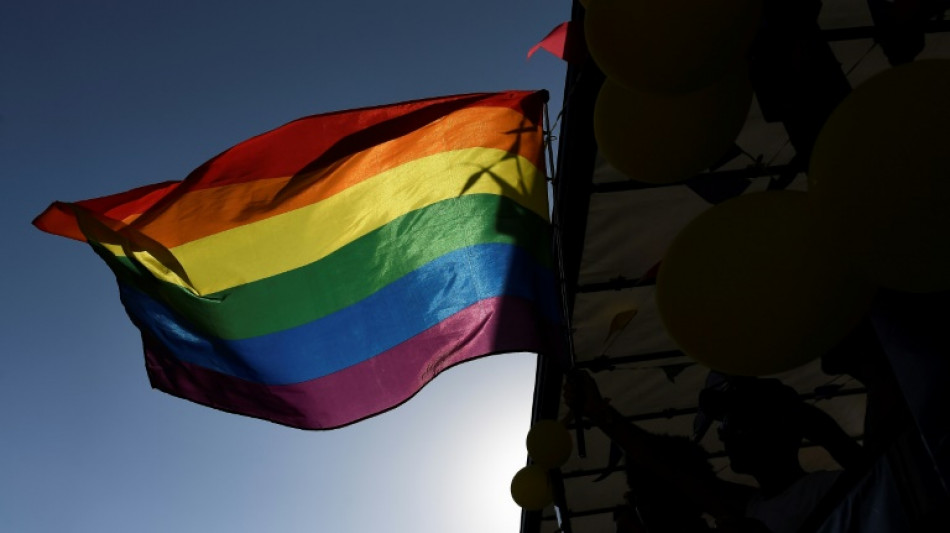
Scientists discover genetic underpinnings of bisexuality / Photo: © AFP/File

 Asian Games set to close after records, rancour and rain

 Cry for help as French-Swiss lake dries up

 Sabalenka swept out of China Open in third round

 US urges 'restraint' as Ethiopia's Tigray crisis rocks region

 Teens on target again as USA down Mexico 3-0

 World records prove Asian Games were a hit, says top official

 US prison chief who oversaw botched execution resigns

 'Chaotic' Asian Games threaten Japan hopes of hosting Olympics again
 Finnish town braces for change from Google data centres
 What is fuelling French school protests?

 Without lawyers, migrant children face deportation from the US
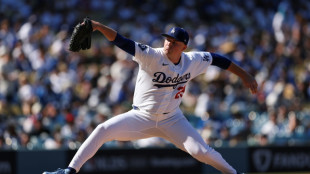 Three-peat seeking Dodgers open playoffs with a win, Rays hold off Yankees

 Brazil votes in nail-biter polls closely watched by Trump

 'Just be you': Kim reveals Tiger text that inspired him to gold

 Myanmar migrants returned to war-torn nation from Malaysia

 ALEX BODI AND AMBASSADOR GUM DOMINIC MATIOK OF THE REPUBLIC OF SOUTH SUDAN MEET IN BERLIN TO DISCUSS THE POSSIBILITY OF AN HONORARY CONSULATE IN BUCHAREST
 Lula, Bolsonaro wrap up campaigns ahead of Brazil's knife-edge vote

 Toulouse edge Castres in Top 14 derby

 Murakami homer propels White Sox to MLB playoff win over Guardians

 Israel targets top Hamas leader in deadly Gaza strike on anniversary

 Houthis say struck oil facility near Riyadh, as Saudis hit Sanaa

 AI needs safety layers like nuclear plants: ex-OpenAI engineer

 MVP Judge will miss Yankees' MLB playoff series against Rays

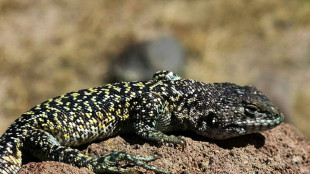 New lizard species discovered in Peru

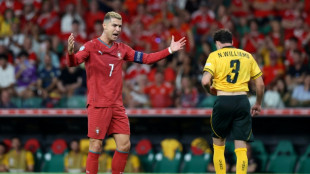 Fernandes hails Portugal's 'greatest symbol' Ronaldo, calls for unity

For the first time, scientists have identified genetic variations associated with human bisexual behavior -- and found these markers are linked to risk-taking and having more offspring when they are carried by heterosexual men.
Jianzhi "George" Zhang, a professor at the University of Michigan and senior author of the new research, told AFP it helped answer the long-standing evolutionary puzzle of why natural selection has not eliminated the genetics underpinning attraction within the same sex.
The study, published Wednesday in Science Advances, was based on data from more than 450,000 people of European descent who signed up for the UK Biobank, a long-term genomics project that has proven a major boon for health research.
It builds on growing research including a seminal 2019 paper in Science that found genetic variants influenced to some extent whether a person engaged in same-sex behavior, though environmental factors were more important.
"We realized that in the past, people lumped together all homosexual behavior...but actually there's a spectrum," Zhang said, explaining part of the motivation for the new work.
By studying participants' complete sets of DNA, or genomes, and combining that information with survey responses, Zhang and his co-author Siliang Song were able to confirm the signatures associated with same-sex behavior and bisexual behavior were in fact distinct.
- 'Nature is complicated' -
This meant they could be analyzed separately -- which in turn revealed that male heterosexuals carrying the markers, which they called bisexual behavior (BSB)-associated alleles, father more children than average and thus carry those genes forward.
What's more, men who describe themselves as risk-takers tended to have more children and were more likely to carry BSB-associated alleles.
"Our results suggest that male BSB–associated alleles are likely reproductively advantageous, which may explain their past persistence and predict their future maintenance," the authors wrote.
Although the UK Biobank's survey simply asked respondents whether they considered themselves risk-takers or not, it is likely risk-taking behavior involves more unprotected sex and more partners.
"Nature is complicated," said Zhang, reflecting on the fact that a single gene can influence multiple traits -- a phenomenon known as "pleiotropy."
"Here we're talking about three traits: number of children, risk taking, and bisexual behavior: they all share some genetic underpinnings."
On the other hand, exclusive same-sex behavior (eSSB) associated alleles were correlated with having fewer children when carried by heterosexual men -- suggesting that over time these traits will fade away.
However, the UK Biobank data also revealed the proportion of people reporting both bisexual and homosexual behavior has been rising for decades, which is probably due to growing societal openness.
The authors estimated, for instance, that whether a person is bisexual or not in their behavior is 40 percent influenced by genetics, and 60 percent by the environment.
"We want to make it clear that our results predominantly contribute to the diversity, richness, and better understanding of human sexuality," they stressed. "They are not, in any way, intended to suggest or endorse discrimination on the basis of sexual behavior."
J.Horn--BTB