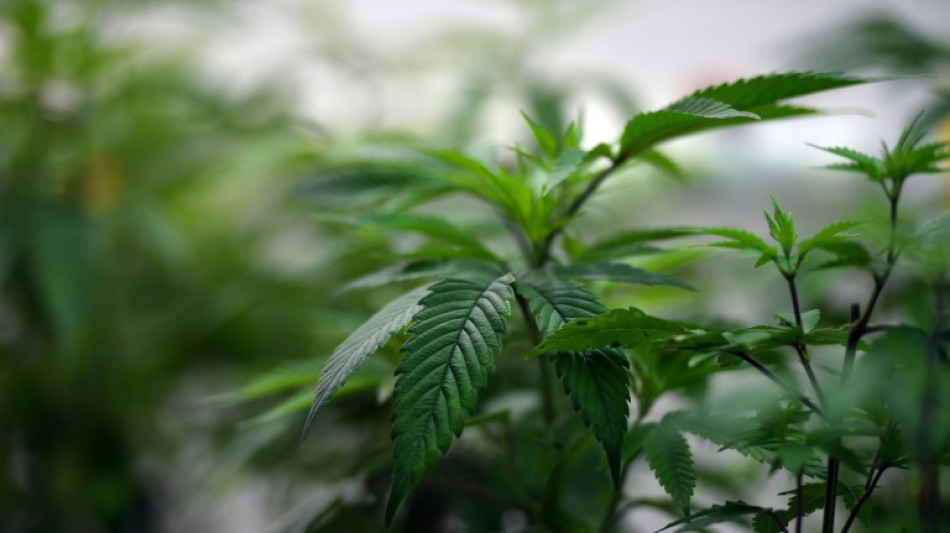
Australia doctors warn of 'excessive' medical weed prescriptions / Photo: © AFP/File

 Prague’s Concert for the Future Kicks Off on Wenceslas Square

 Prince William and Princess of Wales to Announce Earthshot Prize Winners in Mumbai

 Indonesia Forest Fires: Health Crisis, Diplomatic Strains and the Search for Solutions

 BYD Dolphin G Leasing Deal: Plug-in Hybrid Supermini Available from £174 a Month

 JUEL Group Expands from Real Estate to Hospitality with Hyatt Centric Malta Opening

 French Economy Shrinks 0.1% as Consumer Confidence Slumps

 Wall Street Ends Turbulent Week Higher Despite Inflation and AI Jitters
Australia's medical cannabis industry is "excessively" prescribing weed with little oversight and needs urgent regulation, the country's top doctors association and pharmacists warned on Tuesday.
Legalised for medical use in 2016, Australians are estimated to have spent up to $500 million on licit pot last year, according to a think tank.
But on Tuesday the Australian Medical Association (AMA) and the Pharmacy Guild of Australia said the industry was too often issuing prescriptions without "proper clinical oversight".
"Urgent action is needed to ensure medicinal cannabis is prescribed, dispensed and regulated in the same manner as other registered drugs of dependence," AMA President Danielle McMullen said.
While acknowledging evidence suggesting medical cannabis can help treat epilepsy, chemotherapy-induced nausea or Multiple Sclerosis, doctors warned the system was being "exploited".
"There is little, or no evidence base for many of the conditions for which it is being prescribed, such as anxiety, insomnia or depression," McMullen said.
In their submission to an Australian government inquiry into the industry, the AMA called for "comprehensive reform" of the way medical cannabis was bought and sold.
Members working in emergency departments were calling for more resources to deal with growing numbers of patients with cases related to excessive intake of cannabis, including psychosis, they said.
"Alarmingly, doctors are seeing medicinal cannabis use in people who have pre-existing psychotic conditions," they warned.
The AMA warned telehealth models -- in which patients can be issued prescriptions online without an in-person doctor visit -- were being "exploited as commercial pathways for unapproved products".
This year, newspaper the Age revealed that one doctor working for medical cannabis giant Montu had issued 72,000 prescriptions to 10,000 patients in just two years.
In some instances, the newspaper reported, consultations with patients were scheduled to last no longer than 10 minutes.
The global medical cannabis market is expected to grow to over $65 billion by 2030, according to consulting firm Grand View Research.
F.Pavlenko--BTB



