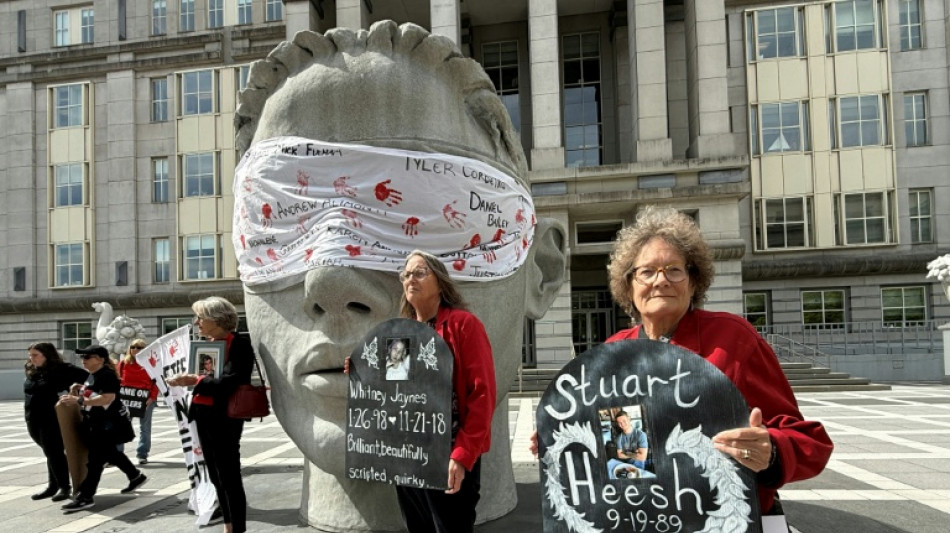
US judge orders Purdue Pharma to pay billions ahead of bankruptcy / Photo: © AFP

 Prague’s Concert for the Future Kicks Off on Wenceslas Square

 Prince William and Princess of Wales to Announce Earthshot Prize Winners in Mumbai

 Indonesia Forest Fires: Health Crisis, Diplomatic Strains and the Search for Solutions

 BYD Dolphin G Leasing Deal: Plug-in Hybrid Supermini Available from £174 a Month

 JUEL Group Expands from Real Estate to Hospitality with Hyatt Centric Malta Opening

 French Economy Shrinks 0.1% as Consumer Confidence Slumps

 Wall Street Ends Turbulent Week Higher Despite Inflation and AI Jitters

 Kansas City Fed Chief Says Inflation Is Still Running Too Hot

A US federal judge on Tuesday sentenced OxyContin-maker Purdue Pharma to pay billions of dollars over its role in the opioid crisis, ahead of upcoming bankruptcy proceedings and its dissolution.
The criminal sentencing caps off years of legal battles and paves the way for Purdue and its former owners, the Sackler family, to pay more than $8 billion as part of a settlement.
Between 1999 and 2023, around 806,000 people died from opioid overdoses in the United States, according to the Centers for Disease Control and Prevention.
Purdue and other opioid makers and distributors are accused of encouraging free-wheeling prescription of painkillers like OxyContin starting in the 1990s, while hiding how addictive the drugs are.
Last year, several US states reached a settlement with Purdue and the Sackler family, with a bankruptcy plan that will see funds routed to affected communities and individuals.
The total amount to be paid in fines, forfeitures and penalties surpasses $8 billion.
The company is set to be dissolved on May 1, with the remnants becoming Knoa Pharma, a public benefit company that will provide opioid use disorder treatments and overdose reversal medicines.
For more than six hours on Tuesday, US Judge Madeline Cox Arleo listened to dozens of victims and their families testify about the impact Purdue Pharma and the opioid epidemic had on them.
She then ordered Steve Miller, Purdue Pharma's board chair, to apologize to them.
During the proceedings to resolve a Department of Justice probe and clear the way for the settlement, Arleo read the names of more than 200 victims who had submitted written statements before the hearing.
"These people are not statistics in an epidemiological study," she said, adding that the testimonies were "heartbreaking."
The judge also apologized on behalf of the US government, saying it had "failed" to protect the public from Purdue Pharma, whose practices were "driven by greed" and had a "corporate strategy much like a criminal enterprise."
While many testifying on Tuesday urged the settlement agreement to be rejected -- in part because it protects the Sackler family from criminal prosecution -- Arleo called it the "best route I see among the options before me."
She urged the lawyers handling the bankruptcy proceedings to honor their promises of compensation.
For many people, opioid addiction begins with prescribed pain pills, such as OxyContin, before they increase their consumption and eventually turn to illicit drugs such as heroin and fentanyl, an extremely powerful synthetic opioid.
O.Bulka--BTB



