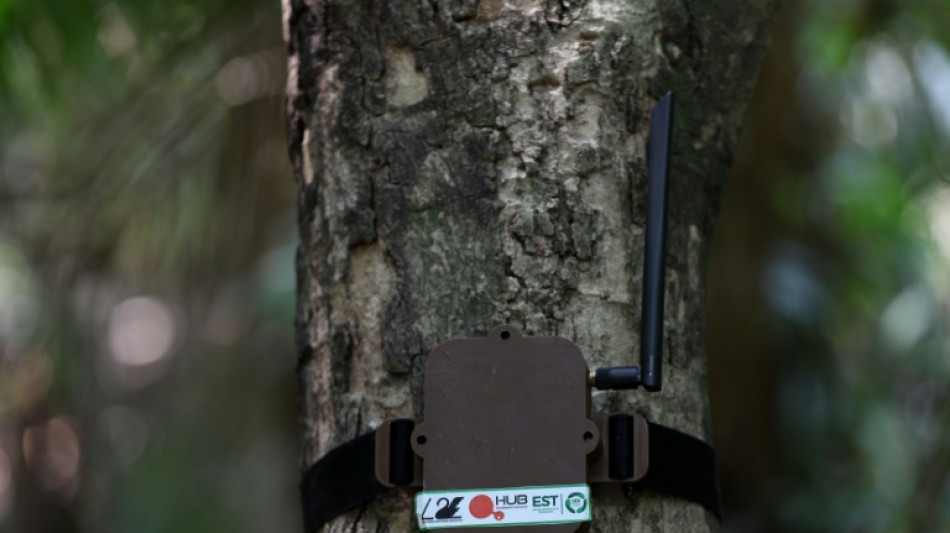
Tree-hugging AI to the rescue of Brazilian Amazon / Photo: © AFP

 Messi and Alcaraz love it, now padel takes step closer to Olympics

 Tolls mount in Thailand, Myanmar floods

 Why India's opposition wants top poll official out

 PU Prime Strengthens UAE Momentum with Strong Showing at Forex Expo Dubai 2026

 Eight dead in Thailand floods since mid-September

 Oil prices spike after Trump rejects Iran truce offer

 Taylor Swift sets new record at MTV VMAs
 Seoul seeks apology after Ukraine reveals transfer of North Korean POWs

 Messi on target again but Miami downed by Columbus

 In Washington's political cauldron, a fight over foie gras

 Flavio Bolsonaro: political heir in his father's shadow

 Ravens grab last-second win in Rio as Commanders stop Seahawks

 USA rallies to capture 11th consecutive Presidents Cup

 Phillies clinch, Astros wrap up division on final day of MLB season

 Commanders hand champion Seahawks their first loss

 Dupont scores twice to send Toulouse top of Top 14

 Ireland beat Israel but no handshakes due to war in Gaza

 Tense standoff over flashpoint N.Ireland parade lasts into night

 Stunned McNulty wins 'miracle' road race world title

 Re-released 'Avengers: Endgame' snaps-up N. America box office lead

 American McNulty wins shock road race world title

 Serbia's President Aleksandar Vucic announces resignation

 Tuchel urges Bellingham to play with 'rage'

 Russian strikes on Ukraine kill 8

 Bavuma, Miller hit centuries as South Africa clinch series

Small, artificially intelligent boxes tied to tree trunks in the Brazilian Amazon are the latest weapon in the arsenal of scientists and environmentalists battling destructive jungle invaders.
The boxes, named "curupiras" after a folkloric forest creature who preys on hunters and poachers, sport sensors and software trained "to recognize the sounds of chainsaws and tractors, or anything that could cause deforestation," project manager Thiago Almeida told AFP.
"We recorded the sound of chainsaws and tractors in the forest... then, all the collected sounds were passed on to the AI team to train (the program) so that... it would only recognize these sounds and not the characteristic sounds of the forest, such as animals, vegetation and rain," he explained.
Once identified, details of the threat can then be relayed to a central point and agents deployed to deal with it.
"The advantage of this system is that it can detect an attack... or a threat in real time," said researcher Raimundo Claudio Gomes of the Amazonas State University behind the project.
Unlike satellite data, which reveal deforestation only after the fact, the curupiras can detect "when the destruction starts," he added.
The sensors look like small internet modems but are in fact wireless and can relay data up to one kilometer (0.6 miles) via satellite to others in a network.
The project has just completed its pilot phase with ten prototype boxes fixed to trees in a densely forested area near Manaus, the capital city of Brazil's northern Amazonas state.
The boxes were named after Curupira, a creature in some Indigenous folklore that has feet turned backwards to confuse the hunters it pursues.
Early results from the project, financed by Brazilian company Hana Electronics, have been "very promising," said Gomes.
The team is now looking for more funding to add hundreds more sensors to the system, including ones that will be able to detect smoke and heat from forest fires.
President Luiz Inacio Lula da Silva has promised to end illegal deforestation in the Amazon by 2030.
His far-right predecessor Jair Bolsonaro had presided over an increase of more than 75 percent in average annual Amazon deforestation compared to the previous decade.
Gomes said that unlike audio sensor-based systems already used in other countries, the Manaus project is comparatively inexpensive as it does not require large antennas for data transmission.
Each sensor costs about $200-$300 to manufacture.
Y.Bouchard--BTB



