France taps nuclear know-how to recycle electric car batteries / Photo: © AFP

 Messi and Alcaraz love it, now padel takes step closer to Olympics

 Tolls mount in Thailand, Myanmar floods

 Why India's opposition wants top poll official out

 PU Prime Strengthens UAE Momentum with Strong Showing at Forex Expo Dubai 2026
 Eight dead in Thailand floods since mid-September
 Oil prices spike after Trump rejects Iran truce offer
 Taylor Swift sets new record at MTV VMAs
 Seoul seeks apology after Ukraine reveals transfer of North Korean POWs

 Messi on target again but Miami downed by Columbus

 In Washington's political cauldron, a fight over foie gras
 Flavio Bolsonaro: political heir in his father's shadow

 Ravens grab last-second win in Rio as Commanders stop Seahawks

 USA rallies to capture 11th consecutive Presidents Cup
 Phillies clinch, Astros wrap up division on final day of MLB season

 Commanders hand champion Seahawks their first loss

 Dupont scores twice to send Toulouse top of Top 14

 Ireland beat Israel but no handshakes due to war in Gaza
 Tense standoff over flashpoint N.Ireland parade lasts into night

 Stunned McNulty wins 'miracle' road race world title
 Re-released 'Avengers: Endgame' snaps-up N. America box office lead

 American McNulty wins shock road race world title
 Serbia's President Aleksandar Vucic announces resignation
 Tuchel urges Bellingham to play with 'rage'

 Russian strikes on Ukraine kill 8

 Bavuma, Miller hit centuries as South Africa clinch series
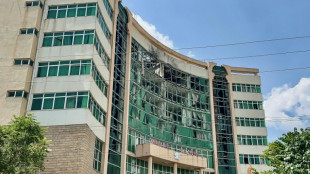
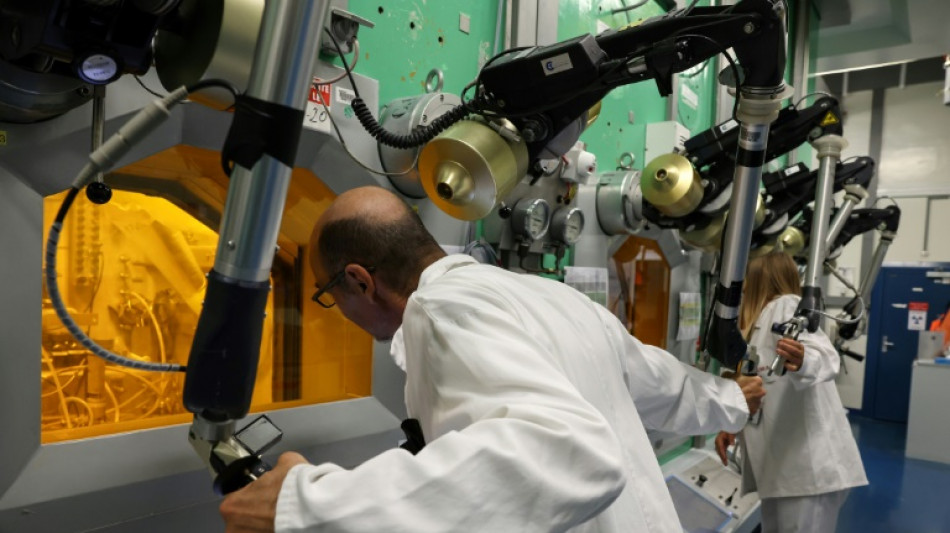
In the cradle of France's atomic programme, researchers are using their nuclear know-how for a key project in the country's energy transition: recycling the raw materials in old electric car batteries, solar panels and wind turbines.
The European Union has made building up its recycling capacity a key part of its strategy to become less reliant on Asia for critical metals such as lithium, nickel and silver.
The 27-nation bloc is trying to close the gap with China, which already recycles car batteries and has its own massive reserves of raw materials and refining capacity.
Reusing old components could help countries such as France, which do not have mines and rely on imports, narrow the gap.
The French atomic and alternative energy commission (CEA) is using its research facility in the southern centre of Marcoule to find ways to recycle the components used for clean technologies.
The sprawling campus, where France's nuclear weapons and energy programmes were born, is so sensitive that images of its location are blurred out or pixelated on Google Maps.
But the CEA gave reporters a rare tour to show off its recycling work ahead of a conference on critical metals to be hosted by the International Energy Agency (IEA) in Paris on Thursday.
Many of the techniques used by Marcoule researchers come from their knowhow in recycling nuclear waste, an area in which France is a world leader.
The goal is to recover the materials and use them on an industrial scale, said Richard Laucournet, head of the new materials department at the CEA centre.
"We are looking at how to store, convert and transport electricity, and how to make the energy transition efficient," said Laucournet.
"Thanks to the simulation tools developed here, we can reprocess rare earths from magnets."
- Black mass -
In one lab, researchers peer into a metre-thick window as they operate large, bike handle-like robotic arms to cut out irradiated fuel rods.
The alloy sections are placed in hot acid solutions to make the metal dissolve. Afterwards it can be extracted again via the use of organic solvents and decanters.
The process can recover lithium, nickel, cobalt and graphite from the black mass that comes from crushing the automobile electric battery cells.
Researchers say the technique developed at Marcoule will be useful for recycling fuels from future fourth-generation nuclear reactors as well as rare earths from magnets.
This technology is all the more useful since there is "no real magnet recycling sector" in the world except scrap in Asia, said Laucournet.
Another technique at the centre is to use carbon dioxide to detach and inflate solar panel cells, allowing the recovery of silicon and the silver contained inside.
For wind turbine blades, the CEA is applying the same process with "supercritical water" that it has been working on for 20 years in a bid to remove radioactivity from metals in a liquid state.
Supercritical water at very high temperature and high pressure has the power to penetrate inside the materials and to break the polymer chains of the fibreglass or carbon composites that make up wind turbine blades and hydrogen tanks.
- Nuclear waste -
The CEA is also working on the possibility of extracting critical rare materials from radioactive waste.
"It contains very rare and very expensive metals, generated by the nuclear reaction itself," including palladium, rhodium or ruthenium, said Philippe Prene, circular economy manager for low-carbon energies at the CEA.
The materials include palladium, rhodium and ruthenium, all of which can be used as catalysts in the electrolysis of water to produce hydrogen.
"We started studies to extract them and it works," Prene said.
He added that recycled materials could one day account for 35 percent of Europe's needs to become self-sufficient to make batteries.
But he warned that "in no case" will such recycling make France and Europe completely self-reliant.
O.Bulka--BTB