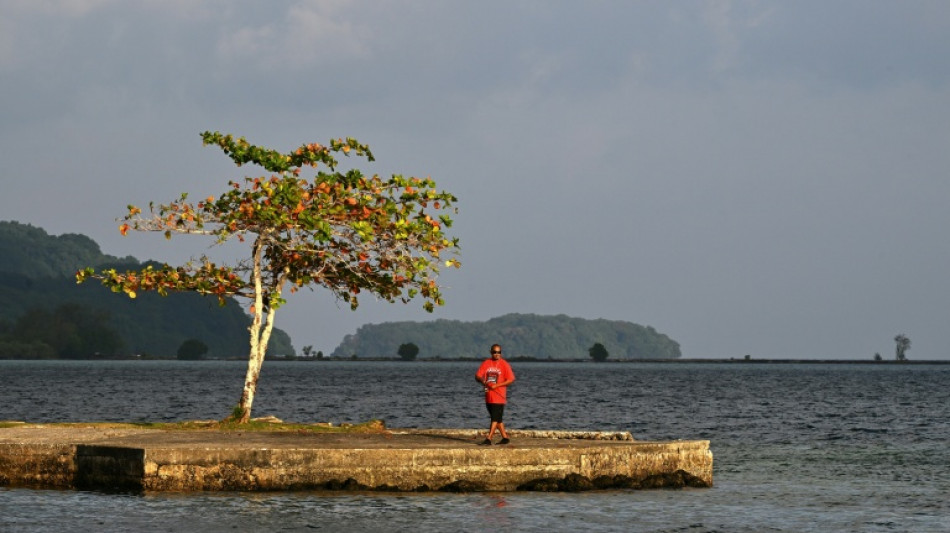
World leaders need to see rising oceans in Pacific: UN official / Photo: © AFP

 US vows to keep economic pressure on Iran as G20 finance talks begin

 Shein valued at $26.3 bn in Hong Kong market debut

 Crude prices rise above $90 per barrel on US-Iran strikes

 Liverpool sign Barcola from PSG for reported £124 million

 Putin, Xi, Iran's Pezeshkian in Kyrgyzstan for summit
 Fully Permitted Tanzanian Gold Project Clears Path to Construction as Financing, EPCM Fall in Place (LVGLF)

 EdWealth Announces MoneyBench Benchmark Comparing AI Money Answers From Ed, ChatGPT and Gemini

 Root says new balls behind batsmen's struggles in England

 Swollen rivers, washed-out roads hamper Nepal rescue effort

 In France's north, winegrowers bet on a warmer future

 Deadly virus stalks South Africa's sardines
 South Korea women's football body probes 'period' insult
 Transitional Fashion Essentials for Autumn: Key Pieces from M&S and Joe Browns

 China's Xi and Iran's Pezeshkian in Kyrgyzstan, Putin expected

 Rescuers hunt for missing after deadly N.Cyprus ferry accident
 Ethiopia's Abiy could consolidate power as 'executive president'
 Crude prices rise on US-Iran strikes, equities mixed after Warsh remarks
 South Korea court gives Unification Church leader 2 years prison
 US hosts G20 finance talks with growth, Iran pressure on agenda
 African players in Europe: Wissa flick seals Newcastle victory

 Venice film preview: Clooney, Oasis and Musk

 Poorly Djokovic crashes out of US Open first round
 Djokovic falls in US Open first round, earliest Grand Slam exit in 20 years

 Chinese guitar capital's stairway to export heaven

 Stocks drop as Warsh fans US rate hike bets, crude up on US-Iran strikes
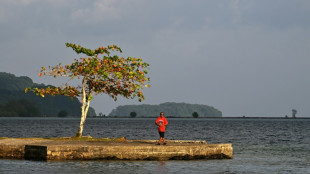
Leaders from the world's top economies should stand on a Pacific atoll to see the reality of record sea level rise, a top UN official said in Palau on Monday.
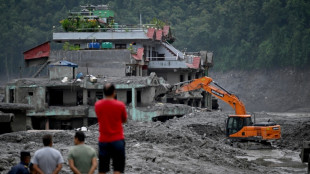
Noting last week's deadly floods in Nepal, United Nations Deputy Secretary-General Amina Mohammed said rising seas in the Pacific were the "other side of that story".
"We do already know that a warming climate is changing the world's ice at extraordinary speeds, not only threatening the communities below glaciers but adding more water to our oceans," she told reporters.
Mohammed was speaking in Palau, where Pacific leaders have gathered for an annual summit to discuss challenges including climate change, crime and regional security.
The United Nations is pushing for G20 leaders to attend and make commitments at a meeting hosted by the tiny nation of Tuvalu in October, ahead of the upcoming UN climate summit in Turkey, according to Mohammed.
"We think they should turn up and really engage with the world on what they need to do," she said, even though there are concerns few leaders outside the Pacific will make the trip.
Tuvalu, which is among the most vulnerable countries in the climate crisis, is preparing to relocate its population after scientists predicted most of its land may become inundated.
Palau's minister for the environment Steven Victor said the Pacific was "not begging for any handouts", but had fewer resources to deal with rising seas that threaten its communities the most.
"We need them to come and see," he said.
A UN report published Monday showed a record pace of sea level rise driven by warming oceans and glacier melt.
Up to 1.2 billion people could be displaced by 2050, with Pacific island countries experiencing sea level rise at twice the global average, it said.
It also highlighted a financing gap, with developing countries needing $310-$365 billion to adapt, yet having only $26 billion in adaptation finance available in 2023.
- Coral reefs under pressure -
Coral reefs are facing a "staircase of decline", with global hard coral cover declining 9.5 percent due to climate change over 40 years, another report released Monday in Palau by scientists found.
The Global Coral Reef Monitoring Network analysed data from 37,000 reefs in 120 countries, finding a narrowing window between major bleaching events.
Although reefs can recover after bleaching if they have enough time, the frequency of marine heatwaves means only partial progress is made.
The study found a major bleaching event every five to six years since 2010.
"We are steadily eroding the conditions they need to recover," said the study's lead author Manuel Gonzalez Rivero.
"Climate change is driving more frequent and severe marine heatwaves, but local pressures such as poor water quality, overfishing and coastal development are making reefs even less able to withstand them," he added.
Among the worst affected are reefs in Australia, the Pacific and Caribbean.
Around 100 million people live within five kilometres (3.1 miles) of a coral reef, a 46 percent increase over two decades.
The ocean was a highway for Pacific nations, connecting its people, but was in crisis, Palau's President Surangel Whipps said on Sunday.
W.Lapointe--BTB