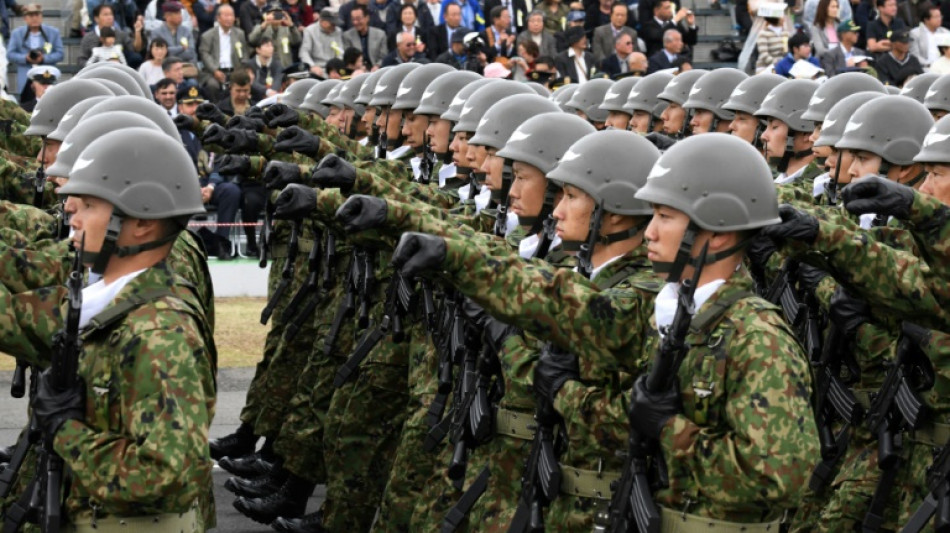
Japan approves major defence overhaul on China threats / Photo: © AFP

 Soldiers' mutiny rocks Niger capital, as junta claims to be back in control

 Seven Arrested After VCK Functionary Killed in Thiruneermalai Attack
 Kanye West Does Not Address Milo Yiannopoulos Detention During New Orleans Concert

 Taylor Swift Donation Supports Connecticut Mother Recovering From Serious Roadside Injuries

 Taylor Swift Gives $50,000 to Fundraiser for Mother Injured While Helping Crash Victims

 Los Angeles County Rapper Among Three Charged in $8.1 Million Stolen-Check Case

 Pittsburgh Speed Painter Surprises Jalen Brunson With 10-Minute Portrait

 California Dairy Hydrogen Project Sets Carbon-Intensity Record and Renews Biogas Debate

 Munoz saves Iraola in Liverpool draw, Hull extend dream start
 'Smooth' Marc Marquez wins Aragon MotoGP sprint, Bezzecchi on pole
 Tiny Elversberg stun Leverkusen on Bundesliga debut

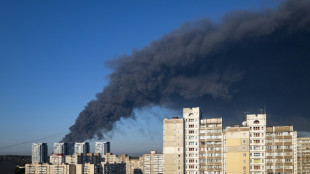
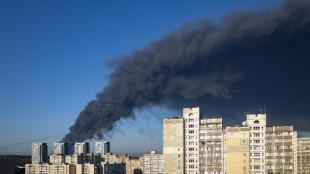 Russian strike blows up arms depot near Kyiv, killing 37

 Lebanon archaeological finds showcase rich heritage despite war woes

 Liverpool held by Forest on Iraola's Anfield debut
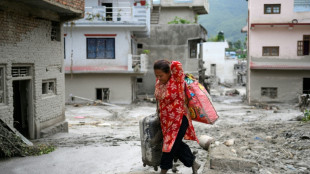 Rescuers claw through mud as missing toll from Nepal, China flood nears 3,000

 Mourinho says Mbappe worthy of Ballon d'Or
 Clashes rock Niger capital, junta says back in control

 India's Neeraj Chopra out for season with ankle injury

 College Values Debate Puts Harvard and Columbia Under Parental Scrutiny

 Michelle Obama Says She Welcomes Life After Active Parenting Years

 Police Report Details Famous Dex Domestic Battery Allegations

 Freedom 250 Winner Kirkwood Jokes Against IndyCar Return to Washington

 Judge Grants Brittany Cartwright Temporary Restraining Order Against Jax Taylor

 Omitted Social Justice Figures Trigger Dispute Over Tamil Nadu Policy Note

 Celebrities Share Late-Summer Photos in August Gallery

Japan's government approved a major defence policy overhaul Friday, including a significant spending hike, as it warned China poses the "greatest strategic challenge ever" to the country's security.
In its largest defence shake-up in decades, Japan vowed to up security spending to two percent of GDP by 2027, reshape its military command, and acquire new missiles that can strike far-flung enemy launch sites.
"Fundamentally strengthening our defence capabilities is the most urgent challenge in this severe security environment," Prime Minister Fumio Kishida said last week.
Polls suggest Japan's public largely backs the shift, worried by growing Chinese military power and geopolitical developments like the war in Ukraine.
But the changes could still be controversial as Japan's post-World War II constitution does not officially recognise the military and limits it to nominally self-defensive capabilities.
The moves are outlined in three defence and security documents approved by the cabinet Friday.
They describe Beijing as "the greatest strategic challenge ever to securing the peace and stability of Japan", as well as a "serious concern" for Japan and the international community.
In response, the government plans to raise its defence spending to two percent of GDP by fiscal 2027, bringing Japan in line with NATO member guidelines.
That marks a significant increase from historic spending of around one percent and has sparked criticism over how it will be financed.
The money will fund projects including the acquisition of what Japan calls "counterstrike capacity" -- the ability to hit launch sites that threaten the country.
The documents warn that Japan's current missile interception systems are no longer sufficient and a "counterstrike capacity is necessary".
- 'Radically strengthen' -
While Japanese governments have long suggested that counterstrikes to neutralise enemy attacks would be permissible under the constitution, there has been little appetite to secure the capacity.
That has shifted with the continued growth of Chinese military might and a record volley of North Korean missile launches in recent months, including over Japanese territory.
Still, in a nod to the sensitivity of the issue, the documents rule out preemptive strikes, and insist Japan is committed to "an exclusively defence-oriented policy".
The counterstrike capacity will involve both upgrading existing Japanese weaponry but also buying US-made Tomahawk missiles, reportedly up to 500.
Other changes include the establishment of a permanent joint command for Japan's armed forces as well as enhancement of the country's coastguard.
Among the documents is the National Security Strategy, which is being updated for the first time since its 2013 launch.
Its language on relations with both China and Russia has hardened significantly.
The strategy document previously said Japan was seeking a "mutually beneficial strategic partnership" with Beijing, a phrase that has disappeared from this iteration.
Instead it suggests a "constructive and stable relationship" and better communication.
China's foreign ministry on Friday urged Japan to "reflect on its policies".
"Japan disregards the facts, deviates from the common understandings between China and Japan and its commitment to bilateral relations, and discredits China," ministry spokesman Wang Wenbin told reporters of the new stance.
And while Japan's strategy document once called for enhanced ties and cooperation with Russia, it now warns that Moscow's military posturing in Asia and cooperation with China are "a strong security concern".
Japan has joined Western allies in imposing sanctions on Moscow over its invasion of Ukraine, sending relations into a deep freeze.
The strategy contained in the documents represents a major evolution of Japan's military posture, according to Chris Hughes, professor of international politics and Japanese studies at the University of Warwick.
"The Japanese government will depict these changes as necessary, moderate and wholly in line with previous defence posture," he told AFP.
Still, "they are going to, in the words often used by the (ruling) Liberal Democratic Party itself in policy documents, 'radically strengthen' Japan's military power", added Hughes, author of the book "Japan as a Global Military Power".
E.Schubert--BTB