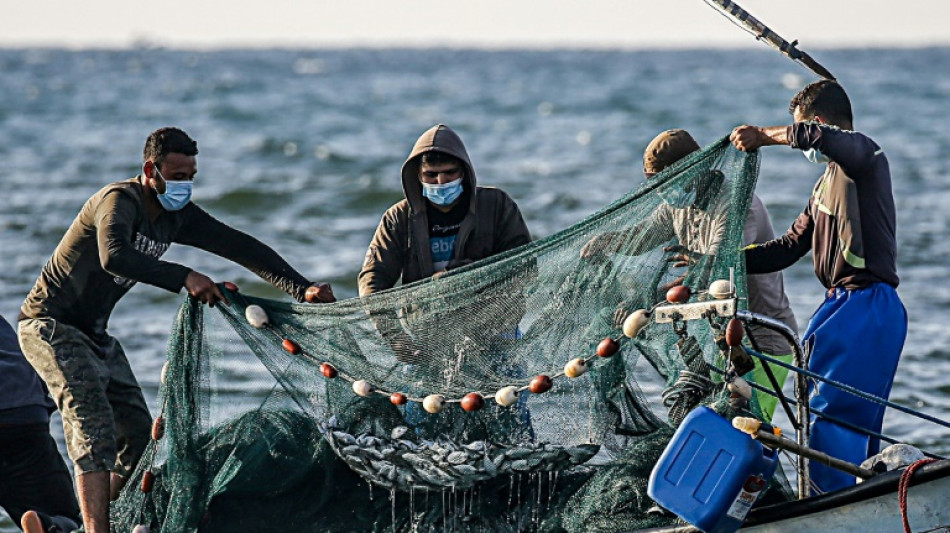
Tax rises fuel merchants' discontent in impoverished Gaza / Photo: © AFP/File

 Optimised urinals and buried underwear at 2026 Ig Nobels

 German factory orders rise again in latest recovery sign

 Nepal's 'Himalayan tsunami': what we know

 SPAYZ.io brings Africa’s payment growth story to Forex Expo Dubai 2026

 Zelensky slams his security services for 'unacceptable' shootout

 Farage's Reform UK meets as new donation scandal hits
 Volunteers fight uphill battle against Indonesian fires

 PU Prime Launches Australian Operations under ASIC Licence

 Night-owl Zverev goes distance to advance as upsets rock US Open

 Marathon man Zverev goes distance again to reach US Open third round

 US study tests psilocybin to fight cancer side effects

 Italy's Meloni throws party to celebrate record in power

 After heatwaves, will EU pivot back to the climate fight?

 South Korean football referee faces hearing over 'period' insult

 Toulouse eye Top 14 history after 'difficult' summer

 Springboks and All Blacks seek series lead after war of words

 Bundesliga brings the band back together in Premier League's shadow

 Asian stocks rally as traders pare rate bets ahead of jobs data
 War-bruised Myanmar finds relief in bareknuckle bloodsport

 Gauff downs Badosa to reach US Open third round

 New Zealand approves use of party drug MDMA to treat trauma

 Westerners test their mettle at World Nomad Games in Kyrgyzstan

 Gauff cruises into US Open third round

 Kyrgios gets month ban for cocaine, enters treatment programme
 Colombian judge bans strikes on guerrillas if minors are present

Hikes in import and export tariffs imposed by the Islamist rulers of the Gaza Strip since last year have fuelled discontent among merchants in the impoverished, blockaded territory.
In March, Gaza's Hamas rulers imposed new duties on the import of fruit and the export of fish.
Although the fruit levy was later reversed after traders went on strike, the seafood duty remains. Traders refusing to pay risk having their perishable goods stalled at crossing points from the enclave.
The increases are the latest in a series of new levies on goods entering and exiting the coastal territory where 2.3 million Palestinians struggle to survive.
In July 2022, Hamas imposed tax increases on 24 other items including bottled water and certain clothes, forcing traders to remove some brands from the market when shoppers could not afford the newly inflated prices.
Wassim al-Hilu, a food importer-exporter and member of Gaza's chamber of commerce, said Gazans are already saddled with taxes paid to Israel -- which collects a range of fees on behalf of the Palestinian Authority (PA).
A split between Hamas and the PA, which administers the Israeli-occupied West Bank, often leads to disputes over taxation and Hilu said the new fees are harming Gaza's "already ailing economy".
The territory has been under a crippling Israeli-led blockade since Hamas -- designated a "terrorist" entity by the United States, the European Union and Israel -- took power in 2007.
The poverty rate has reached 53 percent, according to the Palestinian Central Bureau of Statistics, and unemployment has hit 45 percent, the International Monetary Fund said.
- Rising prices -
In October, dozens of Gazan merchants took legal action against last year's tax hikes, which were then frozen pending a court ruling.
But in supermarkets, traders have already reduced their reliance on imports pending the court decision, said Riyad Sawafiri, from the chamber of commerce.
Critical imports of bottled water, which the territory's residents depend on due to shortages of potable water, have halved as a result.
Osama Nofal, director of planning at Gaza's economy ministry, said the levies aim to encourage consumers to "support the local producer", referring to a desalination plant that makes drinking water.
Since the introduction of the tariffs on imported bottled water, bulk prices for consumers have jumped from 1.67 shekels ($0.36) per bottle to 2.17 shekels.
Baby formula is another product whose price has escalated since last year's tax increases. A pharmacist in Gaza City told AFP that for some types of formula prices went from one shekel per box to nine shekels.
Gaza-based economist Mazen al-Ajlah said the new fees are "illegal".
With Gazans already suffering from a dire economy, the administration should reduce taxes on imported raw materials and offer free electricity to factories, he said.
The latest increases prompted a two-week strike by traders, forcing a reversal to the tariffs on fruit imports.
But authorities refused to budge on the seafood tax affecting an industry that employs around 4,500 people.
The levy on fish is six shekels per kilogram (2.2 pounds) if it comes from Egypt and is then shipped on to the West Bank. For fish locally caught off Gaza the export tax is three shekels a kilogram.
But perishable goods are not the only ones affected. Garment traders decry a new 10 shekel tariff on some clothing items.
Nahed al-Souda, secretary of the clothes traders' syndicate, said a compromise was eventually reached, allowing for the tax-free importation of 600,000 pairs of jeans and 150,000 abayas per year.
Those exemptions are extremely small considering trade volumes in the sector, Souda said, calling the decision to impose the new tax unjust.
For the economist Ajlah, imposition of the levies resulted from an "arbitrary" assessment by Gaza's rulers.
"This reflects a lack of professionalism -- and blackmail," he said.
R.Adler--BTB