
Looming far-right win in Germany sparks security worries / Photo: © AFP

 Optimised urinals and buried underwear at 2026 Ig Nobels

 German factory orders rise again in latest recovery sign

 Nepal's 'Himalayan tsunami': what we know

 SPAYZ.io brings Africa’s payment growth story to Forex Expo Dubai 2026

 Zelensky slams his security services for 'unacceptable' shootout

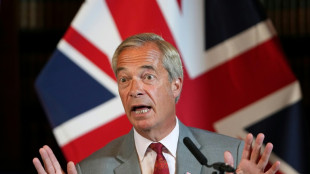 Farage's Reform UK meets as new donation scandal hits

 Volunteers fight uphill battle against Indonesian fires

 PU Prime Launches Australian Operations under ASIC Licence

 Night-owl Zverev goes distance to advance as upsets rock US Open

 Marathon man Zverev goes distance again to reach US Open third round

 US study tests psilocybin to fight cancer side effects

 Italy's Meloni throws party to celebrate record in power

 After heatwaves, will EU pivot back to the climate fight?

 South Korean football referee faces hearing over 'period' insult

 Toulouse eye Top 14 history after 'difficult' summer

 Springboks and All Blacks seek series lead after war of words

 Bundesliga brings the band back together in Premier League's shadow

 Asian stocks rally as traders pare rate bets ahead of jobs data

 War-bruised Myanmar finds relief in bareknuckle bloodsport

 Gauff downs Badosa to reach US Open third round

 New Zealand approves use of party drug MDMA to treat trauma

 Westerners test their mettle at World Nomad Games in Kyrgyzstan

 Gauff cruises into US Open third round

 Kyrgios gets month ban for cocaine, enters treatment programme

 Colombian judge bans strikes on guerrillas if minors are present

If the AfD wins key regional elections on Sunday and becomes the first far-right party in post-war Germany to form a state government, experts fear far-reaching consequences for security and defence.
These range from potentially undermining the work of intelligence services to giving the Russia-friendly party access to sensitive information.
What would the impact be for the security apparatus?
The Alternative for Germany has pledged to overhaul the state branch of the BfV domestic intelligence agency if it wins Sunday's vote in the ex-communist, eastern state of Saxony-Anhalt.
In 2023, the agency classified the party's local chapter as a right-wing extremist organisation, a label that was later extended to the AfD nationwide. The party is challenging this decision in court.
The AfD contends the BfV is a tool used to target opponents of the establishment parties, and has even threatened to abolish it entirely if it wins an absolute majority and takes power in the state.
While they may not be able to go that far, the AfD would have room to influence the agency's work, such as by replacing top officials.
Intelligence services could also be ordered to focus more on left-wing radicalism -- which the AfD regards as "one of the greatest threats to internal security" -- rather than on right-wing extremism.
The anti-immigration party, which has threatened a "deportation and remigration offensive" targeting irregular migrants, could also shift priorities for local police so that they carry out more checks in areas home to large foreign populations.
Could the AfD get access to classified information?
National lawmaker Konstantin von Notz, vice-chairman of the German parliament's intelligence oversight committee, expects "drastic consequences for security policy" if the AfD takes power.
"Right-wing extremists with strong ties to the dictatorial regimes of this world, Russia first and foremost, could come into positions of responsibility with access to highly sensitive security-related information and databases," the Greens party MP told AFP.
Domestic intelligence services share information via internal systems on sensitive topics ranging from suspected extremists to planned attacks and so-called "hybrid threats", including from Russia.
Wolfgang Merkel, a political analyst from the WZB Berlin Social Science Center, however judged the prospect of the AfD sharing classified information with Moscow as unlikely.
Such an act would amount to "treason," he said, and also noted that "being a friend of (Russian President Vladimir) Putin is not popular in Germany, certainly not in the west, but not in the east either."
Could there be consequences for defence more broadly?
The state is home to German military bases and training areas, and Defence Minister Boris Pistorius has expressed fears about the potential consequences should the AfD get their hands on information about the sites.
He has called for AfD ministers in a state government to be barred from accessing classified information.
"We are looking intensively at the question of whom we can grant access to classified information," he told tabloid Bild. "We are obliged to do so, because it concerns the security of our country."
The Welt newspaper has reported the government is even drawing up emergency plans for a scenario in which individual states might, for example, seek to obstruct the movement of NATO troops.
How could the federal government seek to combat the AfD's more extreme plans?
In the event that a state refuses to comply with federal law, Article 37 of the German constitution lays out actions that Berlin can take.
The federal government can, with the consent of the upper house of parliament, compel the state to "fulfil its obligations".
If a state repeatedly refuses to comply with federal law, Berlin could in theory appoint a federal commissioner to enforce compliance, taking over some state functions and effectively sidelining ministers.
However security expert Luca Manns from the University of Cologne believes it is more likely a serious dispute between Berlin and a state would end up before the Constitutional Court.
This could happen, for instance, "if there is indeed a threat of the complete abolition of the local office of the domestic intelligence agency," he said.
A.Gasser--BTB