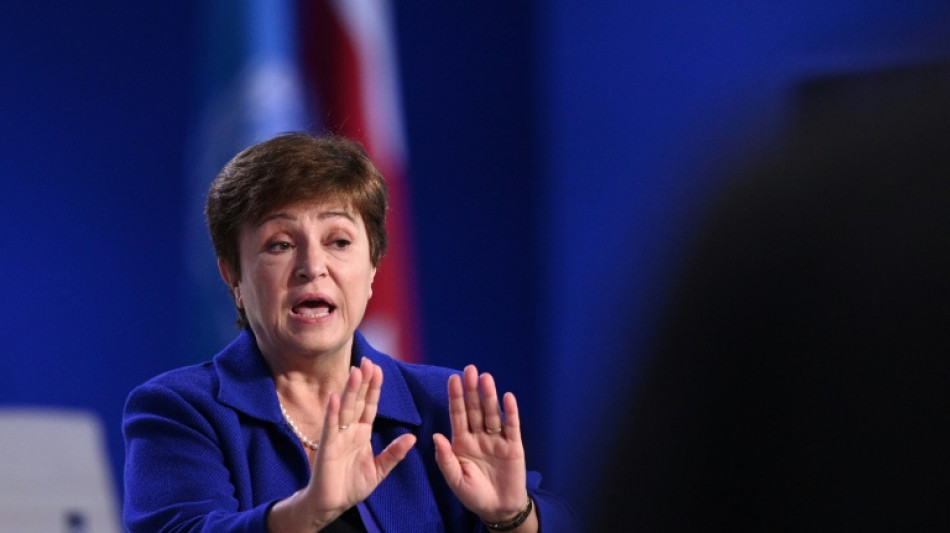
Crises slowing economic growth worldwide: IMF chief / Photo: © AFP/File

 Stocks retreat as bond yield fears persist, oil rises
 ARKBRIDGE’s David Mali Highlights AI-Driven Risk Management at the Finance Magnates London Summit

 Zuckerberg buys Gothic castle in Ireland: spokesman
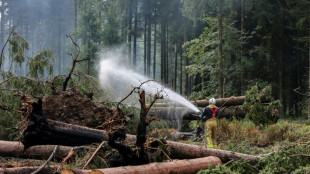 Belgium's fire of the century now 'under control'

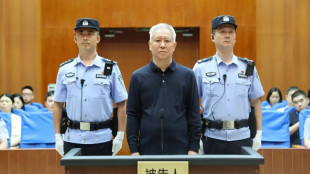 Evergrande's Xu Jiayin: from real-estate tycoon to life in prison

 Spurs eyeing move for Man City's Savinho and Marmoush - reports

 Springboks captain Kolisi to miss first All Blacks Test
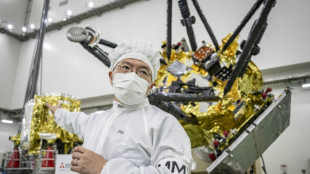 Japan to launch probe for Mars moons in October: space agency

 From beach to Bulls: relaxed Tsunoda savours rare F1 drive

 Prince Harry: key dates in life of returning UK royal

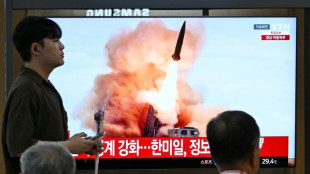 North Korea launches missiles, Seoul says, after Trump floats Kim meet
 Oil jumps on Iran war tensions, offsetting bond yield fears

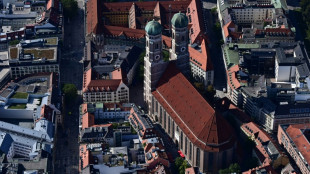 Germany identifies far-right suspect in deadly 1970 antisemitic attack

 PrimeXBT Expands Swap-Free Trading to PXTrader 2.0
 Record number of locations in France top 40C over summer: AFP analysis
 Trump pledges 'economic warfare' on Iran, prompting Tehran derision
 'Girl with a Pearl Earring' in Japan, perhaps for the last time
 Russian strikes kill 13 in Kyiv, surrounding region

 'Simply lovely': Verstappen signs new Red Bull contract until 2030

 Australia coach Walters heading to St Helens after World Cup

 China jails founder, fines disgraced property giant Evergrande

 Russian strikes kill 12 in Kyiv, surrounding region

 US India ambassador's Kashmir remarks rile Pakistan; envoy summoned

 In Senegal's Saint-Louis, traces of slave-trading past fade away
 Russian strikes kill 9 in Kyiv, surrounding region
The war in Ukraine has undercut the global recovery, slowing expected economic growth in most countries in the world, IMF Managing Director Kristalina Georgieva said Thursday.
And beyond the humanitarian tragedy and economic crises, the war has exposed fractures in the international system at a time when global cooperation is the only solution, she said.
The war hit as the world was struggling to recover from the ongoing impact of the Covid-19 pandemic, and has caused an acceleration of inflation that endangers the gains of the past two years.
"To put it simply: we are facing a crisis on top of a crisis," Georgieva said in a speech ahead of the spring meetings of the IMF and World Bank.
"The economic consequences from the war spread fast and far, to neighbors and beyond, hitting hardest the world's most vulnerable people," she said.
Families already were struggling with higher energy and food prices and "the war has made this much worse."
The IMF is due to release its updated economic forecasts on Tuesday, which Georgieva said will further downgrade the estimate for global growth that was cut to 4.4 percent in January.
"Since then, the outlook has deteriorated substantially, largely because of the war and its repercussions," she said, and 143 countries will suffer downgrades.
While most will still achieve positive growth, the future is "extraordinarily uncertain," and she warned of a deep divide between rich and poor countries.
- 'Clear and present danger' -
After a decade of low inflation, prices worldwide have surged amid strong demand for goods that outstripped supply as economies began to return to normal, but the Russian invasion of Ukraine in late February and the sanctions imposed on Moscow pushed fuel and food prices up sharply.
Ukraine and Russia are major grain producers, and Russia also is a key source of energy for Europe.
"The root cause of what we face today is the war and it is the war that must end," Georgieva said in a discussion following her speech to the Carnegie Endowment for International Peace.
Inflation, which has hit a four-decade high the United States, "has become a clear and present danger," she said, noting the trend will likely last longer than expected.
"This is a massive setback for the global recovery," she said.
It also complicates policymaking: major central banks are raising interest rates to contain prices, but that increases borrowing costs for emerging markets and developing nations, which face high debt burdens.
"This is the most universally complex policy environment of our lifetime," she said.
- 'Fragmentation' -
Ending the war and the pandemic are top priorities, but can only be addressed through international cooperation, said Georgieva, who warned of the growing "fragmentation of the world economy into geopolitical blocs."
The IMF leader, who grew up in Cold War-era Bulgaria, lamented, "I have never thought that I would live to see another war in Europe of the magnitude of the tragedy that is happening in Ukraine."
She noted that the end of the Cold War ushered in "a new era of rapidly increasing prosperity... because of an integrated global economy."
Fractures in that system impair the ability to address the current crises and future challenges, but also could cause a "tectonic shift" that would reshape global supply chains.
"The threat to our collective prosperity from a breakdown in global cooperation cannot be overstated," she said.
L.Janezki--BTB