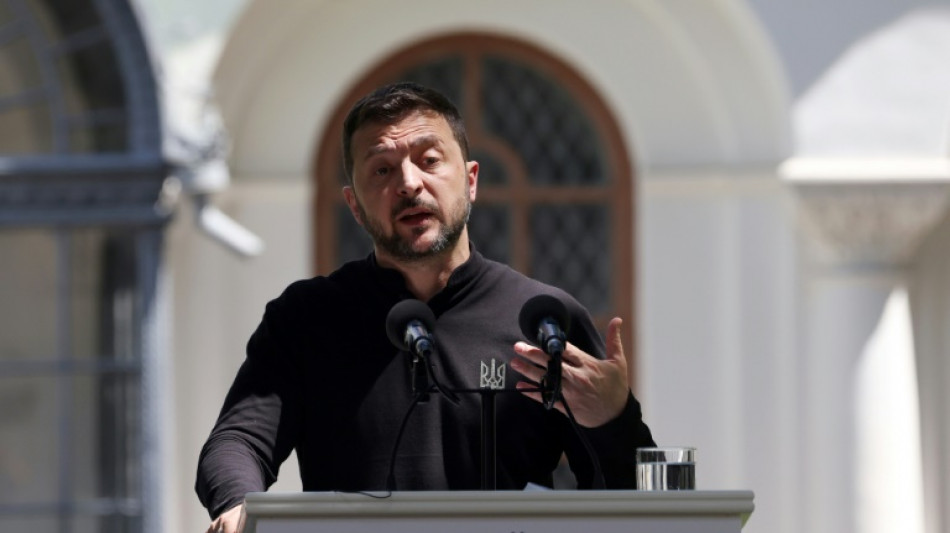
NATO turns 75 with Ukraine and future on line / Photo: © AFP/File

 Stocks rise on AI buzz, oil prices cool

 India narrowly survive huge scare against minnows Japan

 Missing F-35 fighter parts 'not sensitive', says Australia minister

 Cambodia showcases scams crackdown with global conference

 Afghan cyclist who disguised herself as man wins Asian Games silver

 Typhoon Dujuan leaves four dead in Japan, 45,000 houses without power

 G7 leaders condemn Houthi strikes on Saudi Arabia
 Google data centre sparks protests in Austria

 Shin Ohashi: Junk food-loving teen and Japan's next big swimming hope

 Stocks rise on AI buzz, drop in oil prices
 China's robot dancers limber up for America's Got Talent final

 Despite military might, Saudi struggles to crush the Houthis

 Trump to tout deals, defend Iran war in UN speech
 Sri Lanka to issue verdict in landmark Easter attack trial

 No green light to lift EU sanctions on Russian oligarchs, talks to resume

 UK agrees support for Saudi in struggle with Houthis: reports

 EU foreign policy chief calls for continued sanctions on Russia

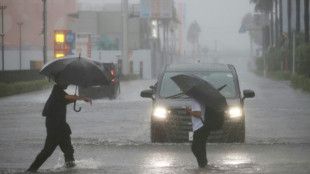 Flights scrapped, evacuations urged as Typhoon Dujuan wallops Japan

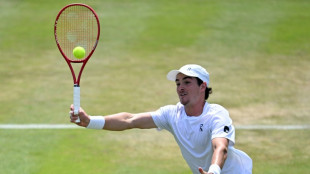 Fonseca to take break from tennis

 A Cuban zoo, and its animals, in epic battle for survival
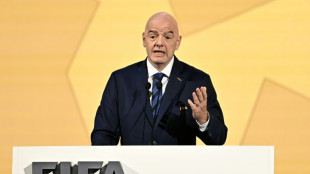 Infantino proposes consulting federations to reform FIFA

 El Nino weather pattern enters record territory: scientist
 OpenAI calls for US to lead global effort on AI standards

 South African ostriches plucked alive for luxury fashion: report

 US networks halt Trump coverage in revolt over White House ban
NATO's 75th anniversary summit was meant to showcase the triumph of a larger, stronger alliance. Instead, leaders are coming together in Washington in the shadow of setbacks in Ukraine and electoral headwinds on both sides of the Atlantic.
US President Joe Biden, fighting for his political life after a disastrous debate against NATO skeptic Donald Trump, will turn his attention away from campaigning to welcome leaders of the 32-nation transatlantic alliance for three days from Tuesday.
Biden has also invited the leaders of Australia, Japan, New Zealand and South Korea, a sign of NATO's growing role in Asia in the face of a rising China.
But the star of the summit is set to be Ukrainian President Volodymyr Zelensky, who is looking for firm signs of support although NATO will not be extending his country an invitation to join.
Founded in 1949 to provide collective defense against the Soviet Union, NATO returned in some ways to its original mission when allies rallied to Ukraine's defense after it was invaded by Russia in 2022.
Ukrainians heartened most of the West by repelling Russia in its push for a quick victory. But Moscow's troops have been grinding on, making advances in the east.
A European official acknowledged the mood ahead of the NATO summit has become "gloomy" with Ukraine slipping on a fragile frontline.
"This summit will be very different from the initial plans because it is happening at a critical juncture for European security," the official said on condition of anonymity.
"Russia is today in a situation which is quite comfortable. They think they can simply wait it out," he said.
- Trump casts shadow -
Max Bergmann, director of the Europe, Russia and Eurasia program at the Center for Strategic and International Studies, said the summit comes at "the best of times, and the worst of times."
"The best of times, in the sense that the alliance knows what it's about -- deterring Russia. Alliance members are spending more," he said.
"But it's also sort of the worst of times -- obviously because of the war in Ukraine, challenges of ramping up European defense spending, concerns about the reliability of the United States."
Trump, who has voiced admiration in the past for Russian strongman Vladimir Putin, has long criticized NATO as an unfair burden on the United States, which spends far more than any other ally.
The 2024 Republican presidential candidate -- whose first term was marked by an impeachment over his strong-arming of Zelensky -- has insisted he can stop the war, with his advisors floating the possibility of conditioning future US assistance on Ukraine entering negotiations to surrender territory.
Trump has enjoyed a narrow lead against Biden in recent polls. Meanwhile France -- where President Emmanuel Macron has mulled sending troops to Ukraine -- is also facing a political shift with the strong gains in legislative elections by the far-right, which is historically close to Russia.
Those setbacks come as Putin recently hosted Viktor Orban, the Russia-friendly prime minister of Hungary, which currently holds the EU's rotating presidency.
The NATO summit is also expected to mark a diplomatic debut for a new leader -- British Prime Minister Keir Starmer, after his Labour Party's landslide election victory.
- Finding a path for Ukraine -
NATO's outgoing secretary-general, Jens Stoltenberg, has led efforts to put the alliance itself, not the United States, in the lead in coordinating military assistance for Ukraine.
Stoltenberg also wants allies to commit to provide at least 40 billion euros ($43 billion) per year in military aid to Ukraine, ensuring reliable and consistent support as Kyiv prepares for a long war against Russia.
Diplomats have dubbed such measures as "Trump-proofing" the alliance, although few believe that NATO or support for Ukraine could endure in the same way without the United States, which under Biden has approved $175 billion for Kyiv in military and other assistance.
The summit also comes on the heels of two more nations joining NATO -- Finland and Sweden -- which both overcame earlier reluctance to formally enter the alliance after witnessing the invasion of Ukraine, which had unsuccessfully sought membership.
Diplomats say that the United States is eager to stage a smooth, drama-free meeting and avoid the bitter recriminations at NATO's summit last year in Lithuania, where Zelensky failed to win firmer commitments for Ukraine to join the alliance.
Ukrainian officials acknowledge there is no chance of a change of heart in Washington. Biden and German Chancellor Olaf Scholz have led opposition to Ukrainian membership, believing that admitting a country already at war would be tantamount to NATO itself confronting nuclear-armed Russia.
Biden instead has reached a 10-year security agreement with Ukraine, with Defense Secretary Lloyd Austin saying the United States will soon announce $2.3 billion in new military assistance.
L.Janezki--BTB