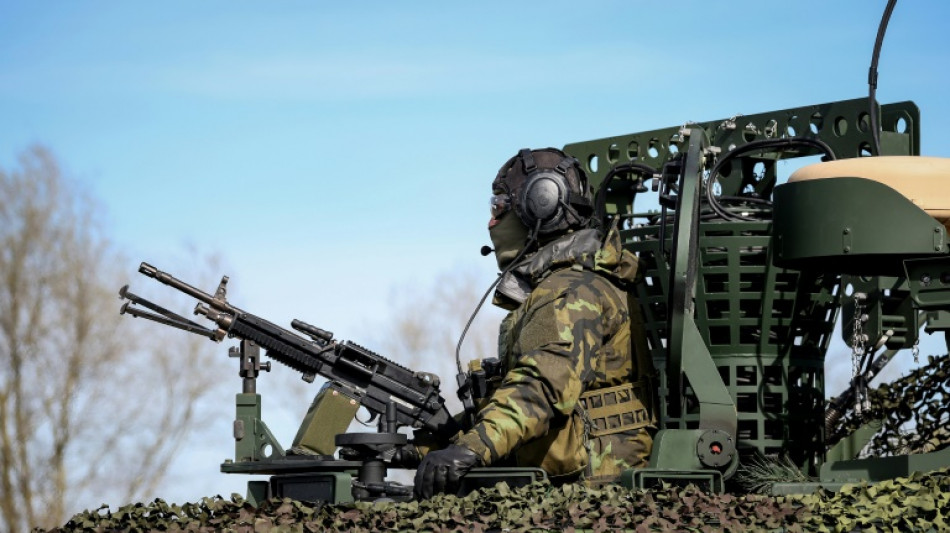
NATO is spending more on defence, but it's likely not enough / Photo: © AFP

 Stocks rise on AI buzz, oil prices cool

 India narrowly survive huge scare against minnows Japan

 Missing F-35 fighter parts 'not sensitive', says Australia minister

 Cambodia showcases scams crackdown with global conference

 Afghan cyclist who disguised herself as man wins Asian Games silver

 Typhoon Dujuan leaves four dead in Japan, 45,000 houses without power

 G7 leaders condemn Houthi strikes on Saudi Arabia
 Google data centre sparks protests in Austria

 Shin Ohashi: Junk food-loving teen and Japan's next big swimming hope

 Stocks rise on AI buzz, drop in oil prices

 China's robot dancers limber up for America's Got Talent final

 Despite military might, Saudi struggles to crush the Houthis

 Trump to tout deals, defend Iran war in UN speech

 Sri Lanka to issue verdict in landmark Easter attack trial

 No green light to lift EU sanctions on Russian oligarchs, talks to resume

 UK agrees support for Saudi in struggle with Houthis: reports

 EU foreign policy chief calls for continued sanctions on Russia

 Flights scrapped, evacuations urged as Typhoon Dujuan wallops Japan

 Fonseca to take break from tennis

 A Cuban zoo, and its animals, in epic battle for survival

 Infantino proposes consulting federations to reform FIFA

 El Nino weather pattern enters record territory: scientist
 OpenAI calls for US to lead global effort on AI standards

 South African ostriches plucked alive for luxury fashion: report

 US networks halt Trump coverage in revolt over White House ban
Spurred on by Russia's war in Ukraine and the spectre of Donald Trump's potential return to the White House, more of NATO's European members are finally hitting the alliance's defence spending target.
But as leaders gear up to celebrate at a NATO summit in Washington there is a clear feeling that will not be sufficient to tackle the challenges it faces.
"Even in countries historically reluctant to spend more on defence, there is now a growing sense of the importance of greatly increased defence spending," said Ian Lesser, from the German Marshall Fund of the United States think tank.
"I think, broadly speaking, in the next years we're looking at levels of defence spending that will begin to approach those of the Cold War."
A decade after setting a spending goal at two percent of gross domestic product, just over two-thirds of NATO's 32 countries are now expected to reach or top that threshold this year.
That is up from only three allies in 2014.
The increase in spending, which includes European heavyweights Germany and France, will be heavily showcased in Washington as NATO stages its show of unity.
That is designed to send a message to Russia's President Vladimir Putin as he wages his war in Ukraine and menaces NATO from the east.
But it is also a message for former US leader Donald Trump as he seeks to reclaim the Oval Office from incumbent Joe Biden at elections in November.
Like other US leaders, upset that Washington shoulders too much of the burden with its vast defence budget, Trump spent his time in office demanding European countries do more.
On the campaign trail in February he unleashed a firestorm by saying he would encourage Russia to "do whatever the hell" it wants to NATO allies not coughing up enough.
- 'Hot war' -
A year after turning the two-percent benchmark from a target to a floor for spending at a summit in Vilnius, a growing number of NATO allies are already pushing to go further.
Chief among them are the Baltic States and Poland -- with all comfortably spending more, and Warsaw even reaching over four percent.
"In 1988 all of the allies were spending more than two percent, actually some even six percent on defence because the threat was real -- there was a Cold War going on," Estonian Prime Minister Kaja Kallas said.
"Now we have a hot war in Europe and we are not spending enough," said Kallas, who was nominated last month as the European Union's next foreign policy chief.
But the Washington summit still looks too early to set a more ambitious target.
"I think we're keen to celebrate the progress," a US defence official said. "There's not an appetite this year to change that benchmark to three percent."
- Defence plans -
A major motivation for ramping up spending is making sure NATO countries can actually fulfil ambitious new defence plans agreed last year to ward off any potential attack from Russia.
After years of slashing budgets as fears of conflict eased in the wake of the Cold War, numerous allies have major gaps in their arsenals -- including key requirements such as air defences.
As part of its planning, NATO commanders are telling capitals what they need to spend on.
"We have specific capabilities targets for each and every ally," said alliance chief Jens Stoltenberg.
"For many allies, this will mean three percent, and at least something more than two percent."
Diverting money away from issues like welfare, education and health is never an easy sell for governments.
The likes of Canada, Italy and Spain still lag behind the NATO target and are reluctant to commit to going further.
But diplomats at NATO said the direction of travel is clear -- spending targets will need to be hiked.
"Some countries are still sticking their heads in the sand," said one diplomat. "But it will happen eventually."
Another diplomat agreed -- adding that if Trump starts breathing down the necks of European allies again that could speed things up.
"This is where we are heading towards -- in order to fill the new plans it is clear that two percent won't be enough," the diplomat said.
"I think we're going to move to something beyond that, regardless of who wins the next US elections -- but if Trump wins it could come sooner."
W.Lapointe--BTB