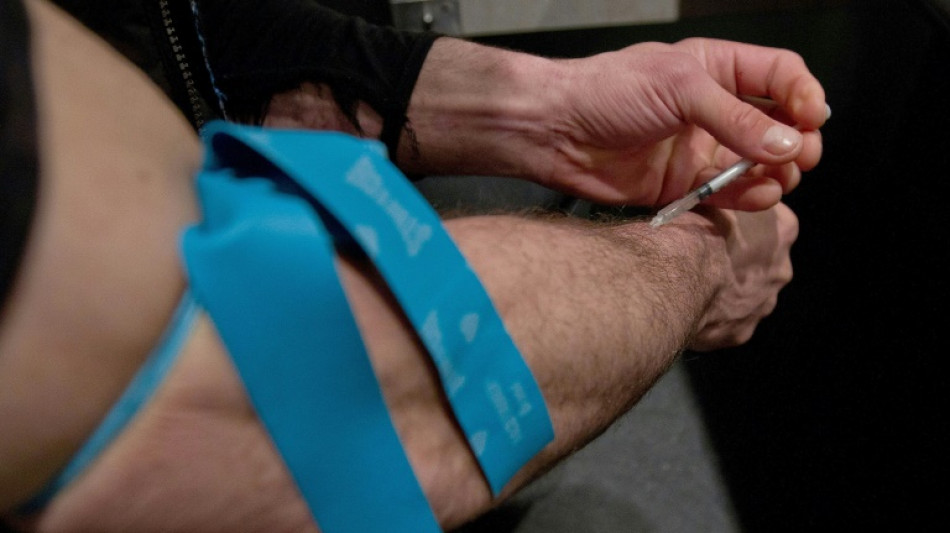
Canada's safe injection sites, 20 years on, face pushback / Photo: © AFP/File

 Marchand 'stressed' about racing Japanese rivals at LA Olympics

 Mobile boat clinics bring healthcare to India's remote islands

 Former India paceman Zaheer Khan named Chennai coach in IPL

 Six-year-old Chinese girl sets world record with Rubik's Cube

 Swimming prodigy Yu, 13, says 'interviews way harder than racing'

 Star coaches make their bows as Nations League returns
 Rams bounce back as Giants reel from Dart injury

 In Bangladesh, Pakistan's Jinnah photo stirs anger

 Two New Zealand naval ships transit Taiwan Strait

 Zidane gets down to work as France start new era

 Inside the Venezuelan prison meant to 'drive you insane'

 UK king braces as memoir by Diana's brother goes on sale

 Akkodis and Hamburg Public Transport Association Showcase hvv mia at InnoTrans 2026, Demonstrating the Future of AI-Powered Mobility

 Macron says talks with Trump on Red Sea, Ukraine 'constructive'

 Green policies just good politics, says UK minister

 Bardot auction in Paris fetches nearly one million euros

 No timeline on Daniels injury return, says Commanders coach

 British Columbia sues OpenAI in US court over Canada school shooting

 French star Batum retires after 18-year NBA career

 Zidane leads first France training session

 Man shot by ICE agent in Texas detained with bullet inside him: lawyer

 California declares state of emergency ahead of El Nino

 South Africa arrests three more suspects, after nine women murdered

 Carse needs time away from England, says captain Brook

 NOWPayments Releases Cross-Chain Payout Data Revealing Key Performance Benchmarks Across TRON, BNB Chain, and Solana

Canada, after two decades of leading on treating addiction as a health issue, is suddenly facing pushback on supervised sites for injecting narcotics that prevent overdoses but are being blamed for spikes in neighborhood crime.
The first such site in North America opened in Vancouver in 2003, followed by dozens more in the last few years as synthetic opioids hit Canadian streets.
Ontario is now closing 10 sites out of 38 nationwide, while other provinces are facing pressure to follow suit. Worldwide there are only 100.
The sites are at the center of a complex problem: they keep drug users from accidental deaths, but don't solve the larger problem of addiction -- or the myriad public safety issues that come with that, leading to growing frustration among the public.
"I do not call watching someone inject an illicit drug to be health care," Ontario Health Minister Sylvia Jones said when announcing the closures of sites near schools or daycares by March of next year.
Harm reduction advocates, however, say less supervision will lead to more deaths.
Jones justified the closures by pointing to "altercations, stabbings, shootings and even a homicide in the vicinity of these sites." She cited crime rates up to 250 percent higher in neighborhoods with safe injection sites.
The sentiment has been echoed across Canada.
Lauren Lemoine, 63, lives near Ottawa's slated-to-close Somerset West site. He was assaulted by people on drugs that, according to experts, have grown much more toxic over the years.
"They're super violent on these bloody drugs," he told AFP.
In Red Deer, Alberta, council member Vesna Higham is pressing for the closure of her city's only site.
Since it opened in 2018, she said there's been an explosion of vandalism including smashed windows, fires being set, public urination, and discarded drug paraphernalia. Storefronts have closed and visits to the downtown neighborhood plummeted.
"Residents and businesses are fed up," Higham told AFP. "They feel desperately burdened by the relentless daily crime and social disorder that plague the area."
"What we've been doing to date has not been working," she said. "It's only proliferating the problem."
"We have to now shift how we are approaching this crisis."
The province is considering legislating forced rehab.
- 44,592 dead -
Yet for those in favor of the sites, the stats are clear: from 2016 to 2023, there were 44,592 fatal overdoses in Canada. None were at safe injection sites.
Getting rid of the sites might not eliminate crime, either.
Jessica Lyons, a nurse at a Toronto site, told a press conference: "Eliminating sites will increase public drug use."
She warned communities will see "increased public disposal of drug use equipment (and) more incidences of bodies being discovered in alleyways and parks, in (public) bathrooms, and in libraries."
It will lead to the spread of diseases such as HIV and hepatitis linked to shared use of needles, she said.
Closing sites also runs counter to the direction others are going.
"More countries are starting to think of drug use as a health issue, as a social issue, and not as a criminal or moral issue," said Nicholas Boyce, of the Canadian Drug Policy Coalition, a grouping of 50 organizations that influence drug policy.
He noted that the UN Commission on Narcotic Drugs in March passed its first resolution recognizing harm reduction strategies. It was supported by 38 nations.
"Canada is looked at internationally as being one of the more progressive countries," Boyce said. "So it's really disheartening to see that there's now this serious pushback."
In another blow to Canada's reformist drug policy, British Columbia in April dialed back decriminalizing the possession of drugs such as cocaine and heroin -- in a move advocates say would reduce the stigma that kept users from seeking help -- following an outcry over soaring use in public.
In 2011, Ottawa tried to close what was then Canada's only authorized safe injection site, but the Supreme Court ruled Insite in Vancouver was "an effective response to the catastrophic spread of infectious diseases... and the high rate of deaths from drug overdoses."
Jonathan McAdam, 42, described "going through psychosis, self-mutilation, being a deadbeat dad and getting fired from all my jobs" before finally getting sober.
It took several attempts. "I tried and I failed. I tried and I failed. I tried and I failed."
He said harm reduction services are essential to keeping addicts alive until they're ready to seek help.
"Recovery can be scary, because you're forced to face your demons," he explained. "People have to do it for themselves. Otherwise they'll just fall back into old patterns."
F.Pavlenko--BTB