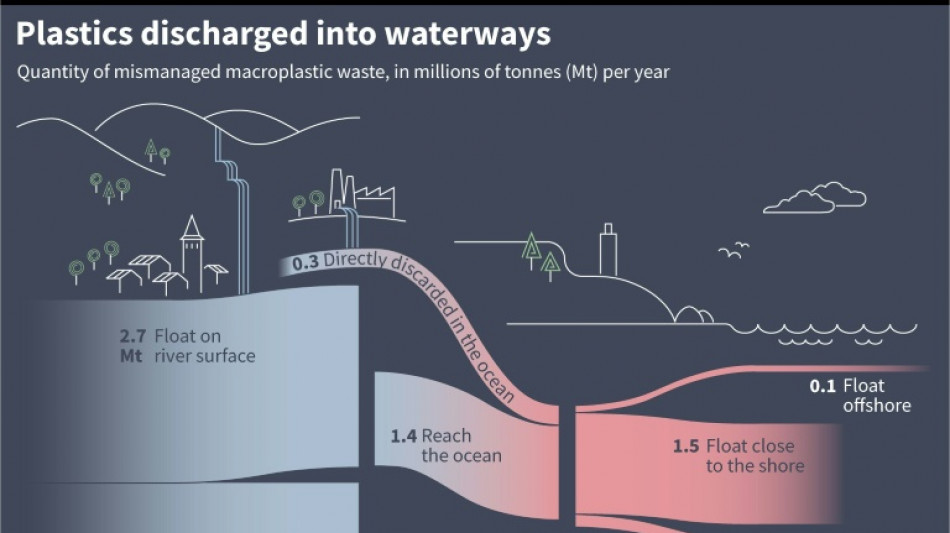
So where does the oceans' plastic waste come from?
/ Photo: © AFP

 Marchand 'stressed' about racing Japanese rivals at LA Olympics
 Mobile boat clinics bring healthcare to India's remote islands
 Former India paceman Zaheer Khan named Chennai coach in IPL

 Six-year-old Chinese girl sets world record with Rubik's Cube
 Swimming prodigy Yu, 13, says 'interviews way harder than racing'

 Star coaches make their bows as Nations League returns
 Rams bounce back as Giants reel from Dart injury

 In Bangladesh, Pakistan's Jinnah photo stirs anger

 Two New Zealand naval ships transit Taiwan Strait

 Zidane gets down to work as France start new era

 Inside the Venezuelan prison meant to 'drive you insane'
 UK king braces as memoir by Diana's brother goes on sale

 Akkodis and Hamburg Public Transport Association Showcase hvv mia at InnoTrans 2026, Demonstrating the Future of AI-Powered Mobility

 Macron says talks with Trump on Red Sea, Ukraine 'constructive'

 Green policies just good politics, says UK minister
 Bardot auction in Paris fetches nearly one million euros
 No timeline on Daniels injury return, says Commanders coach

 British Columbia sues OpenAI in US court over Canada school shooting

 French star Batum retires after 18-year NBA career

 Zidane leads first France training session

 Man shot by ICE agent in Texas detained with bullet inside him: lawyer

 California declares state of emergency ahead of El Nino

 South Africa arrests three more suspects, after nine women murdered

 Carse needs time away from England, says captain Brook

 NOWPayments Releases Cross-Chain Payout Data Revealing Key Performance Benchmarks Across TRON, BNB Chain, and Solana

In the form of bottles, tyres, packaging and piping, millions of tonnes of plastic waste are dumped every year in the world's waterways, often ending up in the oceans.
And their amount could almost double by 2060, unless strong measures are taken against the pollution, the Organisation for Economic Cooperation and Development (OECD) warns.
Due to mass production of the material from the 1950s to 2019, 140 million tonnes have already accumulated in the rivers, lakes and oceans, the OECD said in a 2023 report.
Some 22 percent of this forms a "plastic soup" in the oceans and 78 percent is found in freshwater ecosystems.
- Poor waste management -
Plastic burned in open pits or tossed in uncontrolled or unauthorised dumpsites is the main source of pollution of the aquatic environment.
Most of this plastic waste ends up in freshwaters, with a large part, including bottles and plastic used in the construction sector, sinking in waterways and lakes.
The rest, including food packaging and closed bottles, floats for "years, even decades", before ending up in the oceans, the OECD says.
Waste from shipping activity, including nets and fishing gear, is to a much lesser extent another source of plastic waste in the oceans, as well as so-called microplastics, pieces of plastic which measure less than five millimetres.
So called macroplastic, which is bigger than five millimetres, has an average life cycle of six months to 35 years and slowly decomposes to become microplastic, which is "more likely to be ingested by aquatic species", the OECD says.
- Asia's rivers -
The risk of plastic moving from land to the waterways, and then into the sea, differs from location to location.
Out of some 100,000 waterways, only 1,000 are responsible for four-fifths of the macroplastic waste in the oceans, according to a 2021 study by researchers for NGO Ocean Cleanup published in the Science Advances journal.
The remaining fifth comes from 30,000 other rivers.
Out of the 50 main rivers carrying plastic to the oceans, including small urban waterways, 44 are in Asia, "due to population density and bad waste management", Laurent Lebreton, Ocean Cleanup's director of research, told AFP.
The Philippines, which has thousands of islands, dumps the most plastic into the sea. Its Pasig River, which flows into Manila Bay, is "the most (plastic) polluted" in the world.
With the Philippines' Tullahan and Meycauayan Rivers, India's Ulhas River and Malaysia's Klang River, it is one of the top five carrying plastic into the oceans.
- Gloomy forecast -
Driven by rising population and economic growth, the global use of plastics should almost triple between 2019 and 2060, to 1,231 million tonnes (Mt) per year, according to the OECD.
That is a gloomy outlook for the aquatic environment where 493 Mt of plastic could pile up by 2060, of which more than half from sub-Saharan Africa, China, India, and other developing Asian countries, it says.
In Europe and the United States, on the contrary, plastic industrial waste in the aquatic environment should decrease, due to improved waste management, the OECD forecasts.
F.Pavlenko--BTB