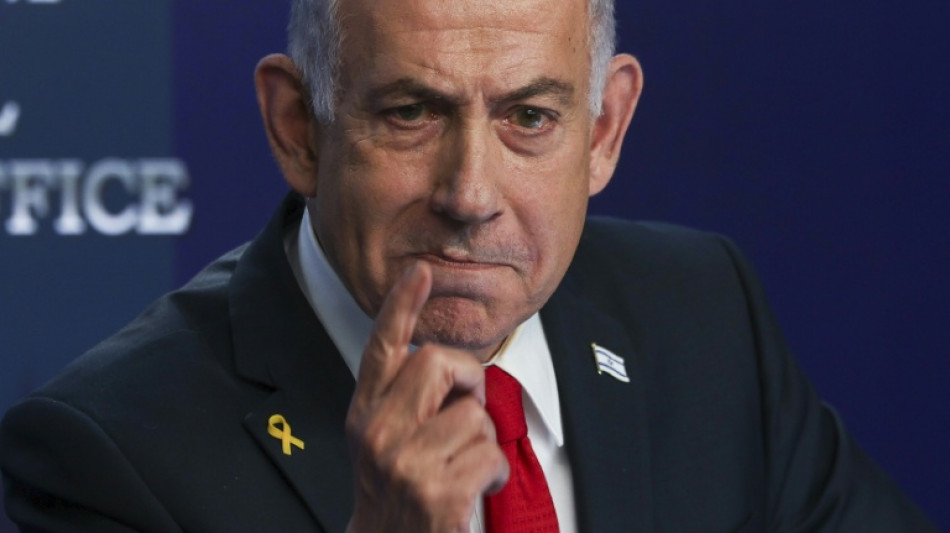
Iran-Israel war: a lifeline for Netanyahu? / Photo: © POOL/AFP

 EU vows AI rules will protect Europeans. Will they?

 Myanmar leader to visit Malaysia after migrant returns begin

 Germany's AfD poised to preside over state assembly for first time
 Australia's opposition vows 'largest cut to immigration' in country's history

 Ready, set, snooze: Sleep-deprived Japanese compete for best-rested

 Falcons thump Saints 45-24 as New Orleans marks Katrina anniversary
 Tuvalu govt adviser says Australia overstepped in pre-COP visit

 Asian stocks mixed despite tech-led Wall St record

 Tens of thousands expected in Paris for high school protests
 AI borrowing binge rattles US markets

 Young Canadians sue government over alleged climate failures

 White Sox down Guardians to take 2-0 series lead

 NHL record-breaker Ovechkin says current season will be his last

 France roar back in Nations League as Italy beat Turkey
 Messi readies for final farewell in Argentina send-off
 Esposito seals Italy win over Turkey in Nations League

 Russia downplays plague reports as Trump offers US help

 Trump says US moved bombers from UK base after 'threats'

 Brazilian stocks surge to record after Bolsonaro election lead

 Leaders to visit Pacific atoll at frontline of climate change

 ICC gives more details about arrest warrants for Taliban ministers

 Nigeria's Tinubu confirms 32 dead after military plane crash

 'Reckless' AI firms can't control models, says whistleblower
 Switching on brain cells: the Nobel-winning science of optogenetics
 Quebec votes as separatist surge poses test for Canada PM
The Iran-Israel war has helped strengthen Israeli Prime Minister Benjamin Netanyahu domestically and overseas, just as his grip on power looked vulnerable.
On the eve of launching strikes on Iran, his government looked to be on the verge of collapse, with a drive to conscript ultra-Orthodox Jews threatening to scupper his fragile coalition.
Nearly two years on from Hamas's unprecedented attack in 2023, Netanyahu was under growing domestic criticism for his handling of the war in Gaza, where dozens of hostages remain unaccounted for.
Internationally too, he was coming under pressure including from longstanding allies, who since the war with Iran began have gone back to expressing support.
Just days ago, polls were predicting Netanyahu would lose his majority if new elections were held, but now, his fortunes appear to have reversed, and Israelis are seeing in "Bibi" the man of the moment.
– 'Reshape the Middle East' –
For decades, Netanyahu has warned of the risk of a nuclear attack on Israel by Iran -- a fear shared by most Israelis.
Yonatan Freeman, a geopolitics expert at the Hebrew University of Jerusalem, said Netanyahu's argument that the pre-emptive strike on Iran was necessary draws "a lot of public support" and that the prime minister has been "greatly strengthened".
Even the opposition has rallied behind him.
"Prime Minister Benjamin Netanyahu is my political rival, but his decision to strike Iran at this moment in time is the right one," opposition leader Yair Lapid wrote in a Jerusalem Post op-ed.
A poll published Saturday by a conservative Israeli channel showed that 54 percent of respondents expressed confidence in the prime minister.
The public had had time to prepare for the possibility of an offensive against Iran, with Netanyahu repeatedly warning that Israel was fighting for its survival and had an opportunity to "reshape the Middle East."
During tit-for-tat military exchanges last year, Israel launched air raids on targets in Iran in October that are thought to have severely damaged Iranian air defences.
Israel's then-defence minister Yoav Gallant said the strikes had shifted "the balance of power" and had "weakened" Iran.
"In fact, for the past 20 months, Israelis have been thinking about this (a war with Iran)," said Denis Charbit, a political scientist at Israel's Open University.
Since Hamas's October 7, 2023 attack on Israel, Netanyahu has ordered military action in Gaza, against the Iran-backed Hezbollah group in Lebanon and the Huthis in Yemen, as well as targets in Syria where long-time leader Bashar al-Assad fell in December last year.
"Netanyahu always wants to dominate the agenda, to be the one who reshuffles the deck himself -- not the one who reacts -- and here he is clearly asserting his Churchillian side, which is, incidentally, his model," Charbit said.
"But depending on the outcome and the duration (of the war), everything could change, and Israelis might turn against Bibi and demand answers."
– Silencing critics –
For now, however, people in Israel see the conflict with Iran as a "necessary war," according to Nitzan Perelman, a researcher specialised in Israel at the National Centre for Scientific Research (CNRS) in France.
"Public opinion supports this war, just as it has supported previous ones," she added.
"It's very useful for Netanyahu because it silences criticism, both inside the country and abroad."
In the weeks ahead of the Iran strikes, international criticism of Netanyahu and Israel's military had reached unprecedented levels.
After more than 55,000 deaths in Gaza, according to the health ministry in the Hamas-run territory, and a blockade that has produced famine-like conditions there, Israel has faced growing isolation and the risk of sanctions, while Netanyahu himself is the subject of an international arrest warrant for alleged war crimes.
But on Sunday, two days into the war with Iran, the Israeli leader received a phone call from European Commission President Ursula von der Leyen, while Foreign Minister Gideon Saar has held talks with numerous counterparts.
"There's more consensus in Europe in how they see Iran, which is more equal to how Israel sees Iran," explained Freeman from the Hebrew University of Jerusalem.
German Chancellor Friedrich Merz said Tuesday that Israel was doing "the dirty work... for all of us."
The idea that a weakened Iran could lead to regional peace and the emergence of a new Middle East is appealing to the United States and some European countries, according to Freeman.
But for Perelman, "Netanyahu is exploiting the Iranian threat, as he always has."
O.Bulka--BTB