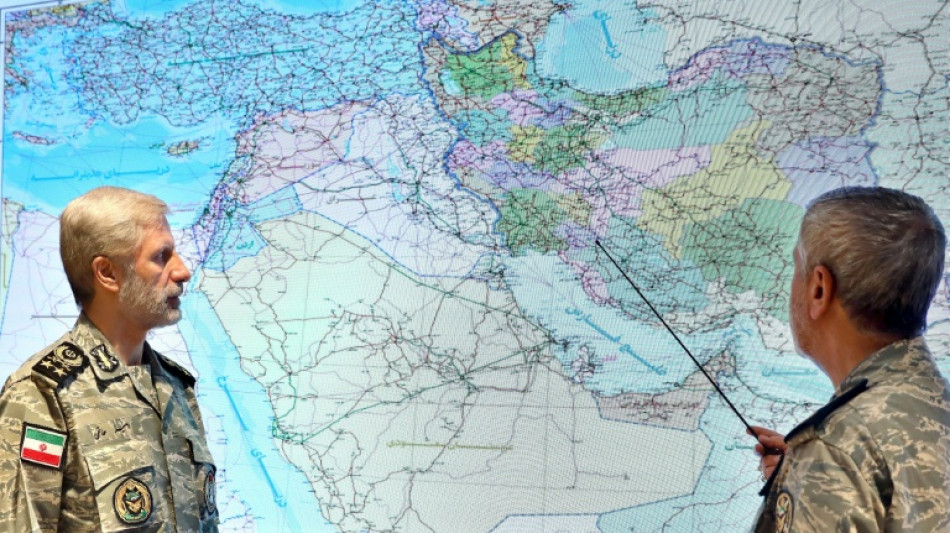
Military bases or vital waterway: Iran weighs response to US strikes / Photo: © Iranian Army Media Office/AFP

 EU vows AI rules will protect Europeans. Will they?

 Myanmar leader to visit Malaysia after migrant returns begin

 Germany's AfD poised to preside over state assembly for first time
 Australia's opposition vows 'largest cut to immigration' in country's history
 Ready, set, snooze: Sleep-deprived Japanese compete for best-rested

 Falcons thump Saints 45-24 as New Orleans marks Katrina anniversary

 Tuvalu govt adviser says Australia overstepped in pre-COP visit

 Asian stocks mixed despite tech-led Wall St record

 Tens of thousands expected in Paris for high school protests

 AI borrowing binge rattles US markets

 Young Canadians sue government over alleged climate failures

 White Sox down Guardians to take 2-0 series lead
 NHL record-breaker Ovechkin says current season will be his last
 France roar back in Nations League as Italy beat Turkey

 Messi readies for final farewell in Argentina send-off
 Esposito seals Italy win over Turkey in Nations League

 Russia downplays plague reports as Trump offers US help

 Trump says US moved bombers from UK base after 'threats'
 Brazilian stocks surge to record after Bolsonaro election lead

 Leaders to visit Pacific atoll at frontline of climate change

 ICC gives more details about arrest warrants for Taliban ministers
 Nigeria's Tinubu confirms 32 dead after military plane crash

 'Reckless' AI firms can't control models, says whistleblower

 Switching on brain cells: the Nobel-winning science of optogenetics
 Quebec votes as separatist surge poses test for Canada PM

Iran has vowed to retaliate for US air strikes on its nuclear facilities, and has two main options: attacking American forces in the region, and closing the strategic Strait of Hormuz.
An advisor to Iran's supreme leader issued a warning on Sunday, saying any US base in the region that takes part in attacks was a "legitimate target".
Disrupting traffic through the narrow Strait of Hormuz, a vital route for oil and gas, would send energy prices soaring in a global inflationary shock.
Closing the waterway would be "extremely dangerous," Kaja Kallas, the European Union's top diplomat, said on Monday.
AFP looks at the two scenarios and their possible implications.
- Strait of Hormuz -
The narrow, U-shaped seaway snaking between Iran and the Arabian Peninsula is the gateway for Gulf energy shipments to global markets, carrying one-fifth of the world's oil and liquefied natural gas exports.
Closing the 50-kilometre (30-mile) wide channel could spike oil to $120 a barrel, according to Deutsche Bank research, raising prices of transport, food and utilities around the world.
"It's in the best interest of all Middle Eastern countries to keep the Strait of Hormuz open and prevent any supply disruption," Rystad Energy senior analyst Lu Ming Pang wrote last week.
Currently, traders do not appear too concerned. Brent crude was trading at $76 on Monday, little changed from Friday's close.
"Looking at the oil price this morning, it is clear that the oil market doesn't assign a very high probability of (a closure) happening," said Bjarne Schieldrop, chief commodities analyst at SEB bank.
The big question is whether Iran is prepared to detonate this economic hand-grenade. Despite threats in the past, including in 2011 as oil sanctions loomed, it has not pulled the pin.
According to a senior European official, the Iranians do not have the means to block the strait "long-term", but they could hamper shipping.
But "it would be a form of suicide to do that," the official said.
"The effect on Israel would be close to zero, the effect on themselves immense, as well as on the United States, Europe and China."
Iranian forces have nearly 200 fast patrol boats that can fire anti-ship missiles or torpedoes, plus mine-laying vessels, according to the International Institute for Strategic Studies.
But the US Fifth Fleet, a major naval force, is stationed across the Gulf in Bahrain, and Iran remains under daily fire from Israeli warplanes and drones.
Iran's own energy exports, in spite of sanctions, remain an important source of income for the world's ninth-biggest oil-producing country.
- US bases -
With United States military bases spread around the Gulf countries to Iran's west, there is no shortage of potential targets.
Kuwait, in a legacy of the 1990 Gulf war, houses about 13,500 US forces, while the biggest US base in the region is Al Udeid in Qatar.
The US Fifth Fleet, covering the Gulf, Red Sea and parts of the Indian Ocean, is based in Bahrain, and about 3,500 US personnel are stationed at Al Dhafra Air Base in the United Arab Emirates.
Increased US involvement in the Iran-Israel war risks attacks "on US interests, US bases and such across the region", said Renad Mansour, senior research fellow at Chatham House.
"The US attack on Iran has now meant that this war is between Israel, the United States and Iran, which means that across the region, Iran may seek to target the US," he added.
However, this option is also fraught for Iran as it risks isolating itself from the powerful Gulf monarchies that enjoy good relations with Washington.
"Tehran is unlikely to strike Gulf Arab states," said Andreas Krieg, a senior lecturer at King's College London.
"Even as it sees the UAE and Saudi Arabia as quiet enablers of the US-Israeli axis, Iran understands that any attack on their soil would likely unify them against it and open the door for greater American military presence.
"Instead, Iran may issue veiled warnings to these states, use regional proxies to pressure them, or engage in cyber or intelligence disruptions targeting their interests -- maintaining plausible deniability while raising the cost of involvement."
R.Adler--BTB