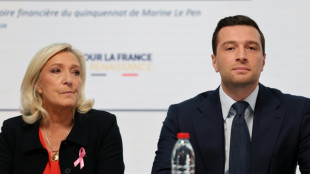
Denmark to push for stricter EU migration policies / Photo: © AFP

 The alleged murder by US marine on Okinawa: five things to know

 End of an era as Messi prepares to hang up Argentina boots

 Superstar duo headline strong New Zealand squad for Rugby League World Cup

 South Korea warns of possible AI use in banking hacks

 EU vows AI rules will protect Europeans. Will they?

 Myanmar leader to visit Malaysia after migrant returns begin

 Germany's AfD poised to preside over state assembly for first time
 Australia's opposition vows 'largest cut to immigration' in country's history
 Ready, set, snooze: Sleep-deprived Japanese compete for best-rested

 Falcons thump Saints 45-24 as New Orleans marks Katrina anniversary

 Tuvalu govt adviser says Australia overstepped in pre-COP visit

 Asian stocks mixed despite tech-led Wall St record
 Tens of thousands expected in Paris for high school protests
 AI borrowing binge rattles US markets

 Young Canadians sue government over alleged climate failures

 White Sox down Guardians to take 2-0 series lead

 NHL record-breaker Ovechkin says current season will be his last
 France roar back in Nations League as Italy beat Turkey
 Messi readies for final farewell in Argentina send-off
 Esposito seals Italy win over Turkey in Nations League

 Russia downplays plague reports as Trump offers US help

 Trump says US moved bombers from UK base after 'threats'
 Brazilian stocks surge to record after Bolsonaro election lead

 Leaders to visit Pacific atoll at frontline of climate change

 ICC gives more details about arrest warrants for Taliban ministers
Denmark's strict migration policies have slowly spread across Europe and the country will now push for harsher EU-wide regulations during its upcoming EU presidency, including on asylum handling and legal appeals.
Migration policy "is linked to security, that is to say that we need a Europe that is safer, more stable and robust, and that isn't really the case if we don't control the flows to Europe," Denmark's European Affairs Minister Marie Bjerre said as she presented the country's priorities for its EU presidency, which it takes over from Poland on July 1.
Danish Prime Minister Mette Frederiksen hopes to build EU consensus on externalising asylum procedures outside Europe, and restricting the scope of rulings from the European Court of Human Rights.
She set the tone during a recent visit to Berlin.
"We need new solutions to reduce the influx to Europe and to effectively send back those who don't have the right to stay in our countries," she said at a press conference with German Chancellor Friedrich Merz, who applauded the Danish "model".
Denmark, where the number of inhabitants of foreign origin has soared from 3.3 percent in 1985 to 16.3 percent in 2025, says it needs to limit the number of immigrants in order to safeguard its generous cradle-to-grave welfare system.
At the same time, the need for foreign labour has surged, with the number of work permits doubling in less than a decade, though these can be swiftly revoked.
- 'Schizophrenic' situation -
Refugees in Denmark are entitled to a one-year renewable residency permit, and they are encouraged to return home as soon as authorities deem there is no longer a need for a safe haven.
"Refugees are expected to integrate while also being prepared to leave at anytime... a kind of contradictory or schizophrenic situation," researcher Marie Sandberg, the head of the Centre for Advanced Migration Studies at the University of Copenhagen, told AFP.
"As recent research shows, the increased focus on return policies and temporary protection, along with high demands for getting permanent residency, create a very, very difficult integration landscape for newcomers into Danish society," she added.
Denmark made headlines in 2020 when it revoked residency permits for 200 Syrians, deeming the situation in Damascus no longer justified a Danish residence permit.
Since her election to the head of the centre-left Social Democrats 10 years ago, Mette Frederiksen has shifted her party's migration policy far to the right, in line with that of preceding right-wing governments backed by the far right.
She has repeatedly called non-Western immigration Denmark's "biggest challenge".
In 2024, she expressed support for an MP who alleged that some well-integrated immigrants were "undermining" Danish society.
"We are a sociable and relaxed country culturally, but for some reason Muslims have been seen as a kind of threat to this liberal culture," lamented Michala Bendixen, head of the Refugees Welcome organisation.
- Externalising asylum -
Championing a "zero refugee" policy, Denmark is keen to externalise the asylum process to a country outside Europe.
In 2024, the country accepted 860 refugees, 13 times fewer than in 2015.
Two years ago, the government halted its plans to process asylum requests abroad -- possibly in Rwanda -- and keep refugees there if their applications were approved, in order to try to find a joint solution with the European Union.
While all similar efforts in European countries have so far failed, "there will be a European attempt to do something on the subject" during the Danish EU presidency, Bendixen said.
Denmark also recently joined Italy and seven other countries to seek a reinterpretation of the European Convention on Human Rights to allow for changes to migration policy, arguing that the text sometimes protects "the wrong people."
"We used to be proud of being one of the first countries to sign the 1951 UN Refugee Convention, and we've also been part of the UNHCR resettlement scheme since the late 1980s. However ... Denmark seems to be ready to test the (limits of the) conventions," Sandberg said.
Bendixen said those efforts were now "undermining the whole mindset of Europe".
O.Lorenz--BTB