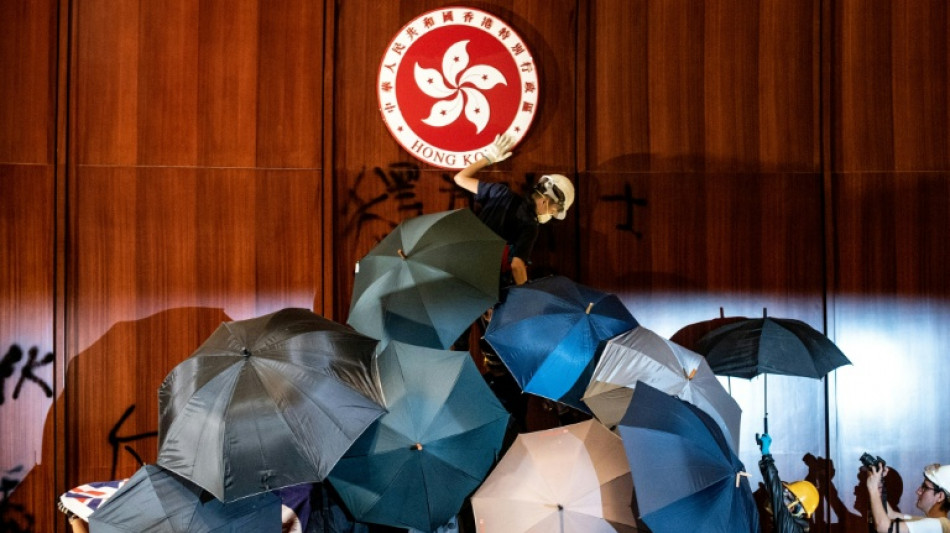
Hong Kong's dragnet widens 5 years after national security law / Photo: © AFP/File

 Kenya reports first-ever Ebola death

 Tennis world No.1 Sinner's season over due to knee injury
 Yemen's Houthis claim attack on Riyadh airport, deny losing territory
 7-Eleven exits India amid mounting competition
 The alleged murder by US marine on Okinawa: five things to know

 End of an era as Messi prepares to hang up Argentina boots

 Superstar duo headline strong New Zealand squad for Rugby League World Cup

 South Korea warns of possible AI use in banking hacks

 EU vows AI rules will protect Europeans. Will they?

 Myanmar leader to visit Malaysia after migrant returns begin

 Germany's AfD poised to preside over state assembly for first time
 Australia's opposition vows 'largest cut to immigration' in country's history

 Ready, set, snooze: Sleep-deprived Japanese compete for best-rested

 Falcons thump Saints 45-24 as New Orleans marks Katrina anniversary

 Tuvalu govt adviser says Australia overstepped in pre-COP visit

 Asian stocks mixed despite tech-led Wall St record

 Tens of thousands expected in Paris for high school protests
 AI borrowing binge rattles US markets

 Young Canadians sue government over alleged climate failures

 White Sox down Guardians to take 2-0 series lead

 NHL record-breaker Ovechkin says current season will be his last

 France roar back in Nations League as Italy beat Turkey
 Messi readies for final farewell in Argentina send-off
 Esposito seals Italy win over Turkey in Nations League

 Russia downplays plague reports as Trump offers US help

Jailed pro-democracy activist Joshua Wong shrugged and shook his head after a Hong Kong court this month announced a fresh charge of breaching the city's national security law.
The 28-year-old protest icon has spent more than four years behind bars and hoped to be let out in early 2027.
Now, there is no end in sight.
Monday marks five years since Beijing imposed a national security law after widespread and sometimes violent pro-democracy protests in the finance hub, which Chinese officials saw as a challenge to their rule.
China sees former protest leaders such as Wong as "incorrigible troublemakers", said John Burns, an honorary professor of politics and public administration at the University of Hong Kong.
"We have a daily drumbeat of national security on TV, in the media," Burns told AFP.
The new charge against Wong, who was jailed for subversion and unlawful assembly, underscores how Hong Kong authorities are still widening the dragnet.
The national security law criminalised for the first time secession, subversion, terrorism and foreign collusion, with offenders facing up to life imprisonment.
Since the law was introduced, 165 people have been convicted of various national security crimes, including under follow-up legislation in 2024 and colonial-era sedition laws.
The most severely punished was legal academic Benny Tai, who was sentenced in November to 10 years in prison as part of a sprawling subversion case involving 47 opposition figures.
A lawyer, who requested anonymity in order to discuss sensitive cases, said five years spent defending security law clients had laid bare the limits of his role. Of all those charged with national security crimes, only two have been acquitted.
"Our hands are tied," he told AFP. "Practically the only thing (lawyers) can do is argue for a lighter penalty."
- 'Information gap' -
Authorities have also warned against "soft resistance", a vague term introduced in 2021 and recently highlighted by Xia Baolong, China's top official overseeing Hong Kong.
Regina Ip, convenor of the Hong Kong government's cabinet, told AFP: "I don't think the government is being paranoid.
"Because of the increasingly complex and volatile international environment, we all need to be alert," she added.
Beijing security officials in Hong Kong also took part in "interviews" this month with collusion suspects for the first time, authorities said.
Eric Lai, a research fellow at the Georgetown Center for Asian Law, said the city was adapting approaches from mainland China such as "invitation to tea" -- a practice associated with state security agents.
Such informal methods "to regulate and to stabilise society" were favoured because they are "less visible", Lai said.
Another local lawyer with experience in security cases also noted a worsening "information gap" that has kept the public in the dark.
"There are fewer prosecutions now but more arrests, 'interviews' and operations where (people) are not brought to court," said the lawyer, who requested anonymity.
High-profile legal battles have not ended: the case of media tycoon Jimmy Lai continues, while a trial involving organisers of Hong Kong's once-annual vigil marking Beijing's deadly Tiananmen Square crackdown has not yet begun.
- Wave of departures -
Scores of pro-democracy and civil society groups, including trade unions and media outlets, have closed since 2020 and the ouster of opposition lawmakers has had "massive consequences for accountability", said Burns.
Hong Kong's Democratic Party has begun a process that will lead to its dissolution, while local media reported on Wednesday that the League of Social Democrats, the other remaining opposition party, could fold within days.
The security law has prompted a wave of departures.
Hong Kong independence advocate Tony Chung said he felt unsafe after finishing a prison sentence for secession and fled to the United Kingdom in 2023.
Chung is among 19 people Hong Kong authorities deem to be national security fugitives.
The 24-year-old has at times struggled to adapt while he waits in Britain for political asylum but insists on promoting his separatist views.
"Many friends told me that I can start a new life here and leave politics behind," he told AFP.
"I see the sun, good weather, a grassy field... But I force myself to remember why I came here."
T.Bondarenko--BTB