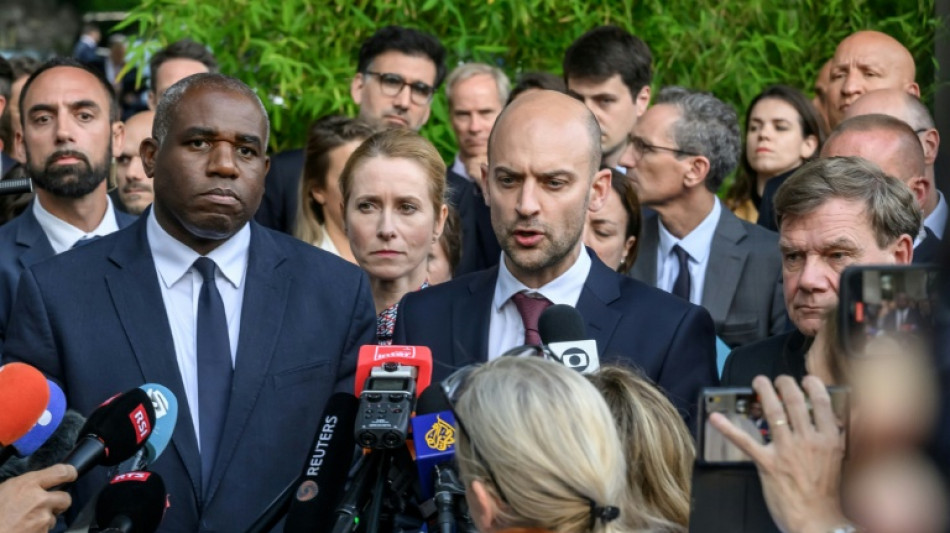
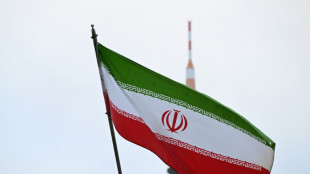
Europe powers move to Iran sanctions 'snapback' over nuclear drive / Photo: © AFP

 UK court quashes five ex-traders' Libor rate rigging convictions
 XM Receives “Global Customer Experience Leader Award 2026” at the TrustFinance Performance Awards
 Stocks slide as oil climbs on Mideast flareup
 Heavy casualties in Ukraine after Russian strikes
 French wine harvest set to hit historic low
 Kyiv 'cannot agree' to EU membership limiting food exports: minister
 Arteta targets more Arsenal glory after signing new deal until 2030
 Russell hit with Singapore grid penalty for taking new power unit
 Spotify expands audiobooks to more than 180 markets
 French-Japanese duo wins chemistry Nobel for solving molecular 'mystery'
 England's Nations League surge helps heal World Cup wounds
 Mayor of opposition stronghold Izmir defects to Erdogan party
 Mertens beats Gauff to set up Swiatek clash at China Open
 Benin full of pride at role in Messi's last dance

 France suspends stun grenade use at student protests ahead of PM speech
 Indonesian court hears 'negligence' complaint against state over fires, haze
 Rubio in Greece to urge against Western civilisation 'decline'
 Micron workers at Taiwan plant vote in favour of strike
 In 'The Social Reckoning,' Jeremy Allen White takes on Facebook's 'frightening' ambition
 Chip industry activists call for South Korea to recognise cancer cases
 Famine-scarred southern Madagascar braces for El Nino
 How the EU regulates lobbyists
 I.Coast refuge offers lifelong care for youngsters scorned as 'sorcerers'
 Indian central bank hikes rates for first time in more than 3 years
 Hotel Blacklist Launches New Accommodation Industry Risk Assessment Tool
France, Britain and Germany on Thursday triggered a mechanism to reimpose United Nations sanctions on Iran for failing to comply with commitments over its nuclear programme signed a decade ago.
The three countries notified the UN Security Council that they "believe Iran to be in significant non-performance of its commitments" under the 2015 nuclear deal, according to a letter seen by AFP.
Iran warned that it would "respond appropriately" to the move which risks drawing a curtain on the most sustained diplomatic push for a peaceful solution to the Iranian nuclear crisis.
The foreign ministers of France, Britain and Germany said they "hereby invoke the process known as the 'snapback' mechanism," which initiates a 30-day process for reimposing sanctions suspended a decade ago.
The move comes just over two months after the end of a 12-day war between Israel and Iran which Israel said was aimed at degrading Tehran's nuclear as well as ballistics capabilities and also saw the US launch its first strikes on the Islamic republic.
It also comes as the window for triggering the so-called snapback mechanism closes on October 18.
The UN Security Council, where France and Britain as well as the US have permanent seats alongside China and Russia, is to meet on Friday to discuss Iran, diplomatic sources said.
Western powers have for two decades feared that Iran is seeking a nuclear weapon under the guise of an atomic energy programme, a charge vehemently denied by Tehran.
- 'Unprecedented' -
Iran has previously warned that cooperation with the UN nuclear watchdog would be affected if the mechanism was triggered.
"The Islamic Republic of Iran will respond appropriately to this illegal and unjustified action by the three European countries, in order to protect and guarantee its national rights and interests," Foreign Minister Abbas Araghchi told his French, British and German counterparts in a phone call, according to a statement from his ministry.
He did not specify further on the nature of the reaction.
Iran has already suspended its cooperation with the UN nuclear agency, accusing it of failing to condemn the Israeli and US attacks.
Inspectors from the International Atomic Energy Agency began work at the key nuclear site of Bushehr in southwestern Iran, the first team to enter the country since Tehran formally suspended cooperation with the UN agency last month. But Tehran said this did not represent a full resumption of cooperation.
In a joint statement, British Foreign Minister David Lammy, Germany's top diplomat Johann Wadephul and French counterpart Jean-Noel Barrot said that Iran's non-compliance with the 2015 nuclear deal was "clear and deliberate".
They said Iran has "no civilian justification" for its high enriched uranium stockpile.
"Its nuclear programme therefore remains a clear threat to international peace and security," they added.
Such a stockpile "is unprecedented for a state without a nuclear weapons programme", they said.
Barrot wrote on X that "Iran's nuclear escalation must not go any further" but emphasised the move "does not signal the end of diplomacy".
He noted there is now a 30-day period where talks can take place before the sanctions are reimposed, adding "we are determined... to engage in dialogue with Iran".
The 2015 nuclear treaty was aimed at resolving the standoff over the Islamic republic's nuclear programme which had escalated ever since secret nuclear facilities were uncovered at the start of the 2000s.
But it was badly weakened when US President Donald Trump left the accord during his first mandate, and as accusations of Iranian non-compliance multiplied.
F.Müller--BTB