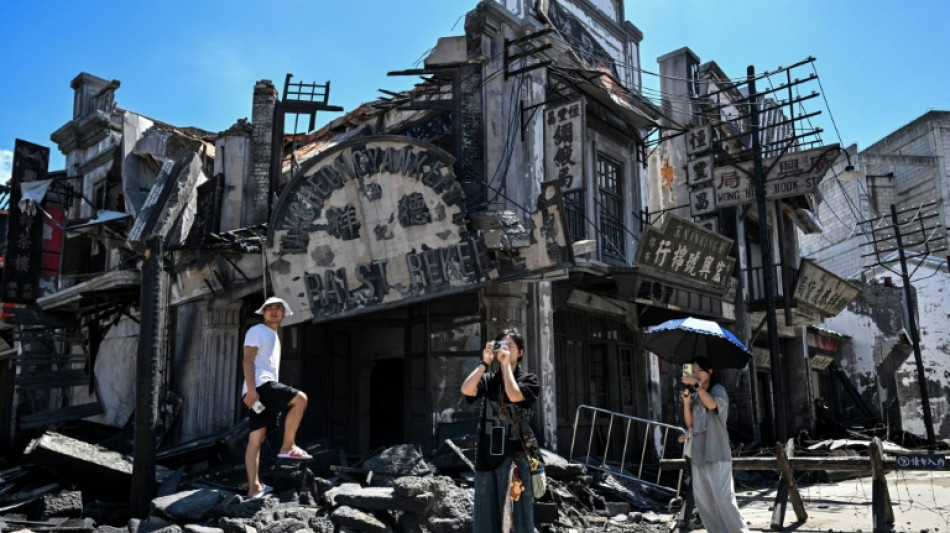
Nanjing massacre film set becomes China school holiday hotspot / Photo: © AFP

 UK court quashes five ex-traders' Libor rate rigging convictions

 XM Receives “Global Customer Experience Leader Award 2026” at the TrustFinance Performance Awards

 Stocks slide as oil climbs on Mideast flareup

 Heavy casualties in Ukraine after Russian strikes

 French wine harvest set to hit historic low

 Kyiv 'cannot agree' to EU membership limiting food exports: minister

 Arteta targets more Arsenal glory after signing new deal until 2030

 Russell hit with Singapore grid penalty for taking new power unit

 Spotify expands audiobooks to more than 180 markets

 French-Japanese duo wins chemistry Nobel for solving molecular 'mystery'

 England's Nations League surge helps heal World Cup wounds

 Mayor of opposition stronghold Izmir defects to Erdogan party

 Mertens beats Gauff to set up Swiatek clash at China Open
 Benin full of pride at role in Messi's last dance

 France suspends stun grenade use at student protests ahead of PM speech

 Indonesian court hears 'negligence' complaint against state over fires, haze

 Rubio in Greece to urge against Western civilisation 'decline'
 Micron workers at Taiwan plant vote in favour of strike

 In 'The Social Reckoning,' Jeremy Allen White takes on Facebook's 'frightening' ambition

 Chip industry activists call for South Korea to recognise cancer cases

 Famine-scarred southern Madagascar braces for El Nino
 How the EU regulates lobbyists

 I.Coast refuge offers lifelong care for youngsters scorned as 'sorcerers'

 Indian central bank hikes rates for first time in more than 3 years
 Hotel Blacklist Launches New Accommodation Industry Risk Assessment Tool

The sound of machine gun fire rattled around collapsed buildings as schoolchildren eagerly explored the ravaged streets of 1930s Nanjing, delighted to be visiting the set of a Chinese blockbuster about a historic massacre.
Slickly produced and star-studded, "Dead to Rights" is set in Nanjing, then China's capital, during six weeks of mass murder, rape and looting by the Japanese army in 1937 that killed tens if not hundreds of thousands.
In keeping with other films about the slaughter, "Dead to Rights" does not shy away from portraying the atrocities, but that hasn't deterred viewers. It has topped the Chinese box office since late July.
Its set at a suburban Shanghai film park is now open to the public, and was thronged with enthusiastic fans -- many of them young children -- when AFP visited this week.
An enormous, bullet-ridden mural of China's former leader, Chiang Kai-shek, stared down from a bombed-out building as visitors poured in, taking selfies and livestreaming excitedly.
Beneath the levity, the film had provoked strong emotions.
"It's a deep pain that comes from within, a feeling of profound hatred," said a woman surnamed He, describing her feelings towards Japan.
"History is something that can't be erased in the heart, no matter what happens in the future."
One man told AFP he had travelled almost 2,000 kilometres from northern Ningxia with his five-year-old son, who had watched the film.
Another young boy holding a Chinese flag struck a triumphant pose on a charred mound of rubble and broken glass, as his parents snapped pictures of him against the blue summer sky.
- 'Stoking fires'? -
The film's plot revolves around a group of Nanjing residents hiding in a photo studio, who are forced to develop Japanese photograph "souvenirs" of war crimes.
A South China Morning Post review called the movie "thunderously powerful" but said some violent scenes were "as though engineered to stoke the fires of anti-Japanese sentiment".
"Dead to Rights" is one of several summer releases about the war with Japan, which killed millions of Chinese, and which many feel Tokyo has never properly atoned for.
The country is gearing up for a major military parade next week to mark 80 years since Japan's defeat and World War II's end.
The "Dead to Rights" poster reads: "No Chinese person will ever forget."
"I don't think (films like this) represent hatred. It's because we need to restore history," said 37-year-old visitor Jiang Xiang.
The death toll of the massacre -- the Chinese put it at 300,000 -- remains a source of debate, and some Japanese arch-conservatives have denied it took place at all, despite overwhelming international evidence.
Jiang said awareness of China's suffering should be passed down the generations -- to teach that "we need to rely on ourselves, keep growing stronger".
- 'Understand history' -
In the on-set photo studio, a visitor's book was completely full of comments both patriotic and profane.
"Japan is the stupidest country in the world," read one in a childish scrawl.
Almost all of the parents AFP met said their children had watched the movie, with one mother from Nanjing saying their school had encouraged it.
China has no film rating system, and it is not uncommon for children to watch content that might be considered overly violent elsewhere.
"Look, that's where the head was hanging (in the film)!" a child giggled to a friend as they passed a wooden post.
Tourist He said war films "teach children how our ancestors fought for us".
The aim was to help "the children understand history -- not to make them hate or anything".
Middleschooler Li Xinyi said she found the Japanese "dislikeable" but cautioned against bitterness.
"Even though they did many cruel things to us, we still need to respect them, because now we must focus on peace."
F.Pavlenko--BTB